
Thinking Works desking: Ovation, Rosie and Okidoki compared
Ovation is the only one of the three that moves: 590 to 1210 mm electric, 100 kg on two legs and 150 kg on three, with a 30 kg point load. Rosie and Okidoki are fixed at 740 and 720 mm and rated at 60 kg with a 15 kg point load.
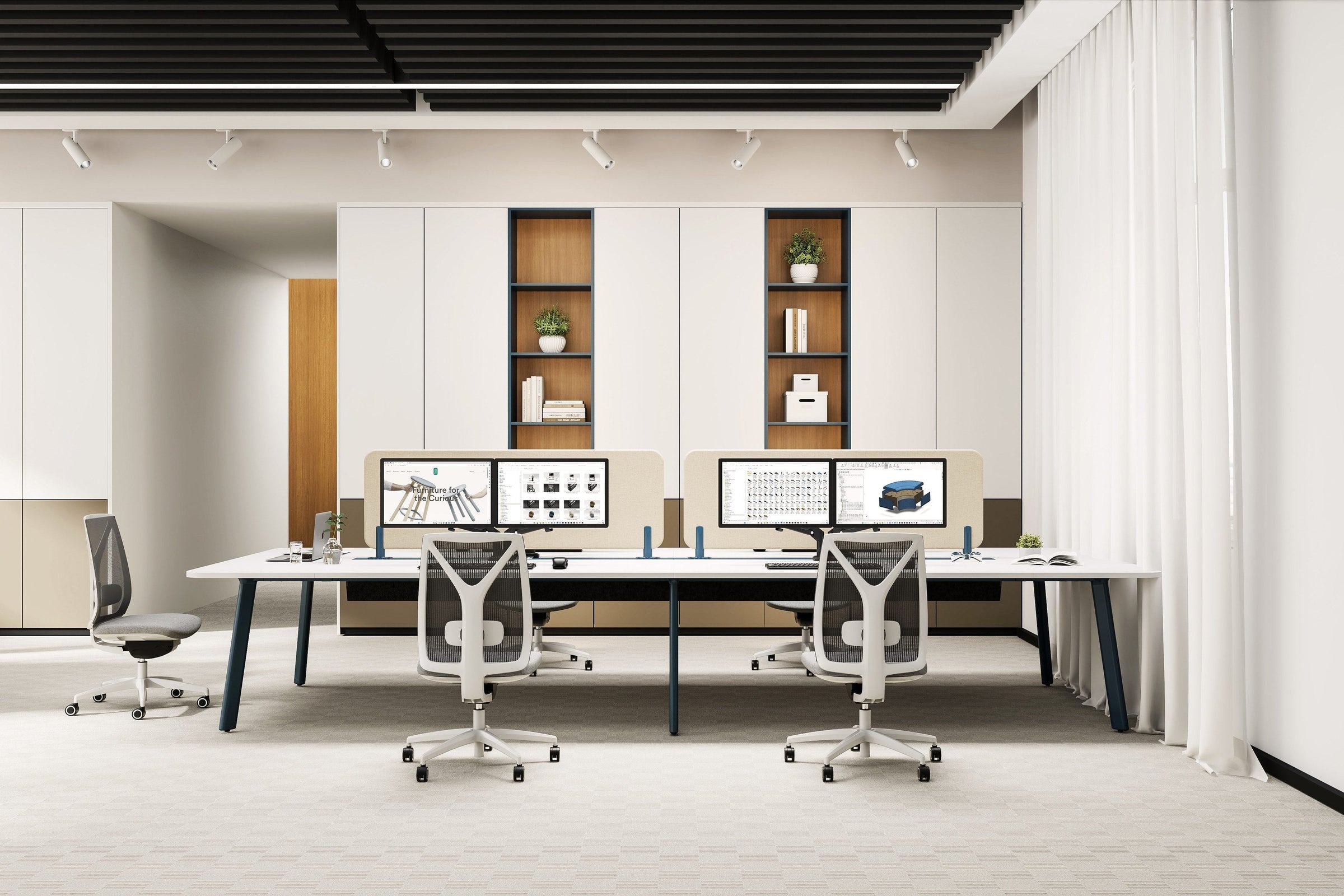
Thinking Works builds three desking systems that turn up on Australian workplace schedules more often than the rest of its range, and they separate on two sets of numbers. Ovation in its electric form runs 590 to 1210 mm to the underside of the worktop, carries 100 kg evenly distributed on a two leg frame or 150 kg on a three leg frame, and takes a 30 kg point load. Rosie and Okidoki are fixed height systems at 740 mm and 720 mm over a 25 mm top, with bench and standing versions at 900 mm and 1050 mm, and both are published at 60 kg a bay with a 15 kg point load. If the brief has height adjustment or a heavy screen array in it, Ovation is the only one of the three that answers it. If it does not, the other two are the better looking floor.
All three come from the same New South Wales company, which has been designing and making furniture in Australia since 1984, and all three sit in the Thinking Works range Geneva carries. They are not three finishes on one chassis. They were drawn for different jobs, and the technical specifications say so plainly once you read past the renders.
What actually separates the three systems
Everything in the table below comes from the current technical specifications published by Thinking Works: the Ovation specification dated 9 June 2026, the Rosie Workstation specification dated 5 November 2025 and the Okidoki Workstation specification. Nothing in it is inferred, and where a figure is not published it says so.
| Item | Ovation | Rosie | Okidoki |
|---|---|---|---|
| Height adjustment | Fixed, crank or electric | Fixed only | Fixed only |
| Heights | Electric 590 to 1210 mm, fixed 715 mm, both to the underside of the top | 740 mm standard, 900 mm bench, 1050 mm standing, to the top surface | 720 mm standard, 900 mm bench, 1050 mm standing, to the top surface |
| Distributed load, worktop included | 100 kg two leg, 150 kg three leg | 60 kg | 60 kg |
| Maximum point load | 30 kg | 15 kg | 15 kg |
| Worktop lengths | 1000 to 2100 mm | 1200 to 2000 mm | 1200 to 2000 mm |
| Worktop depths | 650 to 900 mm electric, 700 to 900 mm fixed | 800 to 900 mm single sided, 1600 to 1800 mm double sided overall | 700 to 900 mm single sided, 1400 to 1800 mm double sided overall |
| Leg | Oval steel profile | Angled steel and aluminium frame | Solid timber leg on a steel and aluminium frame |
| Run sizes | Single sided, back to back, 90 and 120 degree clusters | 2 to 10 people with touchdown ends | 2 to 8 people |
| Screens | Frameless and framed acoustic, grey PET or customer specified fabric | PET or upholstered screens on a central rail | Plywood, perforated plywood, PET or upholstered |
| Frame warranty | 10 years frame, 5 years electrical components | Not stated in the specification | Not stated in the specification |
Two things fall out of that table immediately. Ovation is the only one of the three that moves, and it is the only one of the three built to carry a serious screen array. The rest of the decision is about how the floor should look and how the run should be serviced.
Ovation is the only one of the three that moves
Thinking Works publishes no designer credit for Ovation. What it publishes is the intent, in the Ovation brochure.
Designed with movement in mind, Ovation draws inspiration from iconic transport systems of the world.
That reads as styling, and it is. The oval profile is also what lets the system take a three stage lifting column without the frame turning into scaffolding. The electric build is the one worth understanding in detail, because it is the part of the specification a project can get wrong and not discover for six months.
| Published figure | Value | What it means on site |
|---|---|---|
| Height range | 590 to 1210 mm | Measured to the underside of the worktop, so add the top thickness for the working surface |
| Column | Three stage, spindle drive | Three stages are what buy the low end of the range, not the high end |
| Travel speed | 35 mm per second | A 620 mm travel takes about 18 seconds end to end |
| Noise | Under 50 dB | One frame moving goes unnoticed in an open plan. A whole neighbourhood changing over at 9am does not |
| Memory | Three programmable heights with an electronic display | Enough for a sitting height, a standing height and one shared setting on a hot desk |
| Impact stop | Stops after one second of resistance, then reverses 50 mm | It protects the frame and the obstruction, but it is not a substitute for a clear zone under the desk |
| Glide adjustment | Plus or minus 5 mm | All the level correction the frame gives you. A floor out by more than that needs packing or a different starting point |
| Standby power | 0.5 W | Worth counting on a floor with 120 frames sitting idle overnight |
| Warranty | 10 years on the frame, 5 years on electrical components | The electronics carry the shorter term, which is the part that fails |
The one second delay before the impact stop triggers is the number to hold onto. A frame that reverses only after a full second of resistance will still put load into whatever it has met. Under desk storage, a bin, a cable basket and a chair arm are all objects that a desk can meet at 35 mm per second, and the reversal clears 50 mm, not 200.

The geometry that decides whether the desk fits the plan
Height ranges get quoted in every brochure. The dimensions that actually decide whether a run works are the ones between the leg and the edges, and Ovation publishes them.
| Worktop depth | Front edge to leg | Leg offset from back edge, electric | Leg offset from back edge, fixed |
|---|---|---|---|
| 700 mm | 405 mm | 90 mm | 170 mm |
| 800 mm | 405 mm | 190 mm | 170 mm |
| 900 mm | 505 mm | 190 mm | 170 mm |
Read the first column as knee space. At 700 and 800 mm deep the leg sits 405 mm back from the front edge, and at 900 mm it moves to 505 mm. That is the figure that decides whether a seated user with a pedestal can turn, and it is the figure that decides whether a wheelchair user can approach the desk without meeting steel. On a 1000 to 2100 mm top the distance between the feet runs 744 to 1844 mm, which is what a joiner needs before anyone commits to a plinth or a floor box position.
Two depth limits are easy to miss because they are not the headline. A single sided electric Ovation takes a worktop 650 to 900 mm deep, but the two person back to back H frame starts at 750 mm. A 650 mm deep back to back run is not a smaller version of the same desk, it is a different frame. And where a rear screen is mounted to the frame rather than through the worktop, Thinking Works recommends the longer rear beam, which shifts the leg offset from the back edge to 170 mm and changes where the cable tray lands.
Cable management on Ovation is an enclosed pathway with removable segregation and multiple access points, with a cable tray bridge of 175 to 250 mm to carry a run between work points, and a Power Pocket modesty that takes up to six GPO. The GPOs and the data outlets are not supplied with it. The specification also notes that a cable tray is required on all H frame configurations, which is easy to miss when a schedule is being priced as a base frame plus options, and that adjacent back to back pods need a minimum 30 mm gap between them. Two pods drawn hard against each other on a plan will not move independently once they are built.

Screens are shorter than the worktop, by a published amount
Every desking schedule carries a screen line, and it is normally written as "screen to suit". Ovation publishes the actual relationship, and it is not one to one. A worktop mounted acoustic PET screen is 100 mm shorter than the worktop it sits on. A framed acoustic screen is 165 mm shorter. On a 1800 mm bay that is a 1700 mm screen or a 1635 mm screen, and the difference shows at the end of a run where two bays meet.
| Screen | Panel | Length against the worktop | Height |
|---|---|---|---|
| Acoustic PET, frameless, worktop mounted | 24 mm | Worktop length less 100 mm | 285 or 500 mm above the worktop |
| Framed acoustic, worktop mounted | 25 mm | Worktop length less 165 mm | Two published heights, PET or customer specified fabric |
| Upholstered Lovoc, worktop mounted | 28 mm | Suits worktops 1200 to 2100 mm | 225 to 640 mm above the worktop |
| Upholstered Lovoc, centre mounted | 32 mm | Suits worktops 1400 to 2100 mm | Mounts to the crossbeam between two work points |
| Rear mounted acoustic screen with modesty | 24 mm | Worktop length less 100 mm | 490 mm above the worktop, with a modesty panel below |
Mounting is the second half of the answer. A worktop mounted screen either bolts through the top or sits in a slide on bracket, and only one of those can be moved later without leaving holes. A frame mounted screen fixes straight to the double sided crossbeam, or to single sided screen brackets where there is no crossbeam. On a fixed height Ovation cluster with shared legs, every shared leg needs a bridge bracket before a frame mounted screen can go on it, and those brackets are ordered separately. The sizes above are for rectangular worktops only. Screens for the 90 and 120 degree tops and for clusters are not on the standard chart and have to be confirmed against the layout.
The Lovoc upholstered screen is the one that mounts to an Ovation frame as well as to a worktop, and it is assembled without stitching so the materials separate at end of life. The Cicada wrap screen is the cheaper answer where the requirement is visual privacy on a height adjustable desk rather than absorption: 12 mm acoustic PET in an L or U shape, mounted flush with the rear edge or with a 20 mm gap, and not suitable for a sharknose worktop edge. What a screen of any of these heights can and cannot do to speech crossing an open plan is set out in what the open plan office noise research actually measured.
Rosie puts the accessories on a rail instead of the worktop
The Rosie table system won an Australian Good Design Award in 2023 in Product Design for Furniture and Lighting, alongside the patented Lovoc screen system, and the Good Design entry for the table credits the design to Lowell Mak and Lukas Eitelgoerge. The award is to the table, not to the workstation, and a schedule that cites it against the workstation is citing the wrong product. The idea behind it is a central aluminium rail running the length of a double sided bench, which carries the screens, the monitor arms and the accessories rather than bolting each one to a worktop.
That matters more than it sounds. On a conventional bench, every change of user is a change of hole position, and after three churns the worktop is a record of everyone who has sat there. On a rail, the screen slides and the arm slides, and the top stays intact. For a floor with high churn, that is the difference between refurbishing worktops at year five and not.
Rosie is published at 60 kg including the worktop, with a maximum point load of 15 kg, and seats 2 to 8 in the base configuration, 3 to 9 with one touchdown end and 4 to 10 with two. Cable management is either a segregated wire basket or an enclosed acoustic PET tray, which is the option to take where the underside of a bench is visible from a circulation route.

Okidoki is 20 mm lower than everything else on the floor
Okidoki is the Thinking Works design studio's own, and it is the one of the three that does not read as office furniture. Solid timber legs in ash, walnut or a seasonal solid colour with the grain still showing, set against a slim steel and aluminium frame, with plywood, perforated plywood, PET or upholstered screens above.
The number to carry into a drawing is 720 mm. Okidoki's standard height is 20 mm lower than Rosie's 740 mm and 20 mm lower than a fixed Ovation with a 25 mm top. On its own that is nothing. In a tenancy that runs Okidoki through a creative studio and Rosie through the rest of the floor, it is two different seat height ranges, two different chair setups, and a joint where two systems meet that will not line up. Specify one height per neighbourhood, or accept the step and detail it deliberately.
Okidoki is also the one of the three with a product level entry on the GECA ecolabel directory rather than a range level statement from the manufacturer, which matters on a project where a certificate has to be produced. The detail, and the gap between what the two published lists say, is set out further down.

The load ratings are the number that gets missed
The single most consequential difference between these three systems is not height adjustment. It is that Ovation is rated at 100 or 150 kg distributed with a 30 kg point load, and Rosie and Okidoki are rated at 60 kg with a 15 kg point load. A 15 kg point load is one monitor arm with two heavy screens on it, before a laptop, a dock and a desk lamp.
Specifier's note. Distributed load and point load are two separate limits and both have to be satisfied. Thinking Works publishes the distributed figure as including the worktop, so the top is already eating into the allowance before anything is placed on it. A six screen post system, a heavy single column arm with two 32 inch panels, or a monitor array mounted through the top rather than on a rail, can each pass the distributed test and still fail the point load on a 15 kg bay. Check the arm's own published weight before the frame is chosen, not after, and if the array is fixed, put it on the Ovation frame.
We set out the weight ranges for every arm Geneva carries in monitor arm weight ranges and why the wrong arm fails in month three. Read the two together: the arm has a capacity, the screen has a mass, and the desk has a point load. All three have to agree, and it is normally the desk that nobody checks.
What is actually Australian about them
Thinking Works describes itself as an Australian company founded in 1984 that designs and manufactures in Australia, and says it was the first designer and manufacturer of height adjustable desks in this country. The Ovation technical specification gives country of origin as Australia. The Rosie and Okidoki specifications do not state a country of origin, so on a project where local content has to be evidenced, ask for it in writing against the product code rather than taking a range level statement into a submission.
That distinction is worth making because "Australian" is doing several jobs at once in furniture marketing: designed here, assembled here, made here from imported components, and made here from local components are four different claims with four different evidence trails. The one that holds up in a tender is the one written against a product code on a letterhead.
The certification picture needs the same care, because two published lists do not agree. Thinking Works’ own sustainability page names its certified products and the list includes the Ovation electric height adjustable desk, the Rosie Table and the Okidoki range, alongside AFRDI Blue Tick and Green Tick, GECA Level A, AS/NZS ISO 14001 and UN Global Compact participation since 2016, all stated as applying to selected ranges. The GECA ecolabel directory entry for Thinking Works lists a narrower set against Furniture, Fittings, Foam and Mattresses Level A, standard FFFMv3.1-2017, licence TEX-2022: the Okidoki range, u.r, EONA and Thinking Quietly. Ovation and Rosie are not on it, and the page carries a notice that the certificate has expired and the company is undergoing recertification.
Both statements can be true at once, because a product certified to AFRDI Green Tick is not thereby on the GECA register, and the two schemes are counted differently in a submission. What a specifier cannot do is carry the manufacturer’s range level list into a Green Star claim and expect it to survive review. Ask for the certificate number, the scheme, the product code and the expiry date, for the specific item on the schedule, which is the same discipline we set out in which sustainable office furniture claims hold up on a schedule.
Which one belongs on your floor
The choice is usually settled by three questions, in this order.
- Does the workpoint have to move? If height adjustment is in the brief, the answer is Ovation. Rosie and Okidoki do not offer it, and a fixed bench height with a separate standing setting elsewhere on the floor is a different design decision, not a substitute.
- What is going on top? Two screens on a heavy arm, a dock and a dual laptop setup will push a 15 kg point load. Ovation's 30 kg point load and 150 kg three leg frame carry a technical or trading desk. Rosie and Okidoki carry a laptop workpoint comfortably.
- How often will the run change? Rosie's central rail is the one that survives churn without the worktop recording it. Okidoki's timber leg is the one that makes a floor look like somewhere people want to be rather than a floor of identical grey bays.
In practice a Sydney floor often runs two of the three. Ovation through the open plan where the workpoints are assigned and heavily equipped, Rosie through the hot desk neighbourhoods and touchdown points, Okidoki in the studio, the project room or the client facing corner. That is a reasonable outcome as long as the height step between 720 mm and 740 mm is a decision rather than a discovery. Our guide to how a Sydney CBD floor is laid out, setting by setting covers how many of each you are likely to need and how much circulation has to go around them.
If you are sizing a desking package now and want the published load figures, heights and layout geometry checked against your actual screen and power schedule before it goes out, send us the layout and the equipment list and we will mark up which system each neighbourhood should take. You can also see the full workstation and desking systems Geneva specifies and the Thinking Works brand page for the rest of the range.
Frequently asked
How high does an Ovation electric desk actually go?
The published range is 590 to 1210 mm, measured to the underside of the worktop. The technical specification draws a 25 mm top, so the working surface on a standard build sits at roughly 615 to 1235 mm. Schedule the range you need at the surface, not at the frame, or the bottom of the range will be 25 mm higher than the drawing suggests.
What is the difference between the Rosie and Okidoki workstation heights?
Rosie is 740 mm plus or minus 5 mm at standard height and Okidoki is 720 mm. Both offer 900 mm bench height and 1050 mm standing height. The 20 mm gap only matters where the two systems meet in one run or share a chair specification, and that is exactly where it tends to be discovered.
How much weight can a Thinking Works workstation carry?
Ovation is published at 100 kg evenly distributed on a two leg frame and 150 kg on a three leg frame, including the worktop, with a maximum point load of 30 kg. Rosie and Okidoki are published at 60 kg including the worktop with a maximum point load of 15 kg. Those are the figures to check before a multi screen array is added.
Are Thinking Works desks made in Australia?
Thinking Works describes itself as an Australian company founded in 1984 that designs and manufactures in Australia, and the Ovation technical specification gives country of origin as Australia. Where a project needs country of origin confirmed for a particular item, ask for it in writing against the product code rather than relying on a range level statement.
Is Thinking Works furniture GECA certified?
The two published lists do not match. Thinking Works names Ovation, the Rosie Table and the Okidoki range among its certified products. The GECA ecolabel directory lists a narrower set against Furniture, Fittings, Foam and Mattresses Level A, standard FFFMv3.1-2017, licence TEX-2022: the Okidoki range, u.r, EONA and Thinking Quietly, with a notice that the certificate has expired and the company is undergoing recertification. Ask for the scheme, the certificate number and the expiry date against the specific product code before a claim is counted in a submission.