Acoustic soft seating: what a high back actually does in an open plan
A high back changes the sound path between two people sitting down. It does not make a room quieter and it does not make a conversation private. Here is the height that decides it, and the rating to ask a supplier for.
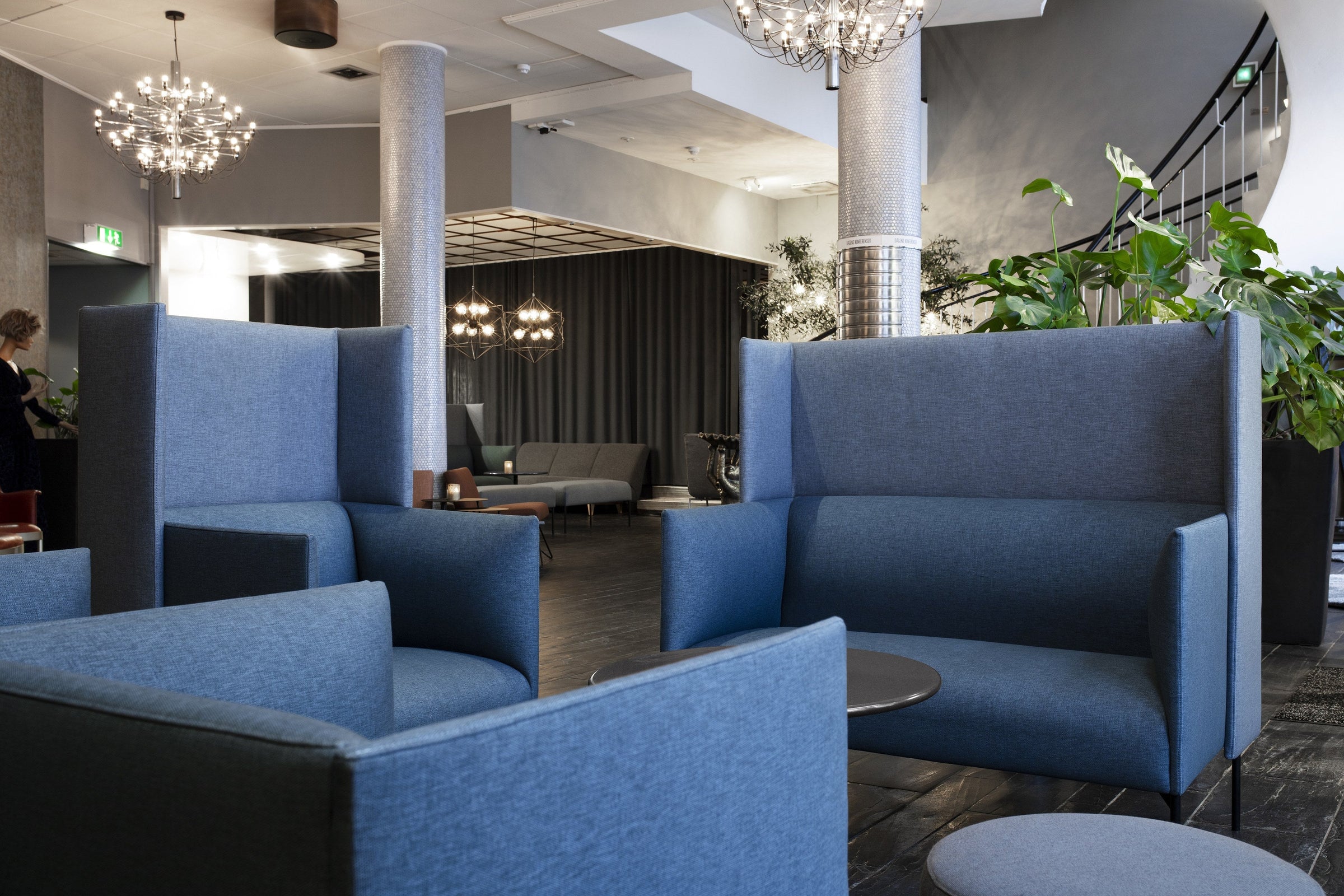
Acoustic soft seating works on the sightline, not on the room. A high back interrupts the direct path between two seated people, and its upholstery takes some mid and high frequency energy out of the air around it. That is the whole of it. For the geometry to do anything at all, the top of the back has to reach the height the standards use for a seated talker: ISO 3382-3 puts both the speaking position and the listening position 1.20 m above the floor. A 610 mm back sits nearly 600 mm below that line. A 1,240 mm back crosses it. Below about 1,100 mm you are specifying a look, not an acoustic effect.
That distinction matters because "acoustic soft seating" is a category name, not a rating. Very little of what is sold under it carries a published number, and the number it would need is not the one most product pages quote. This post sets out the three things upholstered seating actually does to sound, the back heights that decide whether the first of them happens, and the four standards worth naming in a specification so a supplier has to answer with data rather than adjectives.
What upholstered seating actually does to sound
There are only three mechanisms, and a sofa is good at one of them.
It absorbs, modestly and selectively
Fabric over foam is a porous absorber. It converts sound energy to heat through friction in the pore structure, and like every thin porous absorber it works on short wavelengths first. Mid and high frequencies are taken down; the low end passes through almost untouched. A room full of upholstered furniture is measurably less live than the same room empty, which is why an unoccupied fitout always sounds worse than the occupied one. It is also why absorption from furniture is a bonus rather than a strategy: you cannot schedule it, you cannot count on the day it is measured, and the moment a tenant swaps the fabric the measured figure no longer describes what is in the room.
It blocks, if it is tall enough
This is the mechanism a high back is actually for. Sound arriving at a listener in an open plan comes in two parts, the direct path across the floor plate and the reflected energy from the ceiling, the glazing and the hard surfaces. A back that rises above the seated head height removes the first part and does nothing whatsoever to the second. It is a screen you can sit on. Offecct's own acoustics page puts the strategy plainly, listing "choose sofas and chairs with a higher back and sides" under blocking sound, and publishes no performance figure for the seating itself.
It scatters, occasionally and by accident
A deeply shaped or heavily quilted surface will diffuse some incident energy rather than reflect it specularly. This is real, it is the working principle behind the diffuser variant of Offecct's Soundwave range, and on a sofa it is far too small to specify. Treat it as a rounding error.

The number that decides it: back height against the 1.20 m line
ISO 3382-3 is the standard that describes what an open plan floor plate actually does with speech. It measures the spatial decay rate of speech per distance doubling, written D2,S, the A weighted speech level at four metres, and two distances that are the useful output for a designer: the comfort distance rC, defined as the "shortest distance from the middle point of the OSS where the A-weighted SPL of speech is lower than 45 dB", and the distraction distance rD, the "shortest distance from the middle point of the OSS where the STI is lower than 0,50". A smaller distraction distance means better speech privacy.
For our purposes the important part is the geometry the standard assumes. The omnidirectional sound source stands with its middle point at 1.20 m above the floor, and the measurement positions sit "at the position of a sitting occupant's head, which is 1,20 m above the floor". That is the line a sofa back either crosses or does not. Measure it from the floor, because that is how furniture dimensions are published, and compare it against 1,200 mm rather than against the seat.
| Setting | Brand | Back height | Seat height | Against the 1.20 m line |
|---|---|---|---|---|
| Meet sofa system | Offecct | 610 mm | 410 mm | 590 mm below |
| Lucy sofa system, 1-seater | Offecct | 680 mm | 440 mm | 520 mm below |
| Font sofa | Offecct | 755 mm | 460 mm | 445 mm below |
| Talk sofa, standard back | Jonas Ihreborn | 800 mm | 460 mm | 400 mm below |
| Hendrix, high back | Geneva | 1,070 mm | 400 mm | 130 mm below |
| Pod easy chair, high back | Jonas Ihreborn | 1,090 mm | 450 mm | 110 mm below |
| Cara Highline, medium back | Geneva | 1,200 mm | 470 mm | on the line |
| Talk sofa, high back | Jonas Ihreborn | 1,240 mm | 460 mm | 40 mm above |
| Maxwell high back booth chair | Geneva | 1,240 mm | 420 mm | 40 mm above |
| Cara Highline, high back | Geneva | 1,500 to 1,600 mm | 470 mm | 300 to 400 mm above |
| Mr SCREEN room divider | Klaro Design | 1,570 mm | not applicable | 370 mm above |
Read down that table and the category splits in two. Everything under about 800 mm is lounge furniture that happens to be upholstered. From roughly 1,070 mm the back starts to interrupt a seated conversation, and only the Cara Highline high back and a free standing divider such as Klaro's Mr SCREEN stand clear enough to also screen someone walking past. The wrap matters as much as the height: a back with returned sides, like the Cara Highline or the Maxwell booth chair, closes three sides of the setting, while a flat high back leaves the conversation open to either end.

Four standards, and which one to name
The reason "acoustic soft seating" is a slippery category is that suppliers quote whichever of these gives the best looking number. They measure different things, and only one of them describes what a sofa does for the person sitting in it.
| Standard | Measures | Applies to | Result you get |
|---|---|---|---|
| ISO 354:2003 with ISO 11654 | Sound absorption in a reverberation room, rated into classes | Materials and plane absorbers | αw and absorption class A to E |
| ISO 20189:2018 | Sound absorption and sound reduction of screens, furniture and single objects | Screens, furniture and discrete objects for interior use | Equivalent sound absorption area, or object absorption coefficients in octave bands |
| ISO 23351-1:2020 | Reduction in the speech level of the occupant speaking inside the product | Furniture ensembles, explicitly including partially enclosed sofas and chairs, and enclosures | Speech level reduction DS,A in dB, 125 Hz to 8,000 Hz |
| ISO 3382-3:2022 | The acoustic result in the room | Unoccupied open plan offices | D2,S, speech level at 4 m, comfort distance rC, distraction distance rD |
ISO 23351-1 is the one to name. It was written for exactly this problem: it compares "furniture ensembles and enclosures with respect to their ability to reduce the speech level of the occupant speaking inside the product", and its scope covers partially enclosed sofas and chairs alongside pods and booths. The measurement is the difference in radiated sound power with and without the product, in octave bands from 125 Hz to 8,000 Hz. It is the same standard the booth manufacturers publish against, which makes it the only honest basis for comparing a high back setting with an enclosed pod. Our post on choosing between Framery One, Four and Six covers what those figures look like at the enclosed end of the range.
Two cautions. First, ISO 23351-1 specifies a method, not a classification: the standard itself sets no A to D bands, so any class letter attached to a DS,A figure has come from the manufacturer or an industry scheme rather than from ISO. Second, almost nothing in the soft seating market has been tested to it. Where absorption alone has been measured, ISO 354 or ISO 20189 is the reference. Offecct lists the sound absorption of its Lucy sofa system as measured to ISO 354, which is more than most ranges offer, but we have not seen a published absorption class for it, so do not carry one onto a drawing. If a supplier cannot name the standard and the test report, treat the product as untested and specify it for what it looks like and how it sits.
Specifier's note. Check the back height on section, not on plan, and confirm that the published figure is to the top of the back with the base you have actually specified. A sleigh base, a different glide or a castor option moves the top of the back by 20 to 40 mm, which is the whole of the margin for anything in the 1,200 mm band. The same applies to any absorption figure you have been given: it belongs to the fabric that was on the test specimen. Change the cover and you have changed the absorber, and nobody re-tests a sofa because a client picked a different wool.
Where the absorption is really coming from
If the brief is a quieter floor rather than a more private conversation, the furniture is the wrong lever. Absorption is bought by area, and the two large areas in an open plan are the ceiling and the walls. That is what a panel range is for. Offecct's Soundwave Swell, designed by Teppo Asikainen and held in the collection of the Museum of Modern Art in New York, which catalogues it as 1999 to 2000 in recyclable polyester fibre, is described by the manufacturer as a lightweight absorber for the upper frequency range, 500 Hz and above. The panels are 585 by 585 mm and fix with adhesive hook and loop attachments. Offecct's Basfill insert, ordered separately, extends the useful range down to between 150 and 500 Hz. The Soundwave panels are designed for walls and not for ceilings, which is a detail worth catching before a reflected ceiling plan is issued.
The frequency range is the point. A panel that starts working at 500 Hz is doing most of its work in the band where speech intelligibility lives, which is what you want for an office, and almost nothing for the low frequency rumble of plant and traffic, which is a different problem with a different solution. Our guide to what NRC, Rw and dB actually tell you sets out how to size the absorption area once you know what class of absorber you are working with, and the full range sits in Acoustic Solutions.

Offecct's soft seating, read as a schedule
Offecct is a Swedish company founded in 1990 and part of the Flokk group since 2017, and its range is a useful worked example because it spans the whole height band without pretending any of it is a booth. The Meet sofa system by Fattorini + Rizzini + Partners sits at the low end, 610 mm to the top of the back on a 410 mm seat, with modules, tables and planters on a timber platform. It is a setting for a conversation people are happy to have in public. Font, Matti Klenell's system of straight, curved and circular sofas and benches, runs to 755 mm and is tested to EN 16139 level 1 with Moebelfakta and GREENGUARD Gold certification and an environmental product declaration. Its 310 degree open circle is the piece that does the most acoustic work in the range, not because it is tall but because it turns people inward, away from the rest of the floor.
Lucy, by Lucy Kurrein, builds from individual 1-seaters, corners and ottomans into runs from 925 mm to 3,175 mm and beyond, with linking tables and a clip-on swivel table. It is the range's one piece with a measured absorption figure. At the loose end, the Carry On stool by Mattias Stenberg has a handle on the top and stacks, which solves the real problem with breakout furniture, and the Dune ottoman by Front seats up to eight around four integrated table tops. The complete range sits in the Offecct collection, and there is more on the company and its approach on the Offecct brand page.

Putting a setting together
A method that survives contact with a real floor plate:
- Decide what the setting is for. A place to read, a place for two people to talk without booking a room, or a place to take a call. The third one is a pod, not a sofa, and no amount of upholstery will change that.
- Set the back height from the sightline. Anything you want to screen a seated conversation needs to reach 1,200 mm. Anything you want to screen from people walking past needs to go higher, or needs a divider behind it.
- Close the ends. Returned sides, a corner module or a pair of settings facing each other will do more than another 100 mm of height.
- Buy absorption separately. Panels, ceiling treatment or a soffit. Count the area, do not count the sofa.
- Orient inward. Two settings back to back put two upholstered backs between two conversations at no extra cost. Two settings facing each other across an aisle put nothing between them.
- Check the floor build. Slim metal legs on a raised access floor need the pedestal layout checked, and a fully upholstered base traps nothing but does hide the floor box you will want to reach.
Good furniture should never fight the architecture. It should feel like it was always meant to be there. That is the line we come back to at Geneva, and it applies to acoustics as much as to anything else: the settings that work are the ones doing a job the plan already needed done, not the ones brought in to rescue a floor plate that was never treated.
Frequently asked
Does acoustic soft seating give speech privacy?
No. A high back interrupts the direct sound path between two seated people, but the setting is open at the top and the sound reaches the rest of the floor by reflection off the ceiling and other hard surfaces. Where a conversation has to be private, the answer is an enclosure rated to ISO 23351-1, not a sofa.
How high does a sofa back need to be to screen a seated conversation?
ISO 3382-3 places both the speaking position and the listening position 1.20 m above the floor, so a back needs to reach at least 1,200 mm above finished floor level to interrupt that path. Backs below about 1,100 mm shape a setting visually without affecting the direct sound path.
What acoustic rating should I ask a soft seating supplier for?
Ask for a speech level reduction figure, D subscript S,A, measured to ISO 23351-1, which covers partially enclosed sofas and chairs as well as pods. If only absorption has been measured, the references are ISO 354 or ISO 20189. If the supplier cannot name the standard and the test report, treat the product as untested.
Do upholstered sofas absorb sound?
Yes, but modestly and only at mid and high frequencies, and the figure belongs to the fabric that was tested. Absorption is bought by area, so wall panels and ceiling treatment will always do more than furniture. Treat absorption from soft seating as a bonus rather than part of the calculation.
Can soft seating replace acoustic panels in an open plan?
No. Soft seating works on the direct path between two people, and panels work on the reflected energy in the room. They solve different halves of the same problem, and an open plan that is uncomfortable to work in usually needs both.
Where Geneva comes in
Geneva specifies these settings for Australian workplaces every week, and can put the back heights, the wrap and the absorption area on the one drawing so the acoustic intent survives the value engineering. The full soft seating range sits in Lounge Chairs & Soft Seating, and you can talk to our team about a particular floor plate.