

What the furniture delivery leaves behind: packaging, pallets and the waste plan
Nine kilograms of packaging in ten, on the manufacturer's own count, is cardboard. Here is the published waste budget a fitout is measured against, what actually comes off a furniture truck, how the NSW EPA classifies it once it is mixed, and the six lines that belong in the delivery section of a furniture package.
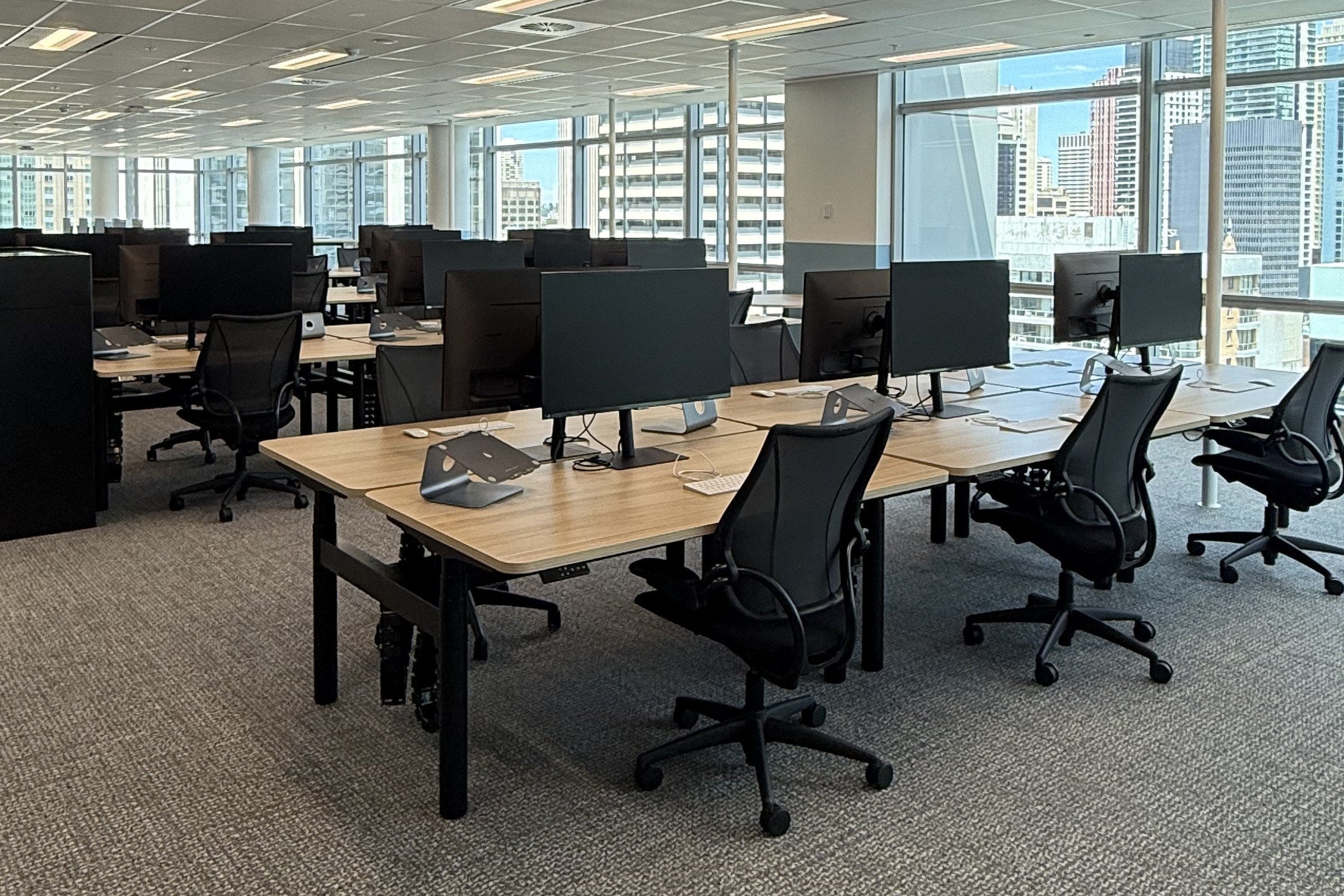
A furniture package arrives as cardboard, timber and film, and nearly all of it leaves the floor inside a fortnight. The Green Building Council of Australia's published Construction and Demolition Waste credit sets the budget it is measured against: a benchmark of 5 kg of waste to landfill for every square metre of fitout area, with one point from 3.6 to 4.5 kg per square metre, two points from 2.6 to 3.5, and three points from 1.6 to 2.5. Cardboard is most of what gets weighed. Flokk, which makes HÅG, reported 1,797 tonnes of cardboard packaging in 2023 out of 1,993 tonnes in total. Separated at source it is a recyclable stream. Mixed, it is building and demolition waste.
That is the whole subject in four sentences, and it is the part of a furniture package that almost never appears on a drawing. The schedule carries finishes, dimensions and quantities. It rarely carries the question of what the delivery is wrapped in, who unwraps it, which bin the wrapping goes into and whether anyone weighs it. On a Green Star project those four answers are worth points. On every project they are worth a clean floor and a smaller bin bill.
The waste budget a fitout is measured against
The Green Building Council of Australia publishes a Construction and Demolition Waste credit worth three points, aimed, in its own words, "To recognise reductions in the amount of waste sent to landfill from construction and demolition works". It is not a percentage credit. It is a weight per square metre, which is the right unit for a fitout, because a tenancy that strips out nothing and a tenancy that strips out a previous fitout are not comparable on a percentage.
| Points | Waste to landfill, kg per m² of fitout area |
|---|---|
| 1 point | 3.6 to 4.5 |
| 2 points | 2.6 to 3.5 |
| 3 points | 1.6 to 2.5 |
The credit then allows for the fact that some tenancies start dirtier than others. A space handed over made good starts at zero allowance. A tenancy handed over with the last tenant's fitout still standing gets three additional kilograms per square metre, because somebody has to demolish it before the furniture arrives.
| Site or space | Additional waste allowance, kg/m² |
|---|---|
| Made-Good space | 0 |
| Conventionally delivered, refurbished | 0 |
| Conventionally delivered, new | 0 |
| Shell and Core, refurbished | 1 |
| Refurbishment of own fitout | 1 |
| Shell and Core, new building only | 2 |
| Integrated fitout, new building only | 2 |
| Untenanted, un-demolished previous tenancy | 3 |
The allowance is not free. At least 80 per cent of the fitout has to meet one of those space definitions to claim it in full, and below that it reduces on a linear scale: the credit's own worked example takes 60 per cent of a 3 kg allowance and arrives at 1.8 kg per square metre. There are two innovation routes as well, one for an untenanted and un-demolished tenancy that still lands between 0 and 0.5 kg per square metre, and one for using a waste processing facility with annual cumulative landfill diversion of 90 per cent or more.
What the evidence actually is
The credit is won on paperwork from the waste contractor, not on intent. It wants monthly waste reports for the full construction period, backed by disposal dockets, stating the total weight removed from site, the estimated weight by material type, the destinations, the total diverted, the total residual to landfill and the fate of the recovered materials. Weights should trace to weighbridge dockets. Projects under 250 square metres with no waste contractor are handled separately.
Two caveats worth stating plainly. The credit document that carries these figures prints no rating tool name, no version and no date on it, and it cites the Green Star Interiors pilot tool and Green Star Office Interiors v1.1 as the source of its benchmark data, so treat the numbers as the published benchmark rather than as the clause reference for a current registration. On the current tools, the Green Building Council of Australia places the credit as Construction and Demolition Waste in Design and As Built, Interiors and Railway Stations, and as Responsible Construction in Buildings, and requires that waste contractors and processing facilities "must comply with the current version of the Green Star 'Construction and demolition waste reporting criteria'". The current submission guidelines sit behind project registration, so confirm the band for your own tool and version before you write a target into a contract.

What actually comes off the truck
Furniture packaging is not one material. It is cardboard by a long way, then film and strapping, then a small amount of expanded polystyrene and foam, then the timber under all of it. The clearest published picture of the mix comes from a manufacturer rather than a regulator. Flokk, the group behind HÅG and RH, publishes its packaging consumption by material in its corporate sustainability reporting, and states that "Our products are delivered to customers either fully assembled with limited use of packaging material or stacked together or knocked down in cardboard boxes".
| Material | 2021, t | 2022, t | 2023, t | Share of 2023 total, calculated |
|---|---|---|---|---|
| Cardboard | 1,270 | 1,186 | 1,797 | 90.2% |
| Plastics | 94 | 77 | 65 | 3.3% |
| Expanded polystyrene | 8 | 6 | 4 | 0.2% |
| Others, tape and similar | 39 | 150 | 127 | 6.4% |
| Total | 1,412 | 1,420 | 1,993 | 100% |
| Of which recycled content | 872 | 760 | 646 | 32.4% |
Nine kilograms in ten, by the manufacturer's own count, is cardboard. That single ratio should decide how the bins are set out on the floor, because it means the dominant waste stream on a furniture install is also the easiest one to recover, and the one most likely to be thrown away in a mixed bin because nobody put a second bin next to the first.
The rest of the mix follows the product type. A stacking chair travels several to a carton, and Pedrali publishes the net weight, the pieces per carton and the packaging volume against each article code, which is the same data that tells you how much cardboard a hundred chair order will generate. A pod is a different problem again: it arrives in plywood crates rather than cartons, and the published crate dimensions and weights are set out in Will it fit in the lift? The access dimensions that decide a furniture schedule. A desking system such as the Ovation desking system arrives knocked down, which trades a smaller packaged volume for more site assembly and more cardboard per workpoint than an assembled chair.
Soft seating sits at the other end. Flokk notes that "Due to a high risk of damage during e.g. transportation, we need to protect our chairs with various types of protective covers", and an upholstered module is normally blanket wrapped or bagged rather than boxed, which produces less cardboard and more film. Film is the stream most often lost, because a loose bundle of stretch wrap is light, awkward and ends up in the mixed bin.

The pallet is a 34 kg timber object, and it has a height
Pallets are the part of a furniture delivery that people forget until the floor is full of them. A pooled Australian pallet is a specified product with published figures. Loscam publishes its Australian wooden pallet at 1165 mm long by 1165 mm wide by 150 mm high, weighing 34 kg, in plantation radiata pine, with 150 mm by 25 mm bottom entry boards, two way entry points, a maximum payload of 2,000 kg and a maximum static load of 10,000 kg, manufactured in accordance with AS4068/1993.
Three of those numbers matter on site. The 1165 mm square footprint is the floor area each delivered stack occupies before anything is unwrapped, and a staging area has to be set aside for it or the pallets end up in the circulation route. The 150 mm height is added to whatever sits on top, which is the figure that turns a comfortable lift car into a tight one; the car and door apertures that have to absorb it are tabulated in the delivery access guide. And 34 kg is a two person lift, which makes the empty pallets a manual handling item in their own right rather than rubbish.
Whether the pallets go back is a commercial question, not a technical one, and it is best settled before the truck arrives. Pooled pallets are hired and expected to return. One way pallets are not, and they become timber on the floor. Either way the answer belongs in the delivery method statement, because a pallet that nobody has claimed will be broken up and put in the general bin, where it stops being wood waste and starts being building and demolition waste.

How the waste is classified, and why mixing changes the answer
In New South Wales, waste is sorted into six classes under the EPA's Waste Classification Guidelines: special waste, liquid waste, hazardous waste, restricted solid waste, general solid waste (putrescible) and general solid waste (non-putrescible). The third step of the classification process asks whether the waste is pre-classified, and for a furniture install the answer is almost always yes.
The useful detail is that the EPA pre-classifies the individual materials and the mixture separately. Paper or cardboard is its own pre-classified general solid waste (non-putrescible). So is wood waste. So is the group of glass, plastic, rubber, plasterboard, ceramics, bricks, concrete or metal. And so, separately, is building and demolition waste, which the guidelines define as unsegregated material from building, demolition or infrastructure work, including bricks, concrete, paper, plastics, glass, metal and timber.
| What arrives | Typical source on a furniture install | Separated at source | Put in one bin with everything else |
|---|---|---|---|
| Cartons | Chairs, boards, desk components, accessories | Paper or cardboard | Building and demolition waste |
| Plywood crates | Acoustic pods, large single pieces | Wood waste | Building and demolition waste |
| Timber pallets | Palletised deliveries of all kinds | Wood waste, or returned under a pooling arrangement | Building and demolition waste |
| Stretch wrap and bags | Upholstered modules, blanket wrapped tops | Plastic | Building and demolition waste |
| Expanded polystyrene and foam corners | Glass, boards, delicate edges | Plastic | Building and demolition waste |
| Strapping, tape, staples, corner board | Everything | Plastic, or paper and cardboard where fibre based | Building and demolition waste |
Read the right hand column and the practical point writes itself. The classification follows the bin, not the material. The same carton is a recoverable paper and cardboard stream in one bin and part of an unsegregated building and demolition waste load in another, and the difference is a decision made in the first ten minutes of the first delivery, usually by whoever is holding the box cutter. A project aiming at a kilograms per square metre band cannot afford for that decision to be made by default.
This is the same distinction that undoes a lot of recycled content and recyclability claims, which is the subject of Sustainable office furniture: which claims hold up on a schedule. A material is recyclable in the abstract and landfill in practice if nobody can separate it.
Who is responsible for the packaging before it reaches your floor
There is an Australian regime sitting behind the carton, and most specifiers have never had cause to look at it. The Australian Packaging Covenant Organisation sets four national packaging targets, published as "100% reusable, recyclable or compostable packaging", "70% of plastic packaging being recycled or composted", "50% of average recycled content included in packaging" and "The phase out of problematic and unnecessary single-use plastics packaging".
Against its latest national consumption and recovery data, for 2023-24, APCO reports 86 per cent of packaging reusable, recyclable or compostable, 20 per cent of plastic packaging recycled or composted, 44 per cent average post-consumer recycled content, and a 46 per cent reduction in priority problematic and unnecessary single-use plastic items measured from the 2017-18 baseline. APCO states that "the Targets are not yet being met" and that "the Targets will continue beyond 2025".
The obligation reaches further than most people assume. The Covenant applies to businesses in the packaging supply chain with a turnover greater than AUD 5 million, and it covers business-to-business and tertiary packaging, not only the consumer pack. The Victorian EPA sets out the alternative route in plain terms: a liable brand owner either signs the Covenant or complies with the Environment Protection Regulations 2021, which require recovery of paper and cardboard, glass, steel, aluminium and plastics "at a rate of at least 70% in each financial year", information to consumers on how packaging can be recovered, records for each packaging material kept for five years, and a report to the EPA "by 30 September each year".
For a furniture tender that means there is a documented answer available. A supplier above the threshold is either a Covenant signatory with an annual report behind it, or it is meeting a state regulation with recovery rates and records behind it. Asking which, and asking for the evidence, is a fair question of the same kind as asking for a warranty document or an environmental declaration, and it belongs in the same evidence pack described in Government furniture procurement: what a panel does not settle.
Specifier's note. The take back scheme in the brochure is usually a European one. Flokk publishes membership of national schemes such as Grønt Punkt in Norway and NPA in Sweden, and those schemes collect and recycle packaging in those countries. The carton that lands on a Sydney floor is handled by the project's waste contractor and counted against the project's own kilograms per square metre. Two things follow. Ask the supplier to state in the tender whether it removes its own packaging from site. Then ask whether that removal is weighed and reported into the project's waste report, because packaging that leaves in the supplier's truck without a weighbridge docket leaves the evidence as well as the floor.
Six lines for the furniture tender
None of this needs a new document. It needs six lines in the furniture package that currently are not there.
- Packaging format by product line. Carton, crate, blanket wrap or bagged, and the approximate packaged volume, so the staging area and the bin provision can be sized before delivery week rather than during it.
- Pallet arrangement. Pooled or one way, who returns them, and by when. A 1165 mm square footprint at 34 kg each is a real floor load and a real manual handling task.
- Who removes the packaging. Supplier, installer or the project's waste contractor, named rather than assumed.
- Weighing and reporting. Any packaging removed by the supplier is weighed and the dockets provided, so it reaches the project's waste report instead of disappearing.
- Separation on the floor. Cardboard, timber and film in separate bins from the first delivery, with the bins in place before the first truck rather than after the first mess.
- Packaging compliance evidence. Covenant signatory status or state regulation compliance, with the supporting report, requested at tender alongside the warranty and the environmental declarations.
Not one of those six lines costs anything to write. Together they are the difference between a waste report that supports a credit and a waste report full of estimates, and between a handover floor that is clear on the Friday and one that still has a stack of flattened cartons behind the lockers.

What this changes in a specification
The furniture schedule will not grow a packaging column, and it should not. The place for this is the delivery and installation section of the furniture package, next to the access requirements, because it is the same conversation: the truck, the dock, the lift, the floor and what goes back down afterwards. A chair such as the HÅG SoFi or the HÅG Tion arrives assembled or close to it and makes cardboard. A Framery Six arrives in crates and makes timber. A Pedrali Remind chair arrives several to a carton and makes a great deal of cardboard very quickly. A Jojo electric folding table arrives built and makes almost none. The Flokk group range and the wider Flokk brand page are a reasonable place to see how one manufacturer's published position translates into what turns up on a dock.
The honest summary is that the packaging question is small, cheap and entirely solvable, and it is left unanswered on most projects purely because nobody owns it. The schedule owns the furniture. The builder owns the bins. The gap between them is where a fortnight of cardboard goes.
Frequently asked
How much packaging waste does an office furniture install produce?
No Australian body publishes a figure per workpoint. What is published is the budget the whole fitout is measured against. The Green Building Council of Australia's Construction and Demolition Waste credit document sets a benchmark of 5 kg of waste to landfill per square metre of fitout area, and awards one point from 3.6 to 4.5 kg per square metre, two points from 2.6 to 3.5 and three points from 1.6 to 2.5. Furniture packaging is one contributor to that figure, alongside the strip out, the plasterboard and the carpet.
Is cardboard from a furniture delivery recyclable under NSW waste rules?
Separated at source it is. The NSW EPA pre-classifies paper or cardboard, and separately wood waste, as general solid waste (non-putrescible), which is the class that carries a recycling route. Once the cartons go into the same bin as the offcuts and the plasterboard, the material is building and demolition waste, which the EPA defines as unsegregated material from building or demolition work. The classification follows the bin, not the material.
Who takes the pallets away after a furniture install?
That depends on the arrangement, and it is worth settling in writing before delivery day. A pooled Australian pallet is a real object with published figures: Loscam publishes its Australian wooden pallet at 1165 mm by 1165 mm by 150 mm, 34 kg, plantation radiata pine, two way entry, a maximum payload of 2,000 kg and a maximum static load of 10,000 kg, manufactured in accordance with AS4068/1993. Ask whether pallets are pooled or one way, who returns them, and to where.
Does the Australian Packaging Covenant apply to a furniture supplier?
It applies to businesses in the packaging supply chain with an annual turnover above AUD 5 million. The Victorian EPA states that a liable brand owner either becomes a signatory to the Australian Packaging Covenant or complies with the Environment Protection Regulations 2021, which require recovery of paper and cardboard, glass, steel, aluminium and plastics at a rate of at least 70 per cent in each financial year, consumer information on recovery, records kept for five years, and a report to the EPA by 30 September each year.
Should the furniture supplier remove its own packaging from site?
Require it, and require it to be weighed. The Green Star reporting the credit relies on comes from the waste contractor's monthly reports backed by disposal dockets. Packaging that leaves in the supplier's own truck, unweighed, never reaches those reports, so it cannot be counted as diverted and it cannot be counted at all. The removal is worth having either way, but it is only evidence if somebody puts it over a weighbridge.
If you are writing the delivery and installation section of a furniture package and want the packaging, pallet and waste lines drafted against what the manufacturers actually publish, talk to the Geneva team and we will put the figures against your product list.