

Modern slavery and the furniture schedule: what a specifier can require
The Modern Slavery Act catches entities over AUD 100 million and sets no penalty for silence, so most furniture suppliers publish nothing. What the register shows, what NSW agencies must do, and why every certificate on a furniture package is about material, not people.
No Australian law requires a furniture supplier to tell you anything about the people who made your chairs unless that supplier turns over at least AUD 100 million. The Modern Slavery Act 2018 (Cth) catches an entity with consolidated revenue of at least AUD 100 million for the reporting period, gives it six months after the end of that period to lodge a statement, and attaches no financial penalty to not lodging one. Almost every furniture manufacturer, importer and dealer in this market sits under that line, so in furniture procurement the evidence about labour is whatever the contract asked for and nothing else. Here is what the law requires, what the public register will and will not tell you, and the lines that put the question on an Australian furniture schedule.
The question usually arrives from somebody else: a government client with a statutory duty, a head contractor with a flow down clause, or a tenant whose statement has to describe its fitout spend. The usual response is to ask the supplier for a modern slavery statement and tick the box when one arrives. That is the wrong document, asked of the wrong entity, about the wrong tier.
Who the Act catches, and what it makes them say
The threshold is in section 5 of the Modern Slavery Act 2018 (Cth). A reporting entity is one with "a consolidated revenue of at least AUD 100 million for the reporting period" that is an Australian entity, or carries on business in Australia, at any time in that period. Carrying on business is read by reference to section 21 of the Corporations Act 2001, which is how a foreign manufacturer with an Australian selling arm is caught. The Commonwealth and corporate Commonwealth entities above the same threshold report as well.
One oddity before quoting the figure in a tender. The simplified outline in section 3 says "annual consolidated revenue of more than AUD 100 million", while the operative provision in section 5 says "at least AUD 100 million". The Attorney-General's Department uses "at least". Section 5 decides, but the inconsistency sits in the published text.
A statement is given to the Minister within six months after the end of the reporting period, approved by the principal governing body, which for a company is its board of directors, and signed by a responsible member of that body. The content is set by section 16(1). Read it as seven questions rather than as a compliance form.
| Criterion | What the Act requires | What it tells a specifier |
|---|---|---|
| (a) | Identify the reporting entity | The legal entity, often not the one on your contract |
| (b) | Describe the structure, operations and supply chains of the reporting entity | Whether manufacturing is in scope, or only Australian distribution |
| (c) | Describe the risks of modern slavery practices in those operations and supply chains | Whether it looked past tier one, and whether textiles and timber are named |
| (d) | Describe the actions taken to assess and address those risks, including due diligence and remediation processes | Whether anything was audited, and what happened when something was found |
| (e) | Describe how the entity assesses the effectiveness of those actions | The most revealing paragraph, usually the shortest |
| (f) | Describe the process of consultation with owned or controlled entities | Whether a group statement reached the factory |
| (g) | Include any other information the entity considers relevant | Voluntary, where the useful detail sits |
Section 4 defines modern slavery by reference to conduct that would be an offence under Division 270 or 271 of the Criminal Code, to trafficking in persons as defined in Article 3 of the United Nations trafficking protocol, and to the worst forms of child labour as defined in Article 3 of ILO Convention 182. It is a criminal definition, not a procurement adjective, which is why a statement describes risk management rather than guaranteeing anything.
There is no fine, and that changes how the document reads
Nothing in the Act creates a financial penalty for failing to lodge. Section 16A lets the Minister give an entity that appears to have failed to comply a written request to explain itself, or to take remedial action, within 28 days or longer, and if it does not comply the Minister may publish its identity and the reasons on the register or in any other way the Minister considers appropriate, reviewable by the Administrative Review Tribunal. Publication is the whole enforcement mechanism.
The statutory review, led by Professor John McMillan AO and tabled on 25 May 2023, made 30 recommendations, among them lowering the reporting threshold from AUD 100 million to AUD 50 million and introducing penalties for non-compliance. The Australian Government response of 2 December 2024 agreed, in full or in part or in principle, to 25 of the 30. As at the date of this post neither the threshold nor the penalty position has changed in the Act.
The register is free, public, and the first thing to check
Section 18 requires a register "to be known as the Modern Slavery Statements Register", which "must be made available for public inspection, without charge, on the internet". It is at modernslaveryregister.gov.au and it is searchable by entity. Before a tender closes that is a two minute check on the legal entity you are contracting with, not on the brand printed on the catalogue.
What it will not do is answer a product question. A statement describes risk management across everything an entity buys, and furniture is rarely the material spend in it. Section 6 also lets an entity under the threshold volunteer, with no revenue test, so absence from the register proves nothing except that the entity was not required to be there.
Australia's first Anti-Slavery Commissioner, Mr Chris Evans, was appointed by the Governor-General on 7 November 2024 and commenced a five year term on 2 December 2024. The role is deliberately bounded: under the Act the Commissioner may not investigate, or resolve complaints concerning, individual instances or suspected instances of modern slavery. On the data a buyer actually needs, his office has published the gap plainly. "We need better public access to information and data about which products are high risk, what products are entering Australia, and who is importing them", Commissioner Evans said, in a statement that also records that other countries have introduced measures such as high risk product lists and import bans and that Australia currently lacks these mechanisms.

If the client is a NSW agency, the duty belongs to the buyer
New South Wales runs a separate and more prescriptive regime, pointed at the buyer rather than the supplier. Under the Public Works and Procurement Act 1912 an agency "must take reasonable steps to ensure that goods and services procured by and for the agency" are not the product of modern slavery, and under section 31 of the Modern Slavery Act 2018 (NSW) its annual report has to describe the steps it took that financial year. Under section 25A, State owned corporations must volunteer to comply with the Commonwealth Act and publish their statements on a website they keep.
Since 1 January 2024 the benchmark for "reasonable steps" is published. The Guidance on Reasonable Steps, version 1.0 of December 2023, issued by the Office of the NSW Anti-slavery Commissioner and signed in its foreword by Dr James Cockayne, sets out seven steps. Buy NSW states that it is effective from that date and that agencies should align with it.
| Step | Sub-steps | Where it lands on a furniture package |
|---|---|---|
| 1 Commit | Engage key stakeholders; Identify salient risks; Adopt a Modern Slavery Policy; Adopt a Modern Slavery Risk Management Plan | Before the brief |
| 2 Plan | Identify and map your risks; Develop a risk-reducing sourcing strategy | The loose furniture package is assessed as a category |
| 3 Source | Select appropriate suppliers; Adopt a shared responsibility approach in contracting | Tender schedules and contract clauses |
| 4 Manage | Monitor and evaluate supplier performance; Develop supplier capabilities | Through delivery and past practical completion |
| 5 Remedy | Provide or enable access to effective grievance mechanisms; Take safe immediate steps to remedy harm; Use leverage to remediate deficient practices; Withdraw responsibly | Rarely in a furniture contract |
| 6 Report | Establish a victim-centred reporting protocol; Report on your modern slavery risk management efforts | Feeds the annual report under section 31 |
| 7 Improve | Learn lessons from your performance and others'; Train your workforce; Cooperate with the Anti-slavery Commissioner | Year on year |
The practical instrument sits one level down. The Commissioner's procurement resource, Integrating modern slavery risk assessments into procurement processes of April 2025, grades each purchase at one of four due diligence levels, Minimal, Light, Standard and Heightened, and a heightened tender has to use the Heightened Model Tender Clauses. Its checklist carries the line that decides whether a furniture tender is affected: "Procurement officer conducted modern slavery due diligence on all tenderers in Moderate or High-Risk product categories". Buy NSW also records that the Small and Medium Enterprise and Regional Procurement Policy sets a 10 per cent non-price sustainability criterion which can be used to assess a response to modern slavery risks, which is how an answer to this question wins or loses a job.
Commonwealth buyers reach it from a different direction. The Commonwealth Supplier Code of Conduct came into effect on 1 July 2024 and, under paragraph 6.12 of the Commonwealth Procurement Rules, its clauses are mandatory in all Commonwealth forms of contract entered from that date, with an accountable authority able to exclude it in part or in full on a documented basis. How the rest of that machinery fits together is in government furniture procurement: what a panel does not settle.
Furniture is not on anybody's risk list. Its inputs are.
This is the part that changes how the question should be asked. Walk Free's Global Slavery Index and its importing risk analysis put more than USD 468 billion of at-risk products into G20 countries each year, up from USD 354 billion in the 2018 edition. Furniture appears nowhere in it. Two of the materials a furniture package is made from do.
| Product | Import value | Source countries named |
|---|---|---|
| Electronics | 8.9 | China, Malaysia |
| Garments | 6.4 | Argentina, Bangladesh, Brazil, China, India, Malaysia |
| Solar panels | 1.3 | China |
| Textiles | 0.5 | China |
| Fish | 0.4 | China, Ghana, Indonesia, Taiwan, Thailand |
Australia imports USD 17.4 billion of at-risk product a year on that measure. The index also estimates that on any given day in 2021 there were 41,000 people living in modern slavery in Australia, a prevalence of 1.6 per thousand, ranking the country 26 of 27 in Asia and the Pacific and 149 of 160 globally. Low prevalence at home and high exposure through imports is the shape of the problem.
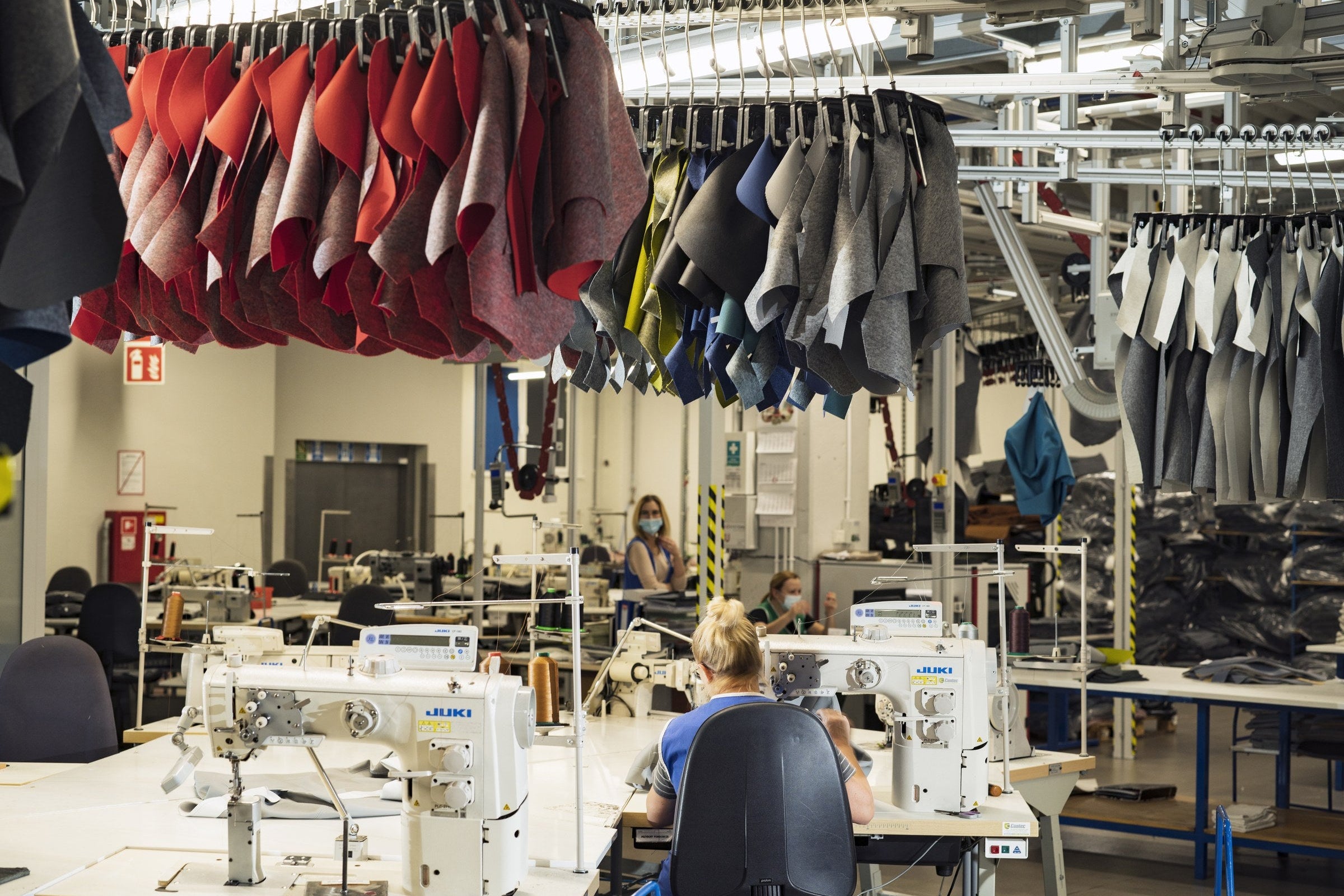
Across the G20 the index puts timber at USD 7.4 billion and textiles at USD 12.7 billion of at-risk imports, and it is explicit about where the textiles go. "Textiles are imported by G20 countries to make many other products within that country, including bedding, PPE, carpeting, upholstery, and garments." Upholstery is named. Textiles are also within the five most valuable imported products in over 70 per cent of the 19 nation states in the G20. The sewing hall at the top of this post, a Profim one, is where that category physically enters a chair.
So the honest position is this. The finished chair is not a listed high risk product anywhere, and no Australian list would make it one. The fabric stretched over it belongs to a category that is listed, and the timber in its frame to another. A schedule that asks about the assembled product is asking about the one tier where the answer is easiest and least useful.

What a furniture package can actually produce, and what each document covers
The certificate numbers are there to read on the product pages. Lintex A01, from Lintex, publishes FSC Mix FSC-C170086, an FSC chain of custody certificate numbered DNV-COC-002282 and ISO 14001:2015, and other boards in the whiteboard range publish Environmental Product Declarations by number, S-P-04560 and S-P-06990 among them. Geneva's Chelsea armchair publishes an FSC-certified plywood frame and GECA certified high density commercial foam. These are numbered third party documents, and the strongest evidence a furniture package routinely carries.
Not one of them is about the people who made it, with a single partial exception.
| Credential | What it certifies | What it says about labour |
|---|---|---|
| FSC chain of custody, for example DNV-COC-002282 with claim code FSC-C170086 | That forest material was tracked through a custody chain held by the certificate holder | A traceability claim about material, not an audit of the tiers beneath it |
| GECA Furniture, Fittings, Foam and Mattresses Level A, FFFM-A GEN 3.0, issued 10 March 2021 | Lifecycle environmental, human health and social impact criteria | The one scheme here with social content. Its standard guide carries a Social and Legal Compliance section covering modern slavery and labour rights legislation |
| GECA Furniture and Fittings Level B, FF-B GEN 3.0, issued 26 May 2021 | The same categories without foam and mattresses | Both levels publish the same commitment, that workers and suppliers through the supply chain can expect fair pay and equal opportunity |
| Environmental Product Declaration, for example S-P-04560 | Lifecycle environmental impact to ISO 14025 | Nothing |
| ISO 14001 and ISO 9001 | Environmental and quality management systems at a site | Nothing |
| EU Ecolabel | Environmental performance against product criteria | Nothing |
| AFRDI Blue Tick, Green Tick and level ratings | Strength, durability and, for Green Tick, environmental performance | Nothing |
| Martindale cycles, EN 1021 ignition | Fabric abrasion and ignition behaviour | Nothing |
The GECA exception deserves care, because it is the only lever of its kind on an Australian furniture schedule. GECA publishes two current furniture standards, Level A for furniture, fittings, foam and mattresses and Level B for furniture and fittings, and the published standard guide for Level A sets out a Social and Legal Compliance section. The guide puts it directly, that nothing is truly sustainable if it overlooks the treatment of workers, and describes the section as engaging with the supply chain to uphold human and labour rights, with criteria focused on environmental legislation, minimum entitlement including wages, and modern slavery and human and labour rights legislation.
Two cautions follow. A product page describing a component as GECA certified is making a claim about that component, usually the foam, not about the finished piece. And the claim is verifiable, because the scheme publishes its licensees, so a claim that does not appear there should be queried before it is relied on in a submission. Which environmental claims hold up is covered in sustainable office furniture: which claims hold up on a schedule, and where the same documents earn points is in Green Star and NABERS: where office furniture actually earns points.

The one question that does have an audited answer
Timber is the exception, because Australia regulates its import on a legality basis. The Illegal Logging Prohibition Act 2012 and its 2024 rules put an enforceable due diligence obligation on the importer of a regulated timber product, with eight tariff codes that catch furniture, and a chain of custody certificate and the documents behind it are the evidence that satisfies it. The full picture, including what an FSC claim on a plywood frame does and does not prove, is in timber chain of custody on a furniture package.
The lesson is structural. Timber works because the obligation falls on a named party at a named moment, the evidence is documentary and numbered, and the question is asked of the material rather than of the brand. A modern slavery clause written the same way, naming the entity, the tier and the document, gets a better answer than one asking a supplier whether it has a policy.
Specifier's note. The entity on the modern slavery statement is almost never the entity on your contract. A European manufacturer's Australian statement, where one exists, is usually lodged by a local sales company whose described operations are warehousing and distribution, with manufacturing out of scope. The dealer you are contracting with may sit well under AUD 100 million and lodge nothing at all, which is lawful and tells you nothing either way. Ask for the registered entity name and ABN that will sign the contract, search that exact entity on the register before tenders close, and write what you find into the tender assessment rather than assuming it. If there is no statement, say so and ask the supplier the seven section 16 questions directly, in writing. A supplier that can answer criterion (e), how it assesses the effectiveness of what it does, is further ahead than one with a glossy policy.
Six lines for the supply chain section of a furniture package
Drafting lines, not legal advice, written so a supplier of any size can answer honestly.
- Name the entity. Require the registered entity name and ABN that will enter the contract, and whether that entity, or any entity that owns or controls it, is a reporting entity under the Modern Slavery Act 2018 (Cth). No is an acceptable answer.
- Ask for the statement by link, not attachment. If one exists, require the register URL. The register is public and free, and a link cannot be an out of date PDF.
- Ask at material level. Require the origin of the upholstery textile and of the timber or panel product separately from the assembled item. Textiles and timber appear on published at-risk lists. The assembled chair does not.
- Require the timber evidence that is already a legal obligation. For a regulated timber product, require the chain of custody certificate number and claim code and the importer's due diligence record. That is documentation the Illegal Logging Prohibition Act already requires someone in the chain to hold.
- Treat an ecolabel as a claim to verify, not a credential to file. Where a GECA level is claimed, require the licence number and check it against the published licensee list. Where an EPD, ISO certificate or AFRDI level is offered against a labour question, record that it does not answer one.
- Write the remedy step in. Say what happens if something is found during the contract: who is notified, within what period, and that the first response is remediation rather than termination. Step 5 exists because withdrawing from a supplier can leave the affected workers worse off.
Two absences are worth naming. The GECA standards sit behind a download form, so no clause number is quoted here. And the GRS High Risk Product List at Appendix H of the NSW guidance was not read, so this post does not say whether furniture, timber or textiles sit on it. If they do, a NSW furniture tender is already a heightened due diligence exercise.
Geneva delivers furniture into government, health, education and corporate fitouts where this question gets asked, and it is always easier to answer before the schedule is issued than after the tender closes. If a package you are drawing carries a modern slavery clause, send us the clause and the schedule and we will tell you which lines a furniture supplier can answer and which will come back empty.
Sources
- Modern Slavery Act 2018 (Cth), compilation No. 2 of 7 November 2024, sections 3, 4, 5, 6, 13, 16, 16A, 18 and Part 3A.
- Attorney-General's Department, Modern Slavery Act, for the 2023 statutory review and the government response.
- Modern Slavery Statements Register.
- Australian Anti-Slavery Commissioner, About, for the appointment and term of Mr Chris Evans.
- NSW Anti-slavery Commissioner, Guidance on Reasonable Steps, version 1.0, December 2023.
- GRS Resource: Integrating modern slavery risk assessments into procurement processes, April 2025.
- Buy NSW, Guidance on reducing modern slavery in supply chains.
- Department of Finance, Commonwealth Supplier Code of Conduct.
- Walk Free, Global Slavery Index, Importing risk and the Australia country study.
- GECA standards index and the published Level A standard guide.
Frequently asked
Does a furniture supplier have to publish a modern slavery statement in Australia?
Only if it is a reporting entity. Section 5 of the Modern Slavery Act 2018 (Cth) catches an entity with consolidated revenue of at least AUD 100 million for the reporting period that is an Australian entity, or carries on business in Australia, at any time in that period. Most furniture manufacturers, importers and dealers here sit below that line and are not required to publish anything. An entity under the threshold may volunteer under section 6, which has no revenue test.
What does the Modern Slavery Act actually require a statement to say?
Section 16(1) sets seven mandatory criteria. The statement must identify the reporting entity, describe its structure, operations and supply chains, describe the risks of modern slavery practices in those operations and supply chains, describe the actions taken to assess and address those risks including due diligence and remediation processes, describe how the entity assesses the effectiveness of those actions, describe the process of consultation with entities it owns or controls, and include any other information the entity considers relevant. It must be approved by the principal governing body and signed by a responsible member.
Is there a penalty for not lodging a modern slavery statement?
There is no financial penalty in the Act. Section 16A lets the Minister ask an entity that appears to have failed to comply for an explanation, or to take remedial action, within 28 days or a longer period, and if the entity does not comply with that request the Minister may publish the entity's identity and the reasons on the register or in any other way the Minister considers appropriate. A decision to publish is reviewable by the Administrative Review Tribunal. The 2023 statutory review recommended penalties be introduced and the Act as it stands does not have them.
Does an FSC or GECA certificate cover modern slavery?
An FSC chain of custody code is a traceability claim about forest material and the custody chain it travelled through, held by the certificate holder rather than by every tier beneath it. GECA is the one scheme in common use on an Australian furniture schedule whose published standard guide carries a Social and Legal Compliance section, which it describes as engaging with the supply chain to uphold human and labour rights and as covering modern slavery and human and labour rights legislation. An EPD, an ISO 14001 certificate, an EU Ecolabel and an AFRDI level say nothing about labour at all.
Do NSW government furniture purchases carry extra modern slavery requirements?
Yes. A NSW government agency must take reasonable steps to ensure that goods and services procured by and for the agency are not the product of modern slavery, and its annual report must describe those steps. Since 1 January 2024 the benchmark is the NSW Anti-slavery Commissioner's Guidance on Reasonable Steps, version 1.0 of December 2023, which sets out seven steps: Commit, Plan, Source, Manage, Remedy, Report and Improve. Its procurement resource grades each purchase at a Minimal, Light, Standard or Heightened due diligence level.