

Commercial outdoor furniture: the corrosion zone decides the specification
A terrace is a corrosivity zone before it is a furniture schedule. AS 4312 by distance from the surf, AS 3715 and AS 4506 for the coating, 316 stainless as the coastal minimum, AS 5604 for timber, and the published weights that decide what stays out.
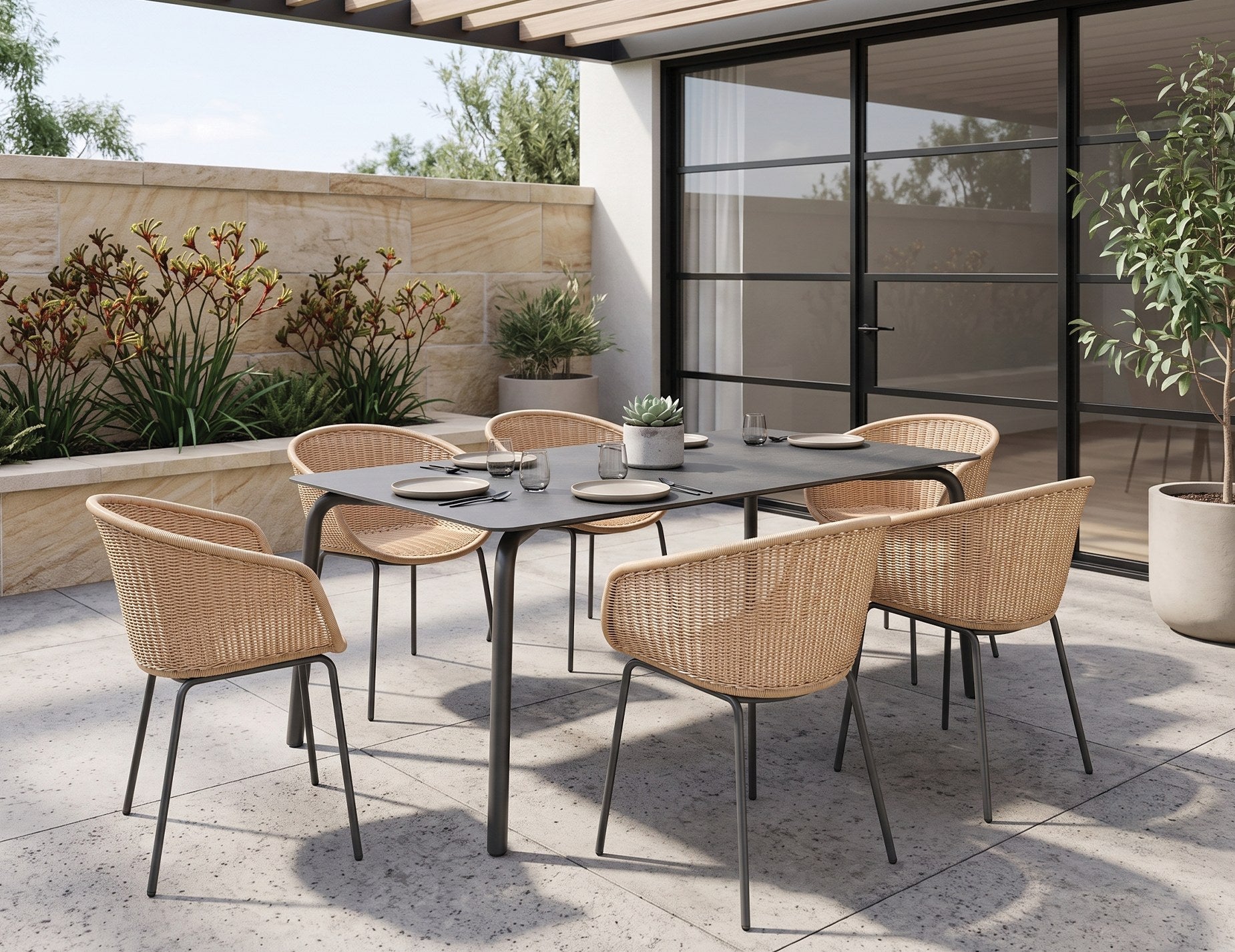
The corrosivity zone decides the specification, and on an Australian site it can change inside a few hundred metres. AS 4312 puts everything within 200 metres of rough seas and surf beaches in category C5, where mild steel loses 80 to 200 micrometres a year and zinc 4.2 to 8.4. From 200 metres to 1 kilometre inland that falls to C4, and from 1 kilometre to 10 kilometres to C3. Grade 316 stainless is the published minimum within 5 kilometres of the surf. None of it sits in the standard commercial outdoor furniture is tested to. EN 581-2:2026, the seating part, says in its own scope that it does not include requirements for the resistance to ageing and degradation caused by light, temperature and moisture.
Which is the problem in one sentence. The certificate a supplier hands you for an outdoor chair describes how hard you can sit on it, not what two summers on a west facing podium will do to it. Everything that actually decides whether a terrace still looks specified in year five lives in other documents: a corrosivity standard, a coating standard, a timber durability standard, and a cleaning schedule nobody writes into the contract. This is a walk through all four, with the figures as their publishers state them, and the places where nothing is published named as such.
The furniture standard does not cover the weather
Outdoor seating and tables have their own European standard set, EN 581, and the mechanical parts were both reissued this year. The catalogue record for EN 581-3:2026 records CEN approval on 13 April 2026 and publication on 19 May 2026, superseding the 2017 edition. The revision added general safety requirements, changed the tests on glass tops, added a vertical impact test and a vertical durability test for cantilever and pedestal tables, and added separate definitions for tables for camping, domestic and contract use. A table for contract use is defined there as a table for outdoor use intended for non-private use in places with public access, which is the line a workplace terrace sits on.
| Part | Title | Edition seen | Stated exclusion |
|---|---|---|---|
| EN 581-1 | Outdoor furniture, seating and tables for camping, domestic and contract use, Part 1: General safety requirements | 2017 | Mechanical requirements are in Parts 2 and 3 |
| EN 581-2 | Mechanical safety requirements and test methods, Part 2: Seating for camping, domestic and contract use | 2026 | Resistance to ageing and degradation caused by light, temperature and moisture |
| EN 581-3 | Mechanical safety requirements and test methods, Part 3: Tables for camping, domestic and contract use | 2026 | Ageing and degradation; street furniture; electrical safety |
| CEN/TR 581-4 | Requirements and test methods for durability under the influence of climatic conditions | 2005 | A Technical Report, not a harmonised standard |
Two things follow. The first is that weathering was deliberately written out of the mechanical parts and pushed into a twenty year old Technical Report that almost nobody cites. The second is that the strength figures in Part 2 are based on use by persons weighing up to 110 kilograms, which is the same basis most indoor contract seating uses, so a pass tells you about load and not about exposure.
There is a related trap worth naming. A great deal of genuinely outdoor furniture is published as tested to EN 16139, the indoor non domestic seating standard, because that is the scheme the factory already runs. Pedrali Nolita, a range that begins with Mario Pedrali's first metal garden chairs in 1963, publishes testing to EN 16139:2013 at level L2. That is a real certificate against a real standard, and the chairs are genuinely built for weather, but as hospitality furniture in a workplace set out, outdoor seating is excluded from the scope of EN 16139 and that standard carries no requirements for resistance to ageing or degradation either. Read the construction, not the logo.

Start with the corrosivity zone, not the chair
AS 4312 divides Australia into atmospheric corrosivity zones, and NATSPEC's TECHnote on atmospheric corrosivity categories records that the categories used across NATSPEC align with AS 4312 and ISO 9223. The categories are based on measured first year corrosion rates in micrometres per year, which is what makes them useful on a schedule: they are a number, not an adjective.
| Category | Mild steel | Zinc | Where it applies in Australia |
|---|---|---|---|
| C1 Very low | Under 1.3 | Under 0.1 | Inside heated or air conditioned buildings with clean atmospheres |
| C2 Low | 1.3 to 25 | 0.1 to 0.7 | Most areas of Australia at least 50 km from the coast |
| C3 Medium | 25 to 50 | 0.7 to 2.1 | 1 km to 10 km inland of breaking surf; 50 m to 1 km inland around sheltered bays |
| C4 High | 50 to 80 | 2.1 to 4.2 | 200 m to 1 km inland of surf; shoreline to 50 m around sheltered bays and harbour foreshores |
| C5 Very high | 80 to 200 | 4.2 to 8.4 | Within 200 m of rough seas and surf beaches |
| CX Extreme | 200 to 700 | 8.4 to 25 | Surf beach shoreline regions with very high salt deposition |
Three readings of that table change decisions. The first is the gradient. A podium 150 metres back from a surf beach and the same building's street level courtyard 400 metres further in are two different specifications, and the distance between them is a four minute walk. The second is that prevailing wind moves the boundary: the GAA notes that C5 may be extended inland by prevailing winds and local conditions, and that in some areas of Newcastle C5 applies more than 500 metres from the coast, while C3 can reach 50 kilometres inland along ocean front areas. The third is that a sheltered bay is not the open coast. Around a harbour foreshore the aggressive band is narrow, from the shoreline to about 50 metres, which is why a Darling Harbour terrace and a Bondi one are not the same brief even though both are on the water.
Specifier's shortcut: write the category into the furniture schedule next to the location, the way a structural schedule carries an exposure classification. It converts an argument about brands into a question about substrates.
Powder coating is a specification, not a colour
Almost every commercial outdoor frame arrives powder coated, and almost every schedule records the finish as a colour name. The standards exist and they are short enough to quote. Dulux Powder Coatings publishes that for aluminium substrates, Australian Standard AS 3715, Metal Finishing, Thermoset Powder Coating for architectural applications, is recommended and most commonly referred to in Australia, and that for general metals including steel and galvanising the relevant standard is AS 4506, Metal Finishing, Thermoset powder coatings. Two substrates, two standards, and a schedule that names neither is not a specification.

The useful part, for a terrace, is that coating suitability is published by distance from the high tide line rather than by colour. Dulux's Alumi Shield warranty page sets out that its Electro, Charisma, Duratec, Armourspray and Protexture ranges are only suitable for environments more than 10 metres from the high tide line; that Duralloy and Precious are only suitable more than 100 metres from it; and that Fluoroset may be suitable in locations under 10 metres from the high tide line, such as harbours, on advice. It also records that Duralloy and Precious are not suitable nor warranted in C4 environments, giving an internal swimming pool as the example. That is the same C4 as the table above, which is the point: the coating maker and the corrosivity standard are speaking the same language, and the furniture schedule is usually the only document in the set that is not.
What the warranty actually promises is worth reading too, because it is narrower than it sounds. The durability warranty covers the coating not peeling, cracking or flaking. The colour warranty is expressed as a delta E Hunter laboratory reading of less than five units from the original colour, assessed in accordance with ASTM D2244, with chalking not exceeding a rating of 2 for whites and pastels and 3 for deep colours under AS 1580.481.1.11. Five delta E units is a visible difference on a large surface. A warranty against fade is not a promise that nothing fades.
Underneath the coating, the substrate preparation is where outdoor furniture is won or lost. Pedrali publishes that every Nolita frame is electro galvanised before powder coating, so a chip in the paint does not start rust, and Geneva's Tulum armchair uses the same logic, a powder coated galvanised steel leg frame under a woven polyethylene shell. Where the frame is aluminium rather than steel the question changes shape: Roku high bar tables and the matching Roku bar stools are powder coated aluminium, so a coating failure is a cosmetic and adhesion problem rather than the start of structural rust. Both are defensible. Neither is the same decision.
Specifier's note. The coating warranty you quote in the submission is conditional on a cleaning regime nobody has costed. Dulux publishes that as a general rule all powder coated surfaces should be cleaned every twelve months, more frequently in coastal or industrial regions, and that its warranties are valid only where the coating was applied by an accredited applicator and maintained within its care and maintenance guidelines. On a terrace that means the furniture belongs in the building's cleaning contract from handover, not in a maintenance manual that goes in a drawer. Write the wash frequency into the schedule next to the finish, name who does it, and the warranty survives the first strata handover.
Stainless, and the tea stain nobody budgeted for
Stainless fixings, feet and fasteners are where outdoor furniture quietly fails, and the Australian Stainless Steel Development Association publishes the clearest numbers on it. Its technical FAQ on preventing coastal corrosion and tea staining states that grade 316, or a grade with equivalent corrosion resistance, should be selected as a minimum within five kilometres of the surf, and notes that grade 304 has occasionally been used successfully in these environments but is not recommended.
Tea staining itself is the brown surface discolouration that appears on coastal stainless. ASSDA defines it as discolouration of the surface of stainless steel by corrosion and is explicit that it is a cosmetic issue that does not affect the structural integrity or the lifetime of the material. That matters on a terrace, because the complaint arrives looking like a defect and the honest answer is that the furniture is fine and the finish is doing what the location does to it. The distances ASSDA publishes are that tea staining is most likely up to five kilometres from a surf beach and one kilometre from still marine waters, becoming progressively worse closer to the marine source, and that wind exposure, pollution levels, local sheltering and higher temperatures can create environments where it occurs twenty kilometres or more from the surf.
Two design consequences. First, sheltered is worse than exposed: ASSDA notes that areas not washed by rain are particularly susceptible, which on furniture means the underside of a seat, the inside of a tubular leg and the shadow of a tabletop, not the top surface everybody inspects. Second, crevices are worse than surfaces. ASSDA notes that designs with corners or crevices such as intermittent welds can trap water and lead to more serious corrosion than tea staining. For selection, ASSDA offers a pitting resistance equivalent guide: a PRE of approximately 18 is adequate away from marine influences, approximately 24 for marine atmospheres, and approximately 34 for severe marine atmospheres.
Timber: a durability class is about rot, not about looks
Timber appears on outdoor furniture as a tabletop, an armrest or a slat, and the Australian rating system that applies to it is AS 5604. WoodSolutions publishes the four classes with expected service lives, and the figures assume good detailing and maintenance.
| Class | Above ground | In ground | Example species |
|---|---|---|---|
| Class 1, very durable | More than 40 years | More than 25 years | Spotted gum, ironbark, tallowwood, merbau |
| Class 2, durable | 15 to 40 years | 15 to 25 years | Blackbutt, jarrah, silvertop ash |
| Class 3, moderately durable | 7 to 15 years | 5 to 15 years | Victorian ash, Tasmanian oak |
| Class 4, non durable | 0 to 7 years | Under 5 years | Radiata pine, slash pine, hoop pine |
Three qualifications decide how useful that table is on furniture. The rating applies only to heartwood, and WoodSolutions states that sapwood is regarded as non durable regardless of species and must be preservative treated if it is to be used in exposed conditions, so a Class 1 species cut badly is not a Class 1 component. The rating is about decay, not appearance: natural durability does not protect against weathering such as surface checking and greying, and finishes and detailing are still required. And the class is not a termite rating, which sits under the AS 1604 hazard classes instead.
Specification in practice: a Roku high bar table is published with a choice of slatted aluminium, teak, spotted gum or compact laminate tops in the same frame, which is a neat test of the argument. Spotted gum is Class 1 in the Australian scheme. Teak is not listed in the WoodSolutions tables at all, so the Australian class for it is simply not published, and the case for it rests on the supplier's own data and its certification. Pedrali's Fibra outdoor coffee tables are published on solid teak legs certified FSC C114358, which answers the provenance question even where it does not answer the durability class one. What a chain of custody claim does and does not prove is set out in timber chain of custody on a furniture package.
Will it still be on the terrace tomorrow?
The question nobody asks at selection and everybody asks after the first southerly. There is no Australian furniture standard that sets a minimum mass for a chair on a podium, and no published rule for restraining loose furniture on a private terrace was found for this article. What does exist is the public domain equivalent, and it is instructive. The City of Sydney's outdoor dining guidelines, published 1 October 2026, cover the footway and the roadway rather than a rooftop, and they resolve the problem by removal rather than by weight: furniture should not have permanent fixings and should be removed and stored safely outside outdoor trading hours, and seating and tables are to be readily removed and stored within the associated premises when not in use, and strong, durable, weather resistant and designed for commercial outdoor use. In the Martin Place and George Street special areas the wording goes further, requiring tables and chairs that are hardy and sturdy to resist wind gusts and stackable or foldable for ease of storage. Umbrellas get the only explicit wind clause: they should be properly secured in place to prevent blowing over in strong winds, with in ground sleeves encouraged, and a clearance of 2 metres from the ground.
Translate that to a private terrace and the specification question becomes storage and mass, in that order. Stackability is not an aesthetic preference, it is the mechanism by which the furniture gets off the deck before the weather arrives, and the pieces that stack are the ones that will actually be moved. Published weights from Geneva's own outdoor range make the spread obvious.
| Piece | Weight | Stacks | Construction |
|---|---|---|---|
| Roku low stool and footrest | About 2.6 kg | Yes | Powder coated aluminium, nylon slides |
| Roku backless bar stool | About 3.2 kg | Yes | Powder coated aluminium, nylon slides |
| Roku bar stool | About 4.2 kg | Yes | Powder coated aluminium, 750 mm seat height |
| Element bar stool | 5 kg | Yes | UV stabilised polypropylene, integrated footrest |
| Tulum rattan armchair | 5.5 kg | No | Woven PE rattan on powder coated galvanised steel, rated to 110 kg |
| Kora side table | 12 kg | No | Aluminium with a ceramic weight inside the cone base |
| Amalfi sun lounge | 24.4 kg | No | Aluminium frame, coated polyester mesh sling, teak and aluminium wheels |

A 2.6 kilogram stool and a 24.4 kilogram lounger are two different operational briefs on the same terrace. The light stackables want a store, and the store wants to be on the same level as the terrace with a door wide enough for a stack, which is a question for the architect and not for the furniture schedule. The heavy pieces stay out, which means they need the corrosivity answer to be right, because nobody is bringing them in. The middle, the 5 to 12 kilogram pieces that neither stack nor stay reliably, is where terraces generate incidents. A weighted base is the quiet fix: Kora carries a ceramic weight inside the base to bring a small side table to 12 kilograms, which is the difference between a table that travels and one that does not.
One more coordination item that is routinely missed. A terrace falls to drain, and a pedestal table with a fixed base on a 1 in 100 fall rocks unless the glides adjust. Roku tables are published on adjustable nylon glides for that reason; many lighter cafe tables are not. Check the glide before the finish.
What to put on the schedule
Six lines, and a terrace specification stops being a shopping list. The corrosivity category for the location, taken from AS 4312 rather than from the postcode. The substrate, naming whether a steel frame is galvanised before coating. The coating standard, AS 3715 for aluminium or AS 4506 for steel and galvanising, with the range and its published distance from the high tide line. The stainless grade for fixings and feet, 316 as a minimum within five kilometres of the surf. The timber class under AS 5604 where timber appears, with a note that heartwood is what is being rated. And the cleaning frequency, with an owner.
Everything else, the comparison of one woven shell against another, is selection rather than specification, and it is the easy part. The full range sits in Geneva's outdoor furniture collection, and the construction detail behind the Italian end of it is on the Pedrali brand page. For the indoor settings these terraces usually spill out from, hospitality furniture in a workplace covers what transfers and what does not, counter, bar and poseur stools covers the heights, and commercial furniture warranty covers what a warranty actually gives you on top of what the law already does.
Frequently asked
Can indoor contract furniture be used on a terrace?
Not on the strength of its indoor certification. EN 16139, the European standard most contract seating is tested to, excludes outdoor seating from its scope, and the outdoor standard that replaces it, EN 581-2:2026, states in its own scope that it does not include requirements for the resistance to ageing and degradation caused by light, temperature and moisture. Neither certificate says anything about weather. Specify the construction instead: the substrate, the coating system and the fixings.
Which corrosivity category applies to my site?
AS 4312 sets it by distance from salt water. The Galvanizers Association of Australia summarises the standard as C5 within 200 metres of rough seas and surf beaches, C4 from 200 metres to 1 kilometre inland of those same beaches, C3 from 1 kilometre to 10 kilometres inland, and C2 for most areas of Australia at least 50 kilometres from the coast. Sheltered bays are gentler: C4 runs from the shoreline to 50 metres inland and C3 from 50 metres to 1 kilometre. Prevailing winds can push a category further inland than the distance alone suggests.
Is grade 304 stainless good enough near the coast?
The Australian Stainless Steel Development Association publishes that grade 316, or a grade with equivalent corrosion resistance, should be selected as a minimum within five kilometres of the surf. It records that grade 304 has occasionally been used successfully in those environments but is not recommended. Tea staining, the brown surface discolouration that follows, is described as a cosmetic issue that does not affect the structural integrity or the lifetime of the material.
Does a timber durability class tell me how the furniture will look in five years?
No. A class under AS 5604 is a decay rating, not an appearance rating. WoodSolutions publishes Class 1 as more than 40 years above ground and Class 4 as nought to seven years, and states that natural durability does not protect against weathering such as surface checking and greying, so finishes and detailing are still required. The ratings also apply only to heartwood: sapwood is regarded as non-durable regardless of species.
How often does outdoor furniture need washing to keep a coating warranty valid?
Dulux Powder Coatings publishes that as a general rule all powder coated surfaces should be cleaned every twelve months, and that in areas where pollutants are more prevalent, especially in coastal or industrial regions, a cleaning program should be carried out on a more frequent basis. Its warranties are stated to be valid only when the coating is applied by an accredited applicator and maintained within the published care and maintenance guidelines.
If you are specifying a terrace, a podium or a courtyard and you want the corrosivity category, the coating range and the stainless grade settled before the schedule goes out rather than after the first summer, send us the location and the exposure and we will work through it with you.