

Counter, bar and poseur heights: matching the stool to the bench
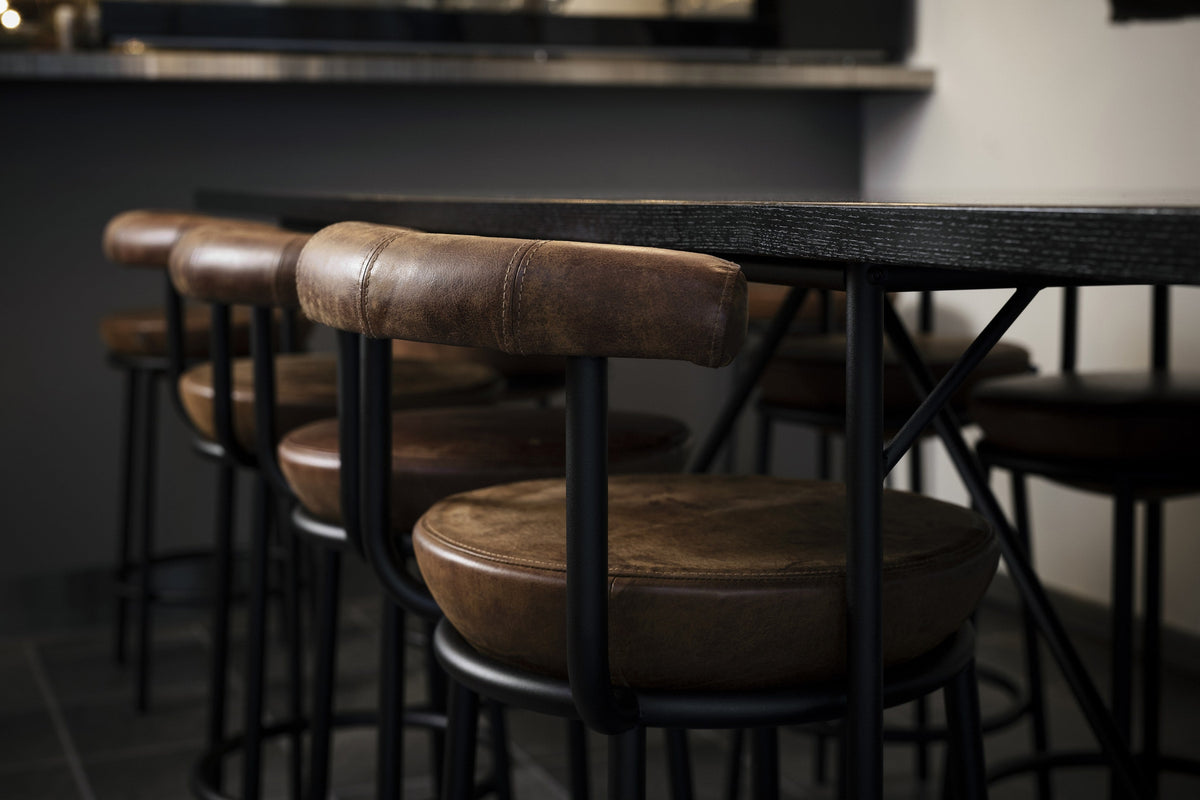
A stool works when its seat sits 250 to 300 mm below the surface it is pulled up to. In an Australian commercial fitout that means three pairings. A 740 mm table takes a chair at about 450 mm, not a stool. A 900 mm bench, the height most joinery islands and agile benches are built to, takes a counter stool at 600 to 650 mm. A 1050 mm poseur or bar takes a bar stool at 750 to 800 mm. Get the pairing wrong by 50 mm and the stool stops working: thighs press into the underside of the bench, or feet dangle and the sitter slides forward. Everything below is the detail behind those three numbers.
The three surface heights you will actually meet
Commercial table systems settle on the same small set of heights. Thinking Works publishes its Diva 1.1 table in 740 mm standard, 900 mm bench and 1050 mm standing. Geneva's own table bases follow the same logic, with a bar band of 900 to 1050 mm. Before anyone chooses a stool, the surface is almost always one of four numbers.
| Surface | Finished height | Seat height that suits it | Gap |
|---|---|---|---|
| Coffee or side table | 450 mm | Lounge seating, not a stool | n/a |
| Desk or dining table | 720 to 740 mm | 440 to 470 mm | 250 to 300 mm |
| Bench, island or agile bench | 900 mm | 600 to 650 mm | 250 to 300 mm |
| Taller bench or high counter | 950 mm | 650 to 700 mm | 250 to 300 mm |
| Poseur, bar or standing bench | 1050 mm | 750 to 800 mm | 250 to 300 mm |
| Highest workable counter | 1100 mm | 800 mm | 300 mm |
The gap is the only figure that travels. Under about 230 mm the sitter cannot get their legs under without turning side on. Over about 320 mm they are reaching up, the shoulders lift, and a long stint at a poseur table becomes tiring. Between those, a stool disappears and people simply sit.

Why the manufacturer's label is not enough
"Counter height" and "bar height" are not defined terms. They are marketing shorthand, and every factory draws the line in a slightly different place. Put the published figures side by side and the spread is wide enough to matter on a drawing.
| Stool | Counter seat height | Bar seat height | Footrest height |
|---|---|---|---|
| Pedrali Jazz (3706 / 3708) | 635 mm | 735 mm | 180 / 280 mm |
| TON Rioja | 640 mm | 800 mm | Not published |
| Offecct Bop Wood | 640 mm | Counter only | Not published |
| Pedrali Babila (2747 / 2758) | 645 mm | 745 mm | Not published |
| Thinking Works Okidoki Too | 650 mm | 760 mm | Not published |
| Pedrali Stiel (2967 / 2968) | 660 mm | 760 mm | 190 / 290 mm |
| Geneva Grayson | 660 mm | 750 mm | 230 / 330 mm |
| Geneva Andi Bar Stool | 660 mm | 750 mm | Not published |
| Infiniti Tondina | 673 mm | 773 mm | 250 / 330 mm |
| Pedrali Inga (5606 / 5607) | 670 mm | 770 mm | Not published |
| Jonas Ihreborn Pod | 680 mm | 760 mm | Not published |
Counter versions run from 635 to 680 mm, a 45 mm spread. Bar versions run from 735 to 800 mm, a 65 mm spread. That is the difference between a stool that tucks under a 900 mm bench and one that does not. A 680 mm stool against a 900 mm bench leaves a 220 mm gap and the sitter will end up angled outwards; the same stool against a 950 mm bench is right. Read the figure, not the word.
Where a manufacturer states the intended surface height, use it. The Grayson Bar Stool lists its 660 mm version as suiting bench heights of 900 to 950 mm and its 750 mm version as suiting 1000 to 1100 mm.

The footrest is the second floor
On a chair the floor takes the feet. On a stool the footrest does, and if it is in the wrong place the seat height stops mattering. Take the published figures and subtract:
- Pedrali Jazz: 635 mm seat with a 180 mm footrest, and 735 mm seat with a 280 mm footrest. A 455 mm drop at both heights.
- Pedrali Stiel: 660 mm seat with a 190 mm footrest, and 760 mm seat with a 290 mm footrest. A 470 mm drop at both heights.
- Infiniti Tondina: 673 mm seat with a 250 mm footrest, and 773 mm seat with a 330 mm footrest. A 423 and a 443 mm drop.
- Geneva Grayson: 660 mm seat with a 230 mm footrest, and 750 mm seat with a 330 mm footrest. A 430 and a 420 mm drop.
Every one of those lands between 420 and 470 mm below the seat, which is ordinary chair seat height. That is not a coincidence. The footrest recreates the floor at the height a seated body expects it. A bar stool without one, or with one at the wrong height, is a stool people perch on for five minutes and then stand up from.
This matters most when the footrest is not on the stool. Many fitouts run a foot rail along the joinery instead, which lets backless stools push fully under. That works, provided the rail lands 420 to 470 mm below the stool seat and the stools have no rail of their own to foul it. On a 1050 mm bar with 760 mm stools, the rail sits roughly 300 to 340 mm above finished floor. Put it on the joinery drawing, not the furniture schedule, or it will not get built.

Spacing along a bench
Height decides comfort, width decides how many you can schedule. Published overall widths across the stools above run from 320 mm for a backless timber stool such as the TON Rioja, through 430 to 480 mm for most upholstered counter stools, to 620 mm for a Jazz with arms.
The working rule is the widest published dimension plus 100 to 150 mm, measured centre to centre:
| Stool type | Overall width | Centres | Per 3000 mm bench run |
|---|---|---|---|
| Backless timber or ply stool | 320 to 360 mm | 450 to 500 mm | 6 |
| Upholstered stool with a low back | 430 to 480 mm | 550 to 600 mm | 5 |
| Larger stool with a full back | 500 to 565 mm | 650 to 700 mm | 4 |
| Stool with arms | 620 mm and over | 720 mm and over | 4 |
Swivel stools need a clear radius rather than a centre spacing, on the approach side as well as between neighbours. Where a bench backs onto a circulation route, the stool footprint plus the swivel is what eats into the corridor, not the bench.
The height a counter cannot be, if it also has to serve
There is no Australian Standard that tells you how high to build a bar. What is published is access guidance, and it sets a ceiling that a lot of poseur joinery quietly exceeds. The Design for Dignity guidelines, published by the Australian Network on Disability, put it plainly:
The highest section of a counter, including things placed on the counter, should be no more than 1100mm.
And on the accessible section itself:
AS 1428.2 suggests counters ideally have at least one place with a low height section (830mm to 870mm) knee and foot clearance of 800mm to 840mm and wide enough for a wheelchair (900mm).
The consequence for a furniture schedule is specific. A 1050 mm poseur bench is a good perch, but it cannot be the only place where someone is served, signed in or handed something. Even a 900 mm bench sits above the 830 to 870 mm band. Where the bench is a working counter, the drawing needs a lowered section, 900 mm clear wide, with 800 to 840 mm of clear knee and foot space and nothing in it: no apron, no plinth, no pedestal.
Specifier's note. The two things that undo a correct stool height on site are both in the joinery, not the furniture.
The first is the return detail. A 900 mm bench with a 100 mm apron, or a solid plinth carried to the floor, leaves nowhere for knees and toes. The stool cannot tuck, so it stands proud of the bench, the sitter turns side on, and the circulation you allowed for disappears. Check the section through the bench, not just the height on the elevation.
The second is gas lift. An adjustable stool quoted at 570 to 810 mm only reaches 810 mm at the top of its stroke, and a foot ring fixed to the base does not rise with the seat. The 420 to 470 mm drop from seat to footrest only holds at one point in that range. If the stool will live at the top of its travel against a 1050 mm bar, confirm the foot ring position there rather than at the height it ships at.
When a fixed stool will not do
Two situations defeat a fixed seat height: a sit-stand workstation, which changes height during the day, and a bench shared by people of very different heights, such as a lab, a workshop or a reception counter.
Both call for an adjustable or a perch stool. The HÅG Capisco 8105 is published at 570 to 810 mm with a 265 mm lift as standard, which covers a 900 mm bench and a 1050 mm poseur from one part number. The Humanscale Saddle and Pony Saddle cover 410 to 825 mm depending on the cylinder, with a high cylinder and foot ring option for counter and bar heights. The Pedrali Arki-Stool is published in two adjustable bands, 550 to 650 mm and 710 to 820 mm, so one family covers a bench and a bar without changing the language of the frame.
Saddle and perch seats sit higher relative to the work surface, because the sitter is partly supported on their feet. For short, active tasks that is an advantage. Where people sit for an hour, a stool with a back and a proper footrest gets used and a perch does not.

Putting it on the drawing
The schedule entry that survives contract review carries four figures, not one: seat height, overall width, footrest height, and the surface height it is paired with. "Counter stool" on a schedule is how a 680 mm stool arrives for a 900 mm bench, and by then the joinery is built.
Geneva's stools collection lists seat and footrest heights on every page, and the tables collection lists the surface heights they pair with. For the seated settings around them, the chairs collection covers the 440 to 470 mm band. Brand background sits on the Pedrali and HÅG pages, and our Mirvac 400 George Street project shows these settings built. More specification pieces are collected in the Journal.
Frequently asked
What seat height do I need for a 900 mm bench?
Aim for a seat height of 600 to 650 mm. Most stools labelled counter height are 635 to 680 mm, which puts the taller ones closer to a 950 mm bench than a 900 mm one, so check the published figure rather than the label.
What seat height suits a 1050 mm poseur or bar?
750 to 800 mm. That is the band most manufacturers call bar height, and it gives the 250 to 300 mm gap between seat and surface that lets someone sit square to the bench rather than angled away from it.
How far below the seat should a footrest sit?
Between 420 and 470 mm, which is ordinary chair seat height. Pedrali Jazz sets its footrest 455 mm below the seat in both heights, Pedrali Stiel 470 mm, Infiniti Tondina 423 mm at counter height, and Geneva Grayson 430 mm.
Is there an Australian Standard for bar and counter heights?
No standard sets how high to build a bar. The published guidance is about access: the Design for Dignity guidelines, citing AS 1428.2, state that the highest section of a counter, including things placed on it, should be no more than 1100 mm, and that at least one section should be 830 to 870 mm high with 800 to 840 mm of knee and foot clearance and 900 mm of clear width.
How far apart should stools sit along a bench?
Take the widest published dimension of the stool and add 100 to 150 mm. A 320 mm backless timber stool sits comfortably at 450 to 500 mm centres, a 450 mm stool with a back needs 550 to 600 mm, and a 620 mm stool with arms needs 720 mm or more.
Where Geneva can help
Send us the joinery sections and the bench heights and we will come back with stools that match them, with the seat, footrest and width figures already checked against the drawing: get in touch.