

Commercial furniture warranty: what it covers and what the law already gives you
Published warranty periods on commercial furniture run from one year to thirty, and none of those numbers is the one that decides a claim. What the Australian Consumer Law gives a business buyer, what the manufacturers publish, and the conditions that override both.
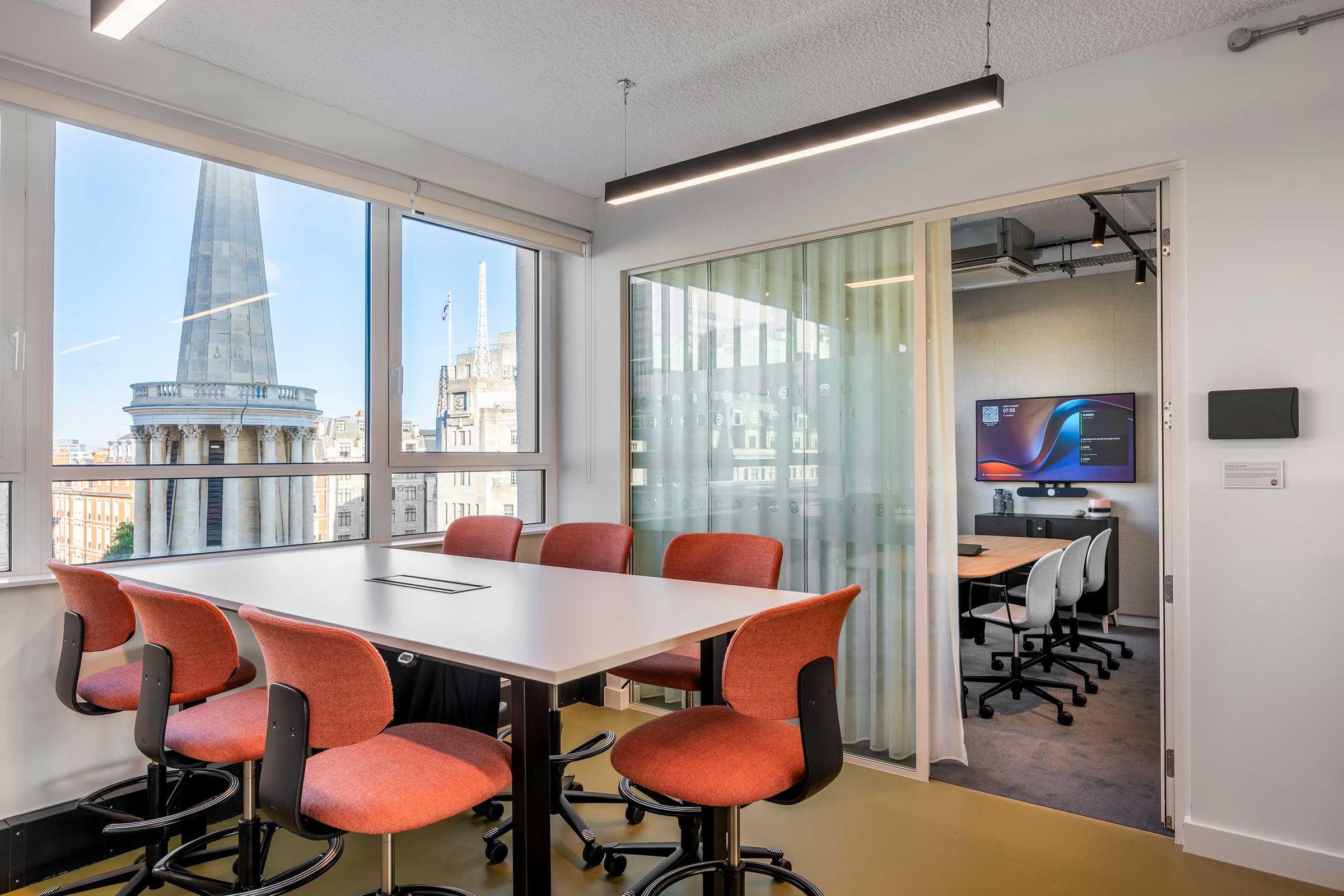
Published commercial furniture warranty periods in Australia run from one year to thirty, and one writing surface carries a lifetime warranty in North America. None of those numbers is the one that matters most. Under the Australian Consumer Law a product bought for business use carries consumer guarantees whenever it costs less than AUD 100,000 including GST, and those guarantees do not stop when a manufacturer's warranty expires. A five year warranty on a pod does not mean the pod is uncovered in year six. It means five years were promised on top of a statutory right whose length is set by what is reasonable for that product.
That distinction decides who pays, who turns up, and how long a schedule can be held to. It is also the part of a furniture package that almost never reaches a drawing. What follows is the published position: what the law gives a commercial buyer, what the manufacturers Geneva represents publish, and the conditions in those documents that decide whether a claim is paid.
Two different things get called a warranty, and only one of them is yours by law
A consumer guarantee is statutory. It attaches automatically to the supply, cannot be contracted out of, and needs no certificate to exist. A warranty against defects is a promise the manufacturer or supplier chooses to make. The Australian Competition and Consumer Commission puts it plainly in its guidance for business on warranties: warranties "are voluntary and are additional to consumer guarantees", and they "can't replace, change or take away a consumer's basic rights".
So a warranty is best read as a service-level commitment rather than the limit of your rights. It says how long the manufacturer will deal with a defect without argument, which parts it covers. It does not say how long the product has to last.
| Consumer guarantee | Warranty against defects | |
|---|---|---|
| Source | Australian Consumer Law, Schedule 2 to the Competition and Consumer Act 2010 | The manufacturer's or supplier's own document |
| How you get it | Automatically on supply, no paperwork | Only if it is offered, and often only if it is activated |
| How long it lasts | No fixed period. The ACCC states the duration "will depend on a range of factors, including the nature of the goods and how much they cost" | The period stated in the document, counted from a stated date |
| Can it be excluded | No | It is voluntary, so its terms are whatever the manufacturer writes |
| Remedy for a major failure | The buyer chooses a refund or a replacement of the same type of product | Usually the manufacturer chooses between repair and replacement |
| Remedy for a minor failure | The business must fix the problem or repair the product free of charge | Typically a part supplied free, with labour and freight often excluded |
Section 54 of the Australian Consumer Law sets the central test. Goods supplied in trade or commerce have to be of acceptable quality: safe, durable, free from defects, acceptable in appearance and finish, and fit for all the purposes goods of that kind are commonly supplied for. Durability is in the statutory words. A chair that fails in its third year of ordinary office use has arguably failed the guarantee whether or not a warranty period has run out, and the assessment takes account of the nature of the goods, the price paid and what was said about them.
Does the Australian Consumer Law reach furniture a business buys?
This is the question most often answered wrongly, usually by someone saying consumer law is for consumers. The test in section 3 of the Australian Consumer Law is about the transaction, not the buyer. The ACCC's guidance on consumer rights and guarantees states that a product or service bought for business use is covered by consumer guarantees when it meets at least one of the following conditions: it costs less than AUD 100,000 including GST, it is of a kind commonly bought for personal, domestic or household use, or it is a vehicle or trailer used mainly to transport goods on public roads.
Those limbs are alternatives. A line under AUD 100,000 including GST qualifies on price alone, whatever it is and whoever bought it. The threshold was AUD 40,000 before 1 July 2021, so an older rule of thumb now understates the coverage.
How the threshold lands on a real furniture package
Most furniture lines sit under AUD 100,000 individually even where the package does not. A task chair, a workstation, a pod, a board, a monitor arm: each is comfortably inside the price limb. Chairs, desks, tables and storage are also goods of a kind commonly bought for household use, which brings them in under the second limb whatever they cost. What may fall outside both is the large bespoke item with no domestic equivalent and a value above the threshold.
The exclusion that catches contractors, not clients
The guarantees do not apply to goods bought for re-supply, or for use or transformation in production or manufacturing. That matters to whoever is doing the buying. A tenant purchasing furniture for its own floor is not re-supplying anything. A fitout contractor buying the same furniture to on-sell to the client in a lump sum is, on the face of it, acquiring for re-supply, so the guarantees may sit with the end client rather than with the contractor. Where the contractor has given its own defects liability undertaking, that asymmetry is worth understanding before the first claim rather than during it.

What the published warranties actually say
The spread is wide, and the differences are less about confidence in the product than about how each manufacturer defines normal use. Everything below is published by the manufacturer. Where a product is not named in a manufacturer's own warranty schedule, it is not listed.
| Range or product group | Published period | Published condition |
|---|---|---|
| HÅG chairs, normal use | 10 years | Use up to 9 hours a day |
| HÅG chairs, extended use | 5 years | Normal use of more than 9 hours a day |
| HÅG chairs bought for 24 hour use | 5 years | Approved fabrics only |
| RH chairs, normal use | 10 years | Up to 9 hours a day |
| RH chairs approved for control room 24/7 use | 5 years | Upholstery excluded unless approved |
| RBM chairs and tables | 5 years | Normal use up to 9 hours a day |
| Flokk spare parts availability | Minimum 10 years | Counted from the chair's production date, not the delivery date |
| Humanscale seating and products listed in a current Humanscale Price Guide | 15 years | Published as a 24/7 warranty |
| Humanscale fabric, cushions, arm pads and wood | 5 years | Published as a single shift warranty |
| Humanscale monitor arms | 15 years for M2, M2.1, M8.1, M/Flex and Para/Flex; 10 years for M4, M7, M8 and M10 | Published as a 24/7 warranty |
| Humanscale customer's own material (COM, COL) | No warranty | Fabric specified by the customer is excluded outright |
| Framery pods | 5 years | From delivery, against defects in material and workmanship |
| Framery wear parts and electronic components | 2 years | Gas lifts, levelling gliders, fabrics, felt, carpet, door, door seals, hinges, locks, LED lights, fans, chargers, screens, motion sensors and motor driven height adjustment |
| Framery Connect sensors | 1 year | A separate limited warranty period |
| Lintex, 2024 catalogue | 30 years on the writing surface, 5 years against defects in manufacture | Reckoned from delivery day, assuming room temperature premises and no abnormal wear |
| Zgonic standard warranty | 10 years | From the date of delivery |
Nine hours a day is the line almost nobody checks
Read the first six rows together and the most consequential number in the table is not a warranty period at all. It is nine hours. Flokk publishes its ten year warranty on HÅG, RH and RBM seating for chairs in normal use up to nine hours a day, and drops to five years once use exceeds that. The same five year period applies to chairs specifically bought for 24 hour use, and for RH control room seating the upholstery is excluded unless it has been approved.
Humanscale takes the opposite approach on the same question. Its warranty schedule designates seating and the products listed in a current Humanscale Price Guide as a fifteen year, 24/7 warranty, while the soft components on those same chairs, the fabric, cushions, arm pads and wood, are published at five years and designated single shift. The structure is covered around the clock and the surfaces are not.
For most office floors nine hours is academic. For a control room, a 24 hour operations desk, a ward station or a shift-based contact centre it is the whole question, and it halves the published coverage on one of these brands while leaving the other intact. If a project has round-the-clock settings in it, the seating warranty is a selection criterion and not a footnote. The HÅG SoFi task chair from the Flokk range and the Humanscale Freedom task chair sit either side of that line, and the published terms behind them are not comparable just because both are described as long.

The conditions that decide whether a claim is paid
A warranty period is the headline. The conditions are the document. Across the manufacturers above they repeat, and every one is something somebody on site has to do, or not do, years before a defect appears.
| Condition | Published by | Effect on a claim |
|---|---|---|
| Activation by installation report | Framery | The purchaser has to complete the installation report form for the warranty to run |
| Installation by a trained installer | Framery | Installation by a Framery trained installer is a condition of the warranty |
| Reporting window | Framery | A defect has to be reported within twenty one days after it is discovered |
| Hours of use per day | Flokk, Humanscale | Moves the period, or moves which components are covered |
| Approved fabric only | Flokk | 24 hour and control room cover applies to approved fabrics; others are excluded |
| Customer's own material | Humanscale | Fabric specified by the customer carries no warranty at all |
| Labour and transport | Flokk | Labour and transport costs are excluded, alongside normal wear and tear |
| Carrier and transit damage, and software | Humanscale, Framery | Damage in transportation is excluded, and all Framery software is supplied without warranty of any kind |
| Unauthorised service, moving or dismantling | Humanscale, Framery | Service, modification or repair by anyone else voids cover on the part, as does moving or dismantling against the manufacturer's instructions |
| Storage and environment | Lintex | The guarantee assumes room temperature premises directly after delivery and no abnormal wear |
Two of those are routinely lost in the gap between trades. The first is activation: a Framery One pod delivered to site, installed by whoever had the hoist that day and never signed off on an installation report may have no running warranty at all, and nobody finds out until a fan fails. The second is the reporting window. Twenty one days after discovery is a short clock for a facilities team that logs a fault, waits for a maintenance round and raises it at the next monthly meeting.
The third is an economic fact rather than a condition. Where labour and transport are excluded, a free part on a tenth floor is not a free repair, and across a decade and two hundred chairs the attendance cost can exceed the value of the parts. Hence the useful tender question: not how many years, but who attends and at whose cost.
Specifier's note. The clause that matters most on a large package is not in the warranty document at all, because it is not a warranty term. Where a product has a major failure the buyer, not the supplier, chooses between a refund and a replacement of the same type of product. And on returning the goods, the ACCC's consumer guarantees guide states that it is the buyer's responsibility to return them "unless the cost of doing so is significant, in which case the seller must collect the goods at their own expense and within a reasonable time". A floor of task chairs or a 400 kg pod is the textbook case of significant cost. Put the collection obligation in the purchase documents in those words and the argument is over before it starts.

Parts and repair, the guarantee nobody reads
Section 58 of the Australian Consumer Law carries a separate guarantee that has nothing to do with defects. A manufacturer has to take reasonable steps to ensure that repairs and spare parts are available for a reasonable period after supply. The ACCC's consumer guarantees guide states that how long depends on the type of product, and that the guarantee does not apply if the buyer is advised at the time of purchase that repair facilities and spare parts will not be available after a specified time.
Read that last clause twice. The guarantee can be displaced, but only by a disclosure made at the time of purchase, so a line in a catalogue issued afterwards does not do it. For a specifier it becomes one question: what is the published parts horizon, and is it in writing before the order?
Flokk answers it directly and in a way almost no other manufacturer does, guaranteeing delivery of spare parts for a minimum of ten years after the chair's production date. Note the datum. Production date, not delivery and not commissioning. A chair built in one year and installed two years later has eight years of the published parts commitment left on the day the floor opens, so on a staged fitout the later stages can inherit a shorter parts horizon than the earlier ones.
Parts availability is where warranty and whole-of-life claims meet. A product sold on repairability needs parts behind it, and the evidence is a published commitment with a datum, not a brochure line. The rest of that evidence test is in which sustainability claims hold up on a schedule, and the repairable-chair argument in how a Humanscale chair adjusts itself and who it does not suit.
What a compliant warranty document has to contain
If a supplier hands over a warranty against defects in Australia, regulation 90 of the Competition and Consumer Regulations 2010 sets what the document must contain. The current mandatory wording has applied since 9 June 2019. The ACCC publishes the required text for goods as follows.
Our goods come with guarantees that cannot be excluded under the Australian Consumer Law. You are entitled to a replacement or refund for a major failure and compensation for any other reasonably foreseeable loss or damage. You are also entitled to have the goods repaired or replaced if the goods fail to be of acceptable quality and the failure does not amount to a major failure.
Alongside that text, the ACCC lists the information such a document has to include.
| Required content | What to do with it |
|---|---|
| Business name, address, email and phone number | Identifies the entity actually bound. An overseas parent does not attend site |
| What the consumer must do to claim, and how | Where activation forms, installation reports and reporting windows live. Hand it to the facilities team at handover, not to the project manager who leaves |
| What the business will do on a claim | Repair, replace or supply a part. Tells you whether labour is in or out |
| How long the warranty lasts | Only meaningful with its datum: delivery, dispatch, production or installation |
| Who bears the expense, and how to be reimbursed | The freight and attendance question, answered in writing |
| The mandatory text above, and a statement that the benefits are in addition to other rights and remedies under the law | The absence of either is a signal the document was not written for this market |
That last pair is a free diagnostic. A warranty certificate for an imported product carrying neither the mandatory wording nor the in-addition statement has almost certainly been written against another jurisdiction's law, which tells you something about who will handle a claim and on what terms. The warranty terms Zgonic issues for its monitor arm systems, including the ZG1DS single arm, are the counter-example: a ten year standard period from the date of delivery, a fallback of three business days after dispatch where there is no proof of delivery, a proof of purchase requirement, and the Australian Consumer Law statement present rather than missing.

Where a manufacturer's own numbers disagree
The honest finding from pulling these documents together is that one manufacturer can publish different periods in different territories, and the version that governs is the one issued for the market of supply. Lintex is the clearest case. Its 2024 product catalogue publishes a thirty year warranty on the writing surface and a five year guarantee against defects in manufacture, reckoned from delivery day. Its North American warranty page publishes a twenty year warranty on all Lintex whiteboards and a lifetime warranty on porcelain enamel steel writing surfaces.
Thirty, twenty and lifetime are three answers to one question, all published by the manufacturer. None is wrong; they are scoped to different markets and, in the catalogue's case, to the surface rather than the whole board. Cite the document, the edition and the territory rather than the number, because a schedule reading "30 year surface warranty" and nothing else is unenforceable in both directions. The depth and surface figures behind those boards are in what belongs on a whiteboard specification, and the Lintex Boarder is the range the catalogue figure attaches to.
What to put in the specification
Warranty is one of the few parts of a furniture package specified in words rather than dimensions, which is exactly why it is usually specified badly. Five requests cover almost everything above.
| Request | What a complete answer looks like |
|---|---|
| The warranty document for the market of supply, current edition | Dated, naming the Australian supplying entity, carrying the mandatory wording and the in-addition statement |
| The period for each component group, not the headline | Structure, mechanism, electrical and electronic parts, upholstery, wear parts and software listed separately |
| The datum each period runs from | Delivery, dispatch, installation or production date, stated per period |
| The use assumption | Hours per day, shift pattern and any approved-fabric condition, checked against the settings on the plan |
| Attendance, labour, freight and parts horizon | Who attends, at whose cost, within what response window, and for how long parts are guaranteed and from which datum |
A schedule carrying those five answers does something a warranty period alone cannot: it describes the product's fourth year rather than its first week. Where furniture is bought through a panel or a standing offer, the same five requests belong in the order rather than the panel terms, for the reasons set out in what a government furniture panel does not settle.
One caution. None of this is legal advice. The statutory position above is summarised from the ACCC's own published guidance so a specifier can ask better questions, and a claim worth arguing is worth a lawyer.
Frequently asked
Does the Australian Consumer Law cover office furniture bought by a business?
Yes, in almost every normal case. The ACCC states that a product bought for business use is covered by consumer guarantees when it costs less than AUD 100,000 including GST, or is of a kind commonly bought for personal, domestic or household use, or is a vehicle or trailer used mainly to transport goods on public roads. Those are alternatives, so a furniture line under AUD 100,000 including GST qualifies on price alone, and chairs, desks, tables and storage also qualify as household goods whatever they cost. The threshold was AUD 40,000 before 1 July 2021. The guarantees do not apply to goods bought for re-supply, which is the limb a fitout contractor on-selling furniture to its client has to consider.
What happens to my rights when the manufacturer's warranty runs out?
The warranty ends and the consumer guarantees continue. A warranty against defects is voluntary and additional, and the ACCC states that warranties cannot replace, change or take away a buyer's basic rights. The statutory guarantee of acceptable quality under section 54 includes durability, and the ACCC states that how long it lasts will depend on a range of factors including the nature of the goods and how much they cost. So a five year warranty is a promise about five years, not a statement that the product only had to last five years.
What is the standard warranty on commercial office furniture in Australia?
There is no standard, and the published spread across the ranges Geneva specifies is one year to thirty. Flokk publishes ten years on HÅG and RH seating in normal use up to nine hours a day and five years above that, and five years on RBM. Humanscale publishes fifteen years on seating and the products listed in a current Humanscale Price Guide, with fabric, cushions, arm pads and wood at five years. Framery publishes five years on its pods, two years on wear parts and electronic components and one year on Framery Connect sensors. Lintex publishes thirty years on the writing surface and five years against defects in manufacture in its 2024 catalogue. Comparing headline numbers without the component breakdown behind them is how the wrong product gets selected.
Does a warranty cover the labour to replace a part on site?
Often not, and it is published. Flokk's warranty excludes labour and transport costs alongside normal wear and tear. Humanscale excludes damage caused by a carrier or in transportation, and excludes service, maintenance or modification by anyone other than a Humanscale authorised representative. On a large package the attendance cost over a decade can exceed the value of the parts replaced, so the useful tender question is who attends, at whose cost and within what response window, rather than how many years the certificate says.
How long does a manufacturer have to supply spare parts?
Section 58 of the Australian Consumer Law requires a manufacturer to take reasonable steps to ensure repairs and spare parts are available for a reasonable period, and the ACCC states that the period depends on the type of product. The guarantee does not apply if the buyer is told at the time of purchase that repair facilities and spare parts will not be available after a specified time, so the disclosure has to come before the order. Few manufacturers publish a figure. Flokk does, guaranteeing delivery of spare parts for a minimum of ten years after the chair's production date, so on a staged fitout the later stages can inherit a shorter parts horizon than the earlier ones.
Geneva reads these documents for a living, because the brands it represents publish them in four different shapes and the differences land on the project rather than on the brochure. If a floor has round-the-clock settings, a staged handover, customer's own fabric or a facilities team that will still be maintaining the furniture in a decade, tell us what the settings are and we will put the published warranty terms for each candidate product side by side, including the conditions that would change them.