

Which Geneva desking system: Envy, Orbit, Totem and Motion compared
Five systems, one planning grid. What Geneva publishes for Envy, Orbit, Totem, Motion and Motion FX, what it does not, and which numbers decide the schedule.
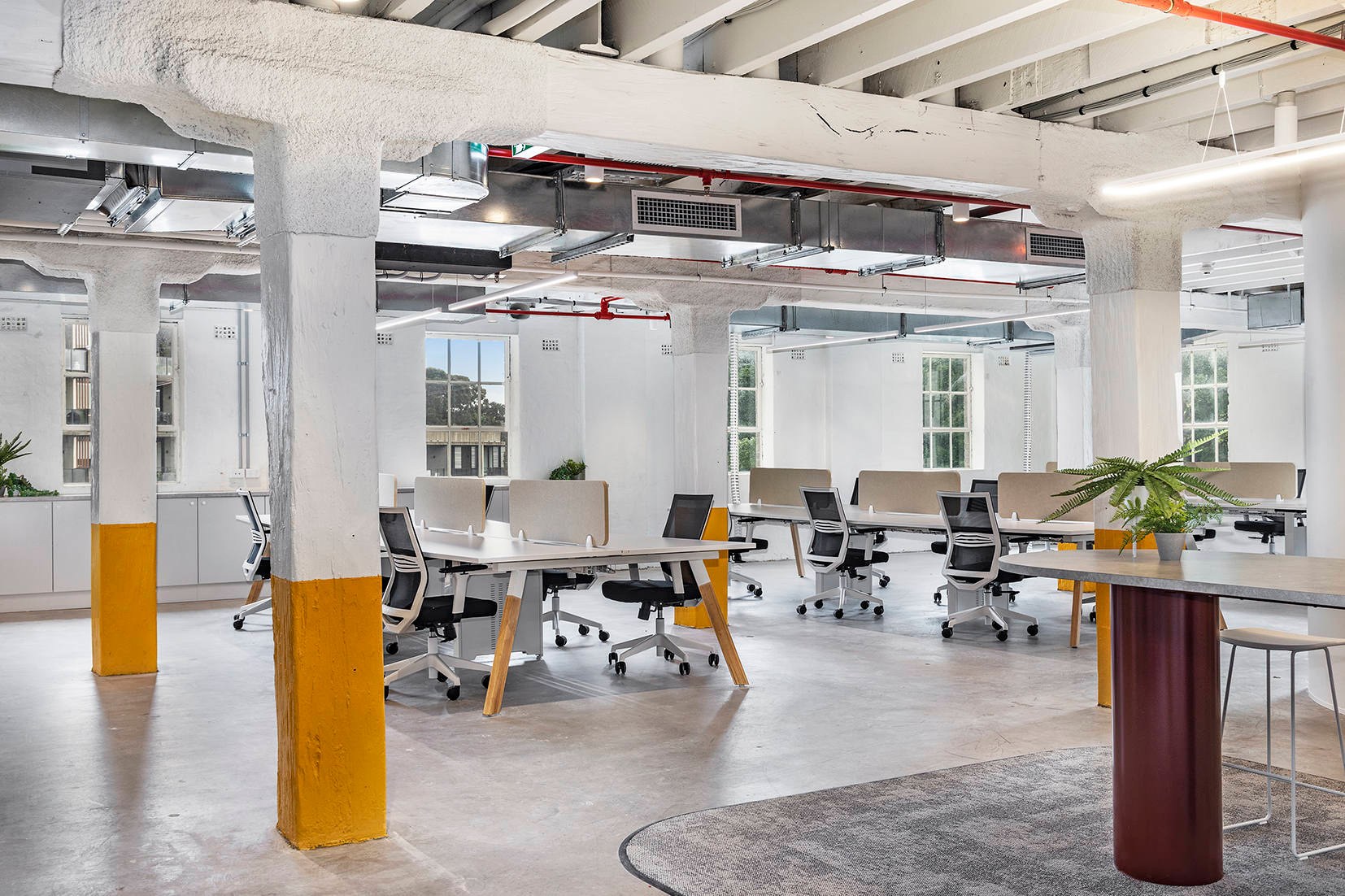
Geneva by Design's own desking is five systems built on one grid. Envy, Orbit, Totem and Motion FX are fixed height. Motion is electric, travelling 670 to 1300 mm on twin motors. All five publish the same bays, 1200, 1500, 1800 or 2100 mm wide by 750 mm deep, the same four way corner and three way 120 degree layouts, and the same 25 mm E0 board top. What separates them is the leg: a 70 by 40 mm angled leg on Envy, a 40 by 40 mm half moon on Orbit, a 138 mm round pole on Totem, and a 70 mm round leg on Motion and Motion FX. The layout does not change when the leg does.
That is the useful thing about this range, and it is not obvious from a catalogue. On most desking ranges the leg and the planning grid are bound together, so changing the look of a floor means redrawing it. Here the grid is held constant across four fixed height systems and one electric one, which means the leg is a finish decision taken late rather than a planning decision taken early. What follows is what Geneva publishes for each system, what it does not publish, and where the two meet on site.
One grid, five systems: what is actually shared
Envy, Orbit and Totem are published as workstation systems, which is to say banks. Envy Desk, Motion and Motion FX are published as desks, which is to say single positions, returns, corners and spines. The two halves of the range use the same numbers.
| Dimension | Published |
|---|---|
| Bay width | 1200, 1500, 1800 or 2100 mm |
| Bay depth | 750 mm |
| Double sided layouts | 2, 4, 6 or 8 way |
| Single sided layouts | 2 or 3 way |
| Four way corner | 1500 by 1500, 1800 by 1800 or 2100 by 1800 mm, 750 deep |
| Three way 120 degree | 1200 by 1200 or 1500 by 1500 mm, 750 deep |
| Top thickness | 25 mm |
| Modesty panel | 1200, 1500 or 1800 mm wide by 300 mm high |
Two things follow for a specifier. The first is that a floor drawn on 1500 by 750 mm bays can take any of the three workstation systems without the plan moving, so a value engineering exercise late in a project can change the leg without reissuing the furniture layout. The second is that the 120 degree bay is published at 1200 by 1200 or 1500 by 1500 mm only, which is a narrower set of options than the linear bays. A 120 degree cluster drawn at 1800 mm is not in the published range.
Depth is where the range is tighter than it first reads. Every workstation bay is 750 mm deep. The 600 mm deep tops appear only on the Envy Desk, at 1500 or 1200 mm wide, and on the fitted returns across the desk systems. If a brief calls for 600 mm deep benching, it is a desk specification in this range, not a workstation one.
The leg is the decision, and it ranges from 40 mm to 138 mm
Four legs, four quite different readings of the same bank. The 40 by 40 mm half moon on Orbit is the quietest, and the one that disappears in a photograph of a large floor. The 138 mm round pole on Totem is the loudest, and it is the only leg in the range that reads as a column rather than a leg. Envy's 70 by 40 mm angled leg sits between them and is the only one offered in timber as well as steel.
| System | Leg | Height | Frame or leg finishes | Warranty |
|---|---|---|---|---|
| Envy Workstation and Envy Desk | 70 by 40 mm angled, robot welded steel tube, or angled timber | Fixed, not published | Steel black or white; timber natural or black stained | 10 years |
| Orbit Workstation | 40 by 40 mm half moon, powder coated steel | Fixed, not published | Black or white | 10 years |
| Totem Workstation | 138 mm diameter round pole, 695 mm high | Fixed, 720 mm with the 25 mm top | Black, white or taupe | 10 years |
| Motion Desk | 70 mm round, three stage lifting columns | Electric, 670 to 1300 mm | Black, white or taupe | 10 years |
| Motion FX Desk | 70 mm round, powder coated steel | Fixed, not published | Black or white | 10 years |
Only Envy publishes a top edge option, straight or sharknose, which is worth noting on a schedule that mixes systems: a sharknose edge on one run and a straight edge on the next is visible from across a floor. Edge profiles and the tops they sit on are covered in more depth in laminate, veneer, linoleum and powdercoat compared.

Motion: what 670 to 1300 mm means on a drawing
The Motion Desk is the only electric system in Geneva's own desking range. Geneva publishes twin motors, three stage lifting columns, a 160 kg lift capacity, a travel speed of 30 mm per second and anti-collision protection. The handset stores one sitting height and one standing height and gives a sit and stand reminder. Available as a desk, a desk with cable duct, a corner desk or spine desking.
Read those figures together and the picture is a conventional commercial sit-stand frame rather than a light one. Three stage columns are what buy the range: 630 mm of travel out of a frame that still comes down to 670 mm. A two stage column of the same closed height would not reach 1300 mm. The 160 kg figure is a lift capacity, which is the load the motors will raise, and it is not the same thing as a static top load. Geneva publishes no separate static load for the Motion top, so a specification carrying heavy equipment should ask for one rather than reading 160 kg as a shelf rating.
For a sense of where 670 to 1300 mm sits against published guidance, a FIRA summary of the 2011 revision of EN 527-1, circulated by the UK dealer Task Systems, gives sit-stand desks a range of 650 mm to 1250 mm, and fixed height desks 740 mm plus or minus 20 mm. LINAK's published comparison of desk standards gives the same EN 527-1 Type A figure of 650 to 1250 mm. Motion starts 20 mm above the bottom of that band and finishes 50 mm above the top of it, so it covers the European sit-stand envelope with room at the standing end.
The Australian standard for office desks and tables, AS/NZS 4442:2018, is not published free to read, so no clause from it is quoted here. What the law in Australia actually requires of a desk, as opposed to what a standard recommends, is set out in WHS and the furniture schedule, which also covers whether a sit-stand desk is ever mandatory.

Which working height Geneva publishes, and which it does not
This is the gap worth knowing before the chairs are chosen. Of the four fixed height systems, only Totem publishes a leg height: 138 mm in diameter by 695 mm high. Add the published 25 mm top and the working surface lands at 720 mm. Envy, Orbit and Motion FX publish widths, depths and top thickness but no leg height and no working height.
720 mm is at the low end of the fixed height band in the FIRA summary above, which puts fixed desks at 740 mm plus or minus 20 mm, so 720 mm is inside it by exactly the tolerance. That is a defensible height for a commercial floor and it is lower than a lot of Australian stock, which matters because a lower top suits a shorter user and asks less of a footrest. It also means a chair selection made on the assumption of a 730 mm top will sit 10 mm high.
Specifier's note. Motion's travel starts at 670 mm, and the only fixed working height published in this range is Totem's 720 mm. Run a Motion spine against a fixed spine and the tops line up only when the Motion is driven about 50 mm above its bottom stop. Put the delivery height on the order rather than leaving it to the installer, or the first thing the client sees is a stepped run. The modesty panel deserves the same question: it is published at 300 mm high on Envy, Motion and Motion FX, and on a desk that travels you need to know whether it is fixed to the top or to the frame, because a run facing a walkway behaves very differently in the two cases.
Desks, returns, corners and spines: the sizes on offer
The desk systems publish a wider size schedule than the workstation systems, because they cover single offices and returns as well as open floors.
| Element | Envy Desk | Motion Desk | Motion FX Desk |
|---|---|---|---|
| Desk, 900 deep | 2400, 2100 or 1800 wide | 2400, 2100 or 1800 wide | 2400, 2100 or 1800 wide |
| Desk, 750 deep | 1800, 1500 or 1200 wide | 1800, 1500 or 1200 wide | 1800, 1500 or 1200 wide |
| Desk, 600 deep | 1500 or 1200 wide | Not published | Not published |
| Fitted return | 900 to 1800 wide by 600 deep | 900 to 1800 wide by 600 deep | 900 to 1800 wide by 600 deep |
| Corner desk | 2100 by 1800 or 1800 by 1800, 600 or 750 deep | 2100 by 1800 or 1800 by 1800, 750 deep | 2100 by 1800 or 1800 by 1800, 750 deep |
| Spine desking | 1800 to 2400 wide by 750 to 900 deep | 1800 to 2400 wide by 750 to 900 deep | 1800 to 2400 wide by 750 to 900 deep |
The 900 mm deep desk is the one to watch on a tight floor. A 1800 by 900 mm desk with a 600 mm deep return is a generous private office position, and it is a long way from the 1500 by 750 mm bay that the same range offers on an open floor. The published depths also decide the circulation behind them, which is where the accessible clearances matter: path widths and the clear spaces at a change of direction are set out in AS 1428 and the furniture schedule.
Power is a separate specification in every case. Envy and Orbit publish power, USB and wireless charging as built-in options, Motion publishes an integrated power solution, and Motion FX publishes a cable duct. None of that tells you the worktop cut-out, which is the dimension a joiner needs: the published cut-outs for the common Australian in-desk boxes are collected in in-desk power and data.
Skyborne: the sit-stand table that is not a desk
The Skyborne Media Sit-Stand Table is classified in the range as a table rather than a desk, and it behaves like one. Geneva publishes two sizes, 2400 by 1200 mm and 3000 by 1200 mm, both adjusting from 675 to 1325 mm. The frame runs four motors driving three stage oval columns through a 650 mm stroke, from an eight button controller, and carries up to 150 kg spread evenly, on adjustable glides. The screen bracket is an L shape with slide adjustment, published for 40 to 60 inch screens, and the bracket set itself is 666 mm wide by 500 mm deep by 800 mm high. The screen is not included.
Two numbers there do real work. The 650 mm stroke on a table of that size is enough to take a standing huddle of six to eight people, and the 150 kg capacity is published as evenly spread, which is a different claim from a point load. A screen on an L bracket at one end is not an even load, which is why the bracket is published as part of the frame specification rather than as an accessory: it is designed into the thing it hangs off. Where a meeting table of that length would normally sit, and how many seats the published lengths actually take, is covered in meeting table sizes.

Tops, edges and the E0 board underneath
Every system in the range publishes the same top construction: a 25 mm E0 commercial board in a matt or woodmatt finish. Envy and Motion FX frames are published as robot welded or powder coated steel, and across the range Geneva publishes VOC free steel frames and fully recyclable packaging.
E0 is a formaldehyde emission class, not a brand. Emissions from Australian and New Zealand wood panels are tested to AS/NZS 4266.16 and classified under AS/NZS 1859. The classification document that Borg Panels publishes for its Oberon mill, certified through the Engineered Wood Products Association of Australasia, gives standard and moisture resistant E0 fibreboard a limit of 0.5 mg/L against 1.0 mg/L for E1, and notes in a footnote that the Super E0 and particleboard E0 classifications are industry limits rather than limits set in the standard. That footnote is worth carrying into a specification: E0 on a particleboard top is a trade classification, so if a project needs a certified figure, ask for the mill's test certificate rather than accepting the letter.
For how the surface itself performs once it is on the floor, rather than what it emits, the abrasion and scratch figures published under EN 438 and EN 14322 are compared in commercial desk finishes. For what happens underneath the desk on a raised floor, the panel grades and point loads are in furniture point loads, panel grades and pedestals.
What this range does not answer
Three gaps are worth stating plainly. Geneva publishes no working height for Envy, Orbit or Motion FX, which is the single most useful number a fixed height desking system can publish. It publishes no AFRDI certification level or test standard compliance for any of the five systems, which a government or university schedule will usually ask for. And it publishes no static top load for the fixed systems and no acoustic rating for the desk screens, which means a brief that specifies either will need a figure supplied rather than looked up.
There is also a design limit that is not a gap. These are fixed height systems with one electric option, so on four of the five the whole adjustment range lives in the chair. That is a legitimate choice on a floor where desks are assigned and the chair is specified properly, and it is the wrong choice on a floor where desks are shared across shifts. If a brief is mixed, Motion with Motion FX is the only pairing in the range that keeps one leg language across both, because both run the same 70 mm round leg. If every position has to move, Motion alone is the answer and the leg choice disappears.
Set against the wider market, this is a range that competes on the grid rather than on the mechanism. A specifier who needs a published height range, a published load and a published standard on a desking system is better served by comparing it with Ovation, Rosie and Okidoki, where the height band, the weight capacity and the point load are all published. A specifier who needs a floor to look different without being redrawn is better served here. The rest of Geneva's own range sits in the Geneva collection, and the studio's own account of how it chooses what it makes and what it imports is on the Geneva brand page.
Frequently asked
What is the height range of Geneva's Motion sit-stand desk?
The Motion Desk adjusts from 670 to 1300 mm, which is 630 mm of travel. Geneva publishes twin motors, three-stage lifting columns, a 160 kg lift capacity at 30 mm per second, and anti-collision protection. The handset stores one sitting and one standing height and gives a sit and stand reminder.
Do Geneva's desking systems share the same bay sizes?
Yes. Envy, Orbit, Totem, Motion and Motion FX all publish bays at 1200, 1500, 1800 or 2100 mm wide by 750 mm deep, four way corners at 1500 by 1500, 1800 by 1800 or 2100 by 1800 mm, and three way 120 degree bays at 1200 by 1200 or 1500 by 1500 mm. The leg changes, the grid does not.
What working height do Geneva's fixed height desks sit at?
Geneva publishes a 138 mm diameter by 695 mm high leg for Totem, which under a 25 mm top gives a 720 mm working surface. No working height is published for Envy, Orbit or Motion FX, so confirm it on the shop drawing before the chairs are selected.
Which Geneva desk suits a floor with a mix of fixed and sit-stand desks?
Motion and Motion FX both use a 70 mm round leg, so a fixed bay and an electric bay read as one system on the same run. Set the Motion delivery height to match the fixed bays rather than leaving it at the bottom of its travel, because 670 mm is 50 mm below the 720 mm that Totem's published leg and top thickness add up to.
If you are drawing a floor and need the working height, the static load or a certification level confirmed before the schedule is issued, send us the layout and we will get the figures from the factory.