

Whiteboards and writable walls: what belongs on the specification
The surface, the size, the depth off the wall and the warranty. Four published numbers decide whether a whiteboard line survives the fitout, and the fifth thing that matters is not on the data sheet at all.
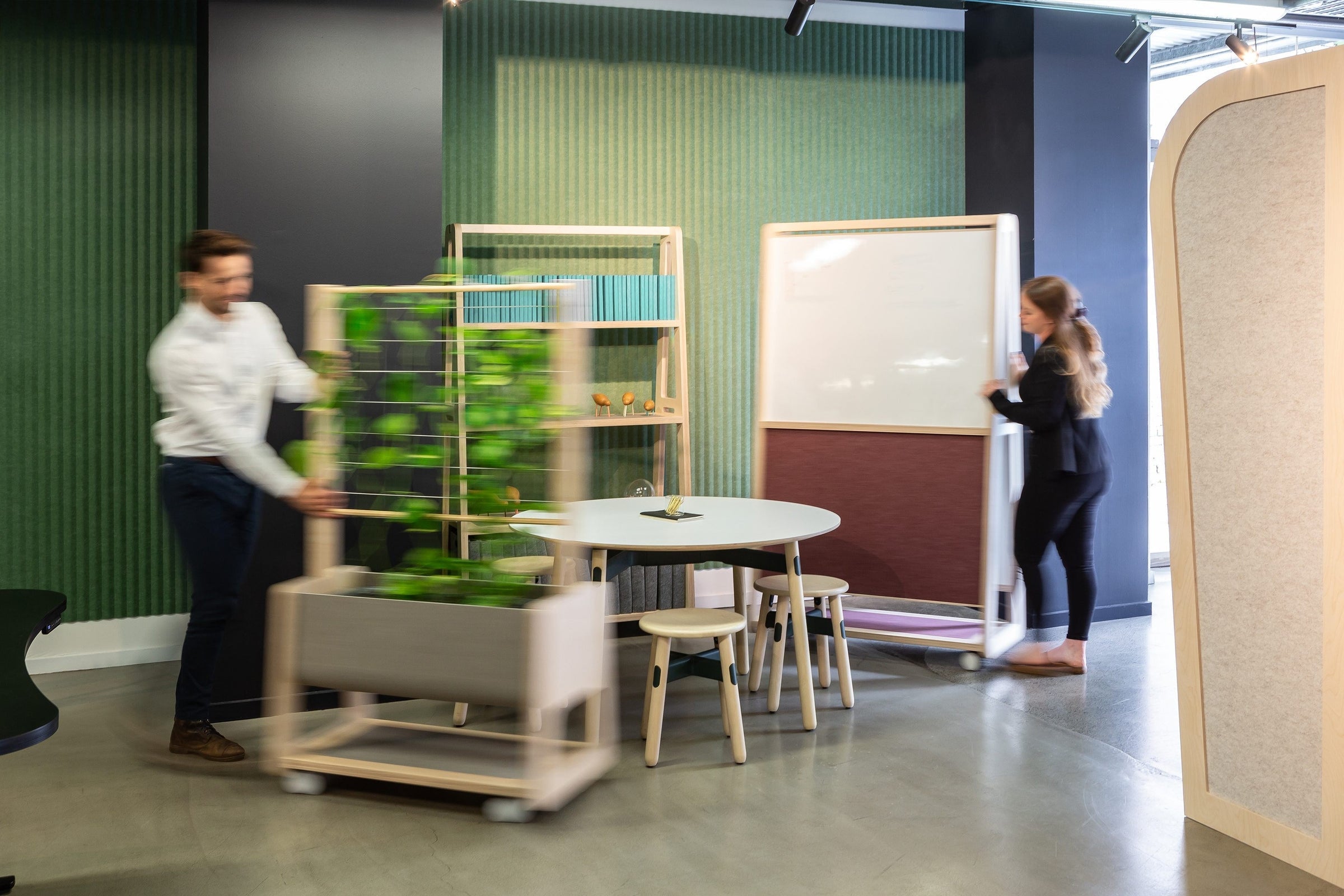
Four numbers decide whether a whiteboard specification survives the fitout: the surface, the size, the depth the board projects from the wall, and the warranty on the writing surface. Two surfaces carry a published surface warranty. Lintex warrants its magnetic ceramic steel writing surface for 30 years, warrants the product for 5 years against manufacturing defects, and holds spare parts for at least 5 years after delivery. Geneva's fibre core mobile boards carry 8 years on the magnetic surface. Wall mounted boards project between 12 and 47 mm. Sizes run from 255 x 355 mm to a 5,950 mm wall run. Mobile boards stand 1,640 to 1,960 mm high and weigh 37 to 46 kg where the weight is published.
Everything after that is detail, but it is the detail that gets a board taken off the wall in year two. A whiteboard looks like the simplest line on a furniture schedule. It is usually the line with the least information on it: a size, a quantity and the word whiteboard. The board then arrives, and the questions start. Will it hold a magnet. Does it clear the door. Is there a stud behind it. Why does the last meeting still show through.
The surface is the whole product
There are three writing surfaces in the ranges Geneva specifies, and they behave differently enough that the choice should be made before the size is.
Enamelled ceramic steel
The white finish is fired onto a steel core, so the surface that takes the pen is glass hard and the core is magnetic. Lintex publishes that its ceramic steel is Cradle to Cradle certified, that the steel core is made of 50 per cent recycled material, and that the boards are up to 99 per cent recyclable at end of life. It is the surface on Boarder, Air, One, Wood and the Acoustic Board, and it is the one carrying the 30 year surface warranty.
Tempered low iron glass
A separate sheet of tempered optiwhite glass with a magnetic writing surface behind it, frameless and fixed on concealed fittings. Low iron glass avoids the green cast of ordinary float glass, so a coloured board reads as the colour it was specified in. Lintex offers it as glossy MOOD-GLASS or matte SILK-GLASS across 24 standard colours, on Mood Wall, Silk Wall and Mood Fabric Wall.
Magnetic surface over a fibre core
The mobile boards use a magnetic dry wipe surface over a board core rather than steel or glass, which is what keeps them light enough to move. JART uses a BIOBOARD core made from recovered and renewable fibre; IdeaBoard uses a sugarcane fibre core. Both are warranted 8 years on the magnetic whiteboard surface under normal conditions.
| Surface | Magnetic | Published surface warranty | Published environmental claim | Where it belongs |
|---|---|---|---|---|
| Enamelled ceramic steel | Yes, steel core | 30 years on the writing surface, 5 years on manufacturing defects | Cradle to Cradle certified; steel core 50 per cent recycled; board up to 99 per cent recyclable | Rooms that will be written on daily for the life of the tenancy |
| Tempered low iron glass | Yes, magnetic backing | 5 years on manufacturing defects | Not published in the product data Geneva holds | Front of house, coloured or frameless walls, rooms where the board has to disappear |
| Magnetic surface over a fibre core | Yes | 8 years on the magnetic surface, under normal conditions | Recovered and renewable fibre core, or sugarcane fibre core | Mobile boards that have to be lifted, folded and moved |

One published detail is worth repeating because it is counter intuitive. Lintex offers matte and semi matte ceramic steel, and in the same finish notes states that it does not recommend a matte surface as a writing board. Matte reads beautifully in a photograph and holds pigment in use. If the board is decorative, matte is available. If it is going to be written on, it should be gloss.
Depth from the wall, the dimension nobody schedules
Every wall mounted board projects. How far is published, it varies by more than a factor of three across one manufacturer's range, and it almost never appears on a drawing. It decides whether the board clears a door swing, a sliding partition pocket, a joinery reveal or a glazed partition head.
| Board | Surface | Depth from wall | Frame |
|---|---|---|---|
| Mood Wall and Silk Wall | Tempered low iron glass | 12 mm | Frameless, concealed fittings |
| Air | Ceramic steel | 16 mm | Frameless, bevelled edges in the surface colour |
| One | Ceramic steel | 20 mm | Black or white aluminium, mitred corners |
| Wood | Ceramic steel | 20 mm | Solid oak, mitred corners |
| Acoustic Board | Ceramic steel over a 30 mm absorbing core | 47 mm | Aluminium with chamfered edges |
Forty seven millimetres is not a large number until the board is on the return wall beside a door that opens back against it. Then it is the difference between a handle mark on the enamel and a board nobody touches.
Sizes, and where the joints land
Wall boards are made in fixed sizes, not cut to a wall. The useful range is wider than most schedules assume, and the very large boards are runs of several panels rather than one sheet.
| Board | Smallest published | Largest published | Notes |
|---|---|---|---|
| Boarder | 255 x 355 mm | 3,005 x 1,205 mm | 26 versions, aluminium frame, pen tray included |
| Air | 990 x 1,190 mm | 2,990 x 1,190 mm | Also made portrait, 1,190 x 990 mm to 1,190 x 2,990 mm |
| Air Spaces | 2,380 x 1,990 mm, two boards | 5,950 x 2,990 mm, five boards | A run of panels, so the joints are a set out decision |
| Acoustic Board | 1,008 x 1,205 mm | 3,008 x 1,205 mm | Five sizes, all 1,205 mm high |
| Wood | 1,008 x 1,208 mm | 2,008 x 1,208 mm | Three sizes only |
Air Spaces at 5,950 mm is five boards, not one. The panel joints will be visible, they will fall where the module puts them, and a specifier who wants a joint clear of the screen or clear of the head of a table should set the run out on the elevation rather than accepting the default. The same applies to Mood Spaces and Silk Spaces, which run from 2,000 x 2,000 mm to 5,000 x 2,000 mm in glass.
Fixing is outside the standard
There is a European standard for writing boards. EN 14434:2023 specifies ergonomic, technical and safety requirements for wall mounted and free standing writing boards, white projecting boards, interactive systems and interactive screens for rooms used for education and training. It replaced the 2010 edition, which was withdrawn on 29 November 2023.
Read what it excludes. The standard sets out requirements for the board after installation, and excludes building structure safety, walls and mounting systems, and electrical safety. It is a standard about the board, not about the wall. Nothing in a manufacturer's compliance statement tells you whether a stud partition will carry a 2,000 mm ceramic steel board on concealed fittings, and the concealed fitting is exactly the kind of fixing that needs to land on something solid.
Specifier’s note. Concealed fittings need noggings, and noggings go in before the plasterboard. Mark the board positions on the partition set out drawing, not on the furniture schedule, and give the builder the fixing centres from the manufacturer rather than a nominal height. A board added after handover gets the anchors that will fit the wall that is already there, which is how a heavy enamelled board ends up on plasterboard anchors and how it ends up back on the floor. The same drawing should carry the depth from wall, because that is what tells the joiner how deep the reveal has to be if the board is meant to sit flush.

A hard surface in a room already full of them
A whiteboard is a rigid, non porous, highly reflective plane, usually installed on the wall a meeting room is designed to face. In a small room with glazing on one side and a board on the other, the board is not neutral. Two products in the range are built to do something about it.
The Acoustic Board puts a 30 mm sound absorbing core behind the ceramic steel. Mood Fabric Wall combines a glass writing panel with a textile covered frame that has a 48 mm sound absorbing filling, and the textile sections are pinnable, so the same wall takes written work and pinned work.
What neither product publishes, in the data Geneva holds, is an absorption class. There is no alpha w figure and no ISO 11654 class on either, so a board cannot be counted in an absorption calculation the way a tested panel can. If the room needs a measured result, it needs a tested absorber and the board is a bonus. Acoustic ratings on a plan sets out which figures can be relied on and which cannot.
Mobile boards and the floor they occupy
A mobile board is specified by its footprint and its weight, not by its writing surface, because the writing surface is the part that behaves. The frame is what has to be pushed, parked and stored.
| Board | Overall W x D x H | Writing surface | Weight | Notes |
|---|---|---|---|---|
| JART | 900 x 600 x 1,800 mm | 1,800 x 900 mm, both faces | 46 kg | A frame folds flat, two internal steel shelves, lockable castors |
| IdeaBoard | 1,000 x 700 x 1,820 mm | Both faces magnetic | 37 kg | Two acoustic pinboard panels, 940 x 335 x 18 mm, attach magnetically |
| Dash | 1,200 x 450 x 1,800 mm | Two boards, 1,200 x 800 mm each | Not published | Boards lift off by a handle, sound absorbing base, braked castors |
| Curved mobile board | 1,200 x 40 x 1,640 mm | Magnetic glass one side, fabric pinboard the other | Not published | 40 mm thick board, lockable castors |
| One Mobile | 707 to 2,007 x 500 x 1,960 mm | 707 x 1,207 mm to 2,007 x 1,207 mm | Not published | Ceramic steel, two lockable castors, flip chart hooks included |
| Etch | 1,060 x 500 x 1,905 mm | Magnetic whiteboard on a hoop pine frame | Not published | 32 mm hoop pine plywood, 12 mm PET at 75 per cent recycled, Greenguard Gold certified |

Two things follow from the table. The first is that the depth is the number that matters in a corridor or a breakout: 450 to 700 mm of frame, standing where a plan shows a thin line. AS 1428.1-2009 sets the minimum unobstructed width of a continuous accessible path of travel at 1,000 mm, and a parked board is an obstruction. Give mobile boards a parking position on the plan, the way the rest of the floor gets one.
The second is weight. Forty six kilograms is a two person lift and a real load on a lift car and a castor. A board that folds flat, as JART does, is worth more than one that does not, because the alternative to folding is that it stands in a corner for the rest of the lease.
When the board and the screen share a wall
The mobile media wall has become the default answer for a room that has to do a video call and a workshop in the same hour. SixtySix puts a screen on the front and a removable magnetic whiteboard on the back, with acoustic PET behind to hide cabling, on a 32 mm hoop pine plywood frame.
The figures to check are the screen ones. Model 1366 takes screens up to 55 inches on a 1,430 x 600 x 1,905 mm frame with a maximum monitor weight of 30 kg. Model 1566 takes up to 65 inches on a 1,630 x 600 x 1,905 mm frame with a maximum monitor weight of 40 kg. The screen is not supplied, so the screen weight is a coordination item, exactly as it is with a monitor arm: the mount has a published rating, and the display has a published weight, and the two have to be read together before either is ordered. Power is either a fixed 3 m lead or mobile battery, which decides where the unit can stand.

What actually goes on the schedule
A whiteboard line that will survive the job carries seven things: the surface, the exact size, the frame or frameless finish, the depth from wall, the mounting method, the surface warranty, and whether it is magnetic. Six of those are published by the manufacturer. The seventh, the mounting method, is the one that has to be agreed with the builder, and it is the one that is almost always left blank.
Lintex makes more than 80 per cent of its products at its own factory in Nybro in Smaland, and the boards are made to order in a small number of fixed sizes, so the size decision is made once and does not get revisited on site. That is an argument for resolving it on the elevation early. Geneva's own range and the Australian made Thinking Works Etch and SixtySix units cover the mobile and media wall side, and the full Lintex range covers the wall.
Frequently asked
What is the difference between a ceramic steel and a glass whiteboard?
Ceramic steel is enamelled steel: the white finish is fired onto a steel core, so the writing surface is magnetic and the enamel does not wear through with pen use. Tempered low iron glass is a separate sheet with a magnetic backing, so it is also magnetic but it is thicker, heavier and frameless in appearance. The practical difference on a schedule is the warranty and the reveal. Lintex warrants its ceramic steel writing surface for 30 years, and its glass boards sit only 12 mm off the wall against 16 to 20 mm for the framed steel boards.
How far does a wall mounted whiteboard project into the room?
Between 12 and 47 mm across the Lintex wall range. Mood and Silk glass boards are 12 mm from the wall, Air is 16 mm, One and Wood are 20 mm, and the Acoustic Board is 47 mm because it carries a 30 mm sound absorbing core behind the steel. That figure decides whether the board clears a door swing, a sliding partition pocket or a joinery reveal, and it is the number most often left off a drawing.
Does a whiteboard standard cover how the board is fixed to the wall?
No. EN 14434, the European standard for writing boards, covers wall mounted and free standing boards for educational and training rooms and explicitly excludes building structure safety, walls and mounting systems, along with electrical safety. The 2010 edition was withdrawn on 29 November 2023 and replaced by EN 14434:2023. A compliant board says nothing about whether the partition behind it will hold. That is a set out question for the builder, answered before the plasterboard goes on.
Should a whiteboard surface be matte or gloss?
Gloss, if it is going to be written on. Lintex offers matte and semi matte ceramic steel and states in its own finish notes that it does not recommend a matte surface as a writing board. A matte surface diffuses reflection, which reads well in a photograph, and it holds pigment, which reads badly after six months of daily use.
How much floor area does a mobile whiteboard take?
More than the drawing suggests, because the frame is deeper than the board. JART is 900 mm wide and 600 mm deep on its A frame and weighs 46 kg. IdeaBoard is 1,000 mm wide, 700 mm deep and 37 kg. Lintex One Mobile is 500 mm deep, Dash is 450 mm deep and Etch is 500 mm deep. A board parked against a wall in a corridor also has to stay clear of the 1,000 mm minimum unobstructed width that AS 1428.1-2009 sets for a continuous accessible path of travel.
Geneva specifies and installs wall mounted and mobile writing boards across the whiteboard range and the wider workplace furniture program, and can mark the fixing set out on the partition drawing before the plasterboard goes on. Talk to our team about a room, a floor or a schedule that needs resolving.