

Weight-balanced recline: how a Humanscale chair adjusts itself, and who it does not suit
Humanscale task chairs have no recline tension dial. What the weight-balanced mechanism actually does, the figures Humanscale publishes for each chair in the range, and the four briefs where it is the wrong answer.
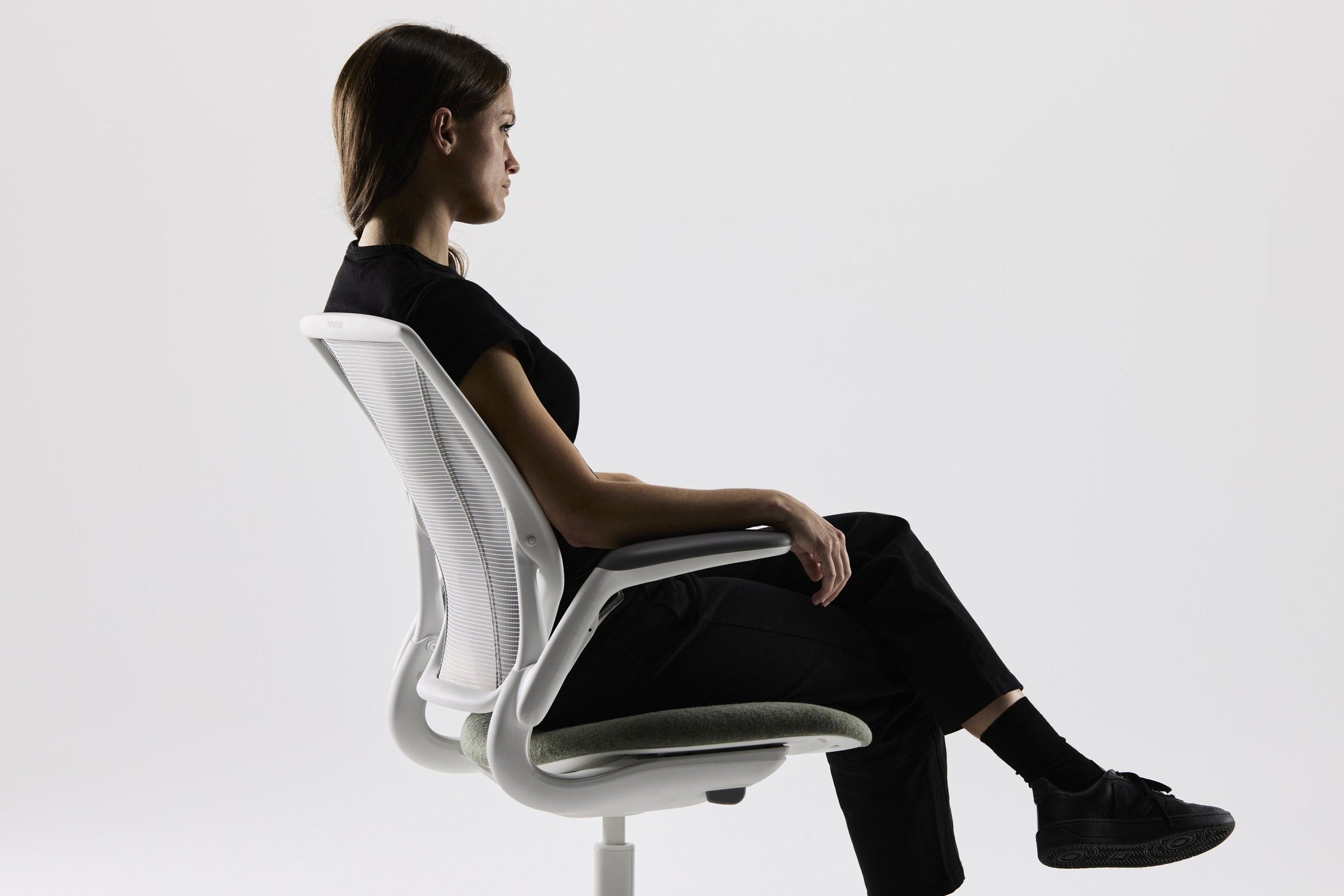
A Humanscale task chair has no recline tension dial because the mechanism is counterbalanced against the sitter instead of against a spring the sitter is expected to set. Humanscale publishes it as a weight-sensitive, self-locking recline on Freedom and Diffrient Smart, and as a Gravity Mechanism on Diffrient World and Path. Freedom and Diffrient Smart are published with 20 degrees of movement and a backrest that pivots a further seven or eight degrees. On a schedule that means one fewer control to train people on, and one fewer thing set wrong on handover. It also means there is no tilt lock, which rules the range out of some briefs entirely.
This post covers what the mechanism does, the figures Humanscale actually publishes for each chair in the range Geneva carries, and the four briefs where a weight-balanced chair is the wrong answer. Every number traces to a Humanscale brochure or product page, or to a Geneva product page read on 24 September 2026, and where nothing is published we have said so.
What the mechanism does, and what it replaces
A conventional synchro mechanism works off a spring. The spring has to be matched to the sitter, which is what the tension knob under the seat is for, and the recline is then held by a lock with a set number of positions. Two things follow from that on a real floor. The first is that the knob is almost never set: audit a hundred desks on a churn day and most chairs are still on the factory setting. The second is that the lock invites people to sit rigid, which is the posture the chair was bought to avoid.
Niels Diffrient, whose partnership with Humanscale began in 1998 and who designed Freedom, Liberty, Diffrient World and Diffrient Smart, removed both. In Humanscale’s published description of the Freedom mechanism, he found that movement during recline took pressure off the sitter’s body and transferred it to the back of the chair, and built a weight-sensitive, self-locking recline around that. Liberty is published the same way, as an intelligent counter-balance recline with, in Humanscale’s words on the Liberty brochure, no recline locks to set or release.
Three details matter more to a specifier than the headline. The backrest pivots on its own as the chair reclines, a further seven degrees on Freedom and eight on Liberty, Diffrient World and Diffrient Smart, which is what keeps lumbar contact through the movement. The arms attach to the back frame rather than the seat, so they travel with the torso instead of falling away from it. And the seat stays close to level through the recline, which is why people keep working rather than stopping to sit back up.

Freedom and Freedom Headrest: the published figures
Humanscale publishes Freedom’s dimensions in its Freedom brochure, revision v.20230706, in inches. The millimetre figures below are converted from those published inches and rounded to the nearest millimetre.
| Figure | Freedom Task | Freedom Headrest |
|---|---|---|
| Width | 26.75 in, 680 mm | 26.75 in, 680 mm |
| Depth | 17.40 to 19.85 in, 442 to 504 mm | 17.40 to 19.85 in, 442 to 504 mm |
| Height range | 36.7 to 41.5 in, 932 to 1,054 mm | 48.2 to 53 in, 1,224 to 1,346 mm |
| Recline | 20 degrees of movement plus seven degree back tilt | 20 degrees of movement plus seven degree back tilt |
| Headrest adjustment | Not applicable | 5 in, 127 mm vertical |
| Arm adjustment | 5.85 in, 149 mm vertical, arms on the back frame | 5.85 in, 149 mm vertical, arms on the back frame |
| Arm length and spacing | 8.8 in, 224 mm long, 19 in, 483 mm apart | 8.8 in, 224 mm long, 19 in, 483 mm apart |
| Chair weight | 30 lbs, 13.6 kg armless; 34 lbs, 15.4 kg with arms | 34 lbs, 15.4 kg armless; 38 lbs, 17.2 kg with arms |
| Published fit range | 5 ft 0 in to 6 ft 4 in, 1,524 to 1,930 mm; 100 to 400 lbs, 45 to 181 kg | As Freedom Task |
| Warranty | 15 year | 15 year |
One inconsistency is worth knowing about before it turns up in a submission. Humanscale’s current Freedom configurator page publishes a chair width of 27.25 in and a chair weight of 34 lbs without arms and 38 lbs with arms, against the brochure’s 26.75 in and 30 lbs and 34 lbs. The two documents are describing different reference configurations. If a width is going on a drawing, or a weight is going into a lift or a freight calculation, get the current specification sheet for the exact configuration being ordered rather than taking either figure as settled.
The range compared
Geneva carries seven Humanscale task chairs and a matching side chair. They share the mechanism family and differ in the back, the recline figure and, in one case, the capacity.
| Chair | Mechanism as published | Back | Recline | Capacity | Warranty |
|---|---|---|---|---|---|
| Freedom | Weight-sensitive, self-locking | Cushioned, pivoting | 20 degrees plus 7 degree tilt | Up to 400 lbs, 181 kg | 15 year |
| Freedom Headrest | Weight-sensitive, self-locking | Cushioned, pivoting, dynamic headrest | 20 degrees plus 7 degree tilt | Up to 400 lbs, 181 kg | 15 year |
| Liberty | Counter-balance, no recline locks | Tri-panel Form-Sensing Mesh | 18 degrees plus 8 degree tilt | Up to 400 lbs, 181 kg | 15 year |
| Diffrient World | Gravity Mechanism | Tri-panel Form-Sensing Mesh | 17 degrees plus 8 degree tilt | Up to 400 lbs, 181 kg | 15 year parts, 5 year fabric and cushions |
| Diffrient Smart | Weight-sensitive, self-locking, 20 degrees | Tri-panel Form-Sensing Mesh on an aluminium horseshoe | 18 degrees plus 8 degree tilt | Up to 400 lbs, 181 kg | 15 year |
| Path | Gravity Mechanism with Counterbalance | FormSense Eco Knit | Not published as a degree figure | Up to 300 lbs, 136 kg | 15 year |
| World LM | Weight-compensating | Tri-panel Form-Sensing Mesh | Not published as a degree figure | 45 to 181 kg published fit range | 12 year |
Two entries in that table change a schedule. Path is the only chair in the range published to 300 lbs rather than 400, so a floor that has standardised on a single chair for every setting should not assume Path is a like for like swap. And World LM is the only one on a 12 year rather than a 15 year warranty, which matters where whole of life cost is being compared across a tender rather than a unit rate.

Dimensions across the mesh chairs
The mesh chairs are published to different levels of detail, and Path is the only one Humanscale publishes fully in millimetres. The figures below are as published: where a cell is blank in Humanscale’s own documents it is marked not published rather than estimated.
| Figure | Liberty | Diffrient World | Diffrient Smart | Path |
|---|---|---|---|---|
| Chair width with arms | 26.5 in, 673 mm | 25.75 in, 654 mm | 26.5 in, 673 mm | 620 mm adjustable, 605 mm fixed |
| Chair width armless | 21 in, 533 mm | 21 in, 533 mm | 21 in, 533 mm | Not published |
| Base diameter | 25 in, 635 mm | 25 in, 635 mm | 26 in, 660 mm | 635 mm |
| Seat height range | Varies by cylinder | 15.6 to 20.75 in, 396 to 527 mm | 16.5 to 22.8 in, 419 to 579 mm | 395 to 530 mm |
| Seat depth adjustment | Not published on the current page | Not published on the current page | 16.25 to 18.75 in, 413 to 476 mm | 414 to 475 mm |
| Seat width | Not published on the current page | Not published on the current page | 19.25 in, 489 mm cushion | 520 mm |
| Backrest height | Not published on the current page | Not published on the current page | Not published | 525 mm |
| Overall height | Not published on the current page | Not published on the current page | 40 to 44.8 in, 1,016 to 1,138 mm | 880 to 1,010 mm |
| Chair weight | 34 lbs, 15.4 kg with arms | 27 lbs, 12.2 kg with arms | 34 lbs, 15.4 kg with arms; 31 lbs, 14.1 kg armless | 18.6 kg with arms; 16.1 kg armless |
Diffrient World is the lightest chair in the range at 27 lbs, about 12.2 kg, and Humanscale attributes that to component count: the brochure states that where the average task chair uses more than 200 components, World is built with 78. That is not a marketing figure on a floor where chairs are moved weekly, and it is not a small consideration for a project manager pricing a delivery of four hundred of them up a single goods lift.

Who a weight-balanced chair does not suit
A brief that specifies a tilt lock
This is the one that ends the conversation. Humanscale publishes that Liberty has no recline locks to set or release, and the rest of the range is built on the same principle. If the client’s ergonomic assessment, the tender schedule or the workplace health and safety policy calls for a positive tilt lock with set positions, no amount of demonstrating the counterbalance will satisfy it. Establish that before the chair goes on the schedule, not at the sample stage.
A sitter outside the published fit range
Humanscale publishes a fit range of 5 ft 0 in to 6 ft 4 in, about 1,524 to 1,930 mm, and 100 to 400 lbs, about 45 to 181 kg, for Freedom, Liberty and Diffrient Smart, and Geneva’s World LM page publishes 152 to 193 cm and 45 to 181 kg. A mechanism calibrated to body weight has a floor as well as a ceiling. Below about 45 kg the counterbalance is outside the range it was designed for, and the sitter gets less recline support than the chair is capable of. On a floor with a wide range of body sizes, that is an argument for trialling rather than for schedule wide standardisation.
A tender written to Australian certification
Humanscale publishes testing and certification against North American and international programs, including BIFMA LEVEL and the Declare label. Australian government, education and health tenders frequently ask for AFRDI Blue Tick or compliance with AS/NZS 4438:1997, Height adjustable swivel chairs, instead. They are separate schemes with separate test regimes, and one does not substitute for the other on a compliance schedule. Ask for the certificate the tender names, for the model and configuration being offered, and put the answer in the submission rather than the assumption.
A floor standardising on one chair at a heavier capacity
Path is published to a capacity of up to 300 lbs, about 136 kg, where the rest of the range is published to 400 lbs, about 181 kg. Path is the most sustainable chair Humanscale makes and it is the right chair for a great many floors, but it is not interchangeable with Freedom or Liberty on capacity, and a schedule that carries one chair type for every setting needs to know which figure it is working to.
Specifier’s note. Check the cylinder before the finish. Every chair in this range is offered with more than one gas cylinder, and the standard one is not always what the setting needs. Diffrient World alone is published with a 5 in standard, a 3.75 in low, a 3 in and a 5 in return to height, an 8 in high with a 20 in foot ring and a 10 in extra high with a 20 in foot ring. The high and extra high cylinders are how a task chair becomes a task stool at a 900 mm bench or a 1,050 mm poseur, and the return to height cylinders are what stop a hot desk drifting to its lowest position over a week of unassigned use. Get the cylinder decision into the schedule at the same time as the fabric, because it is a different part number, not an accessory, and it cannot be swapped on site as easily as a caster. Our guide to counter, bar and poseur heights sets out which seat heights go with which bench heights.
The sustainability figures that are actually published
Humanscale publishes more third party verified environmental data than most manufacturers in this category, which makes it unusually easy to put real numbers into a Green Star submission rather than adjectives. The Path brochure states that the chair incorporates nearly 22 pounds of recycled material, about 10 kg, including fishing nets recovered from the ocean, and that it contains almost ten pounds of ocean plastic, about 4.5 kg. Its FormSense Eco Knit back is made with 100 per cent post-consumer recycled polyester yarn from upcycled plastic bottles, and the chair is published as free of Red List chemicals.
Diffrient World is published as BIFMA LEVEL 3, Declare Red List Approved, Living Product Challenge Certified, carrying a Health Product Declaration, and 95 per cent recyclable. The direction of travel is consistent with what Diffrient himself wrote, and Humanscale publishes the quote on its page about him:
The key to sustainability is efficiency. A design should use less material and energy for the most useful result ... No amount of recycling will equal using less in the first place.

Where these chairs sit on a floor
Task seating is one line on a furniture schedule and it is rarely the line that decides the fitout, but it is the one people touch for eight hours. The pattern we see most often on a Sydney floor is a mesh chair through the workstation field, a cushioned chair in the offices and the boardroom, and a matching side chair in the meeting rooms so the meeting tier reads as one family. Diffrient World or Liberty through the field, Freedom Headrest in the offices and the Diffrient Occasional in the meeting rooms does that in one brand, and the Occasional is offered in three versions whose mesh matches Liberty, Diffrient Smart or Diffrient World.
For the perching and standing settings, the Saddle and Pony Saddle stools sit on the same high cylinder and foot ring logic as the task stools above. The whole range is on the Humanscale collection, the wider seating range is under office and commercial chairs, and the Humanscale brand page covers the company’s own position. How this layer fits against the rest of a level, including the densities and the circulation it has to work inside, is set out in anatomy of a Sydney CBD floor, and the broader range by setting is on the workplace furniture page.
What we could not verify
Three things were left out rather than estimated. Humanscale does not publish a seat height range for Freedom on its current product page, so none is given here and the cylinder options are described instead. Liberty’s current page publishes a seat height range of 16.5 to 34.2 in, which spans multiple cylinder options rather than describing one chair, so it is not reproduced as a single chair figure. And no AFRDI Blue Tick or AS/NZS 4438 certification has been confirmed for any model in this range as at 24 September 2026, so nothing is claimed either way: the position above is to ask for the certificate the tender names.
Frequently asked
How does the Humanscale weight-balanced recline work?
The mechanism is counterbalanced against the sitter rather than against a spring the sitter sets. Humanscale calls it a weight-sensitive, self-locking recline on Freedom and Diffrient Smart and a Gravity Mechanism on Diffrient World and Path. Body weight sets the resistance, so there is no tension dial to turn and nothing to reset when the next person sits down. Freedom and Diffrient Smart are published with 20 degrees of movement, and the backrest pivots a further seven or eight degrees as you lean back.
Can you lock the recline on a Humanscale chair?
No, and that is the point of the design. Humanscale publishes that Liberty has no recline locks to set or release. If a tender or a workplace assessment calls for a positive tilt lock in set positions, a Humanscale weight-balanced chair will not meet it, however comfortable it is.
Who does a Humanscale task chair not suit?
Humanscale publishes a fit range of 5 feet 0 inches to 6 feet 4 inches, about 1,524 to 1,930 mm, and 100 to 400 lbs, about 45 to 181 kg, for Freedom, Liberty and Diffrient Smart. A sitter below about 45 kg is under the range the counterbalance is calibrated for. Path is published to a lower capacity than the rest of the range, up to 300 lbs or about 136 kg.
What warranty does Humanscale publish?
Humanscale publishes a 15-year, 24/7 warranty on Freedom Task and Liberty. The Diffrient World brochure sets it out as 15 years on components and parts and 5 years on fabric and cushions. Geneva's World LM page publishes a 12-year warranty, which is the one model in the range on a shorter term.
Are Humanscale chairs certified to Australian standards?
Humanscale publishes testing and certification against North American and international programs, including BIFMA LEVEL and Declare. Australian tenders frequently call for AFRDI Blue Tick or AS/NZS 4438:1997 Height adjustable swivel chairs instead. Those are different schemes, so ask for the certificate that the tender names rather than assuming one covers the other.
Geneva specifies task seating on commercial floors in Sydney and nationally, and the part that usually needs a conversation rather than a brochure is the cylinder, the arm and the certification the tender asks for. Talk to our team if you have a schedule and a set of settings and want the seating tested against them.