

Infiniti chairs compared: what the base does to the seat height
Infiniti draws a shell once and offers it on a dozen bases. Across the Pure Loop family that moves the published seat height by 50 mm and the width of the four leg frame by 125 mm, which is why the model name alone is not a specification.
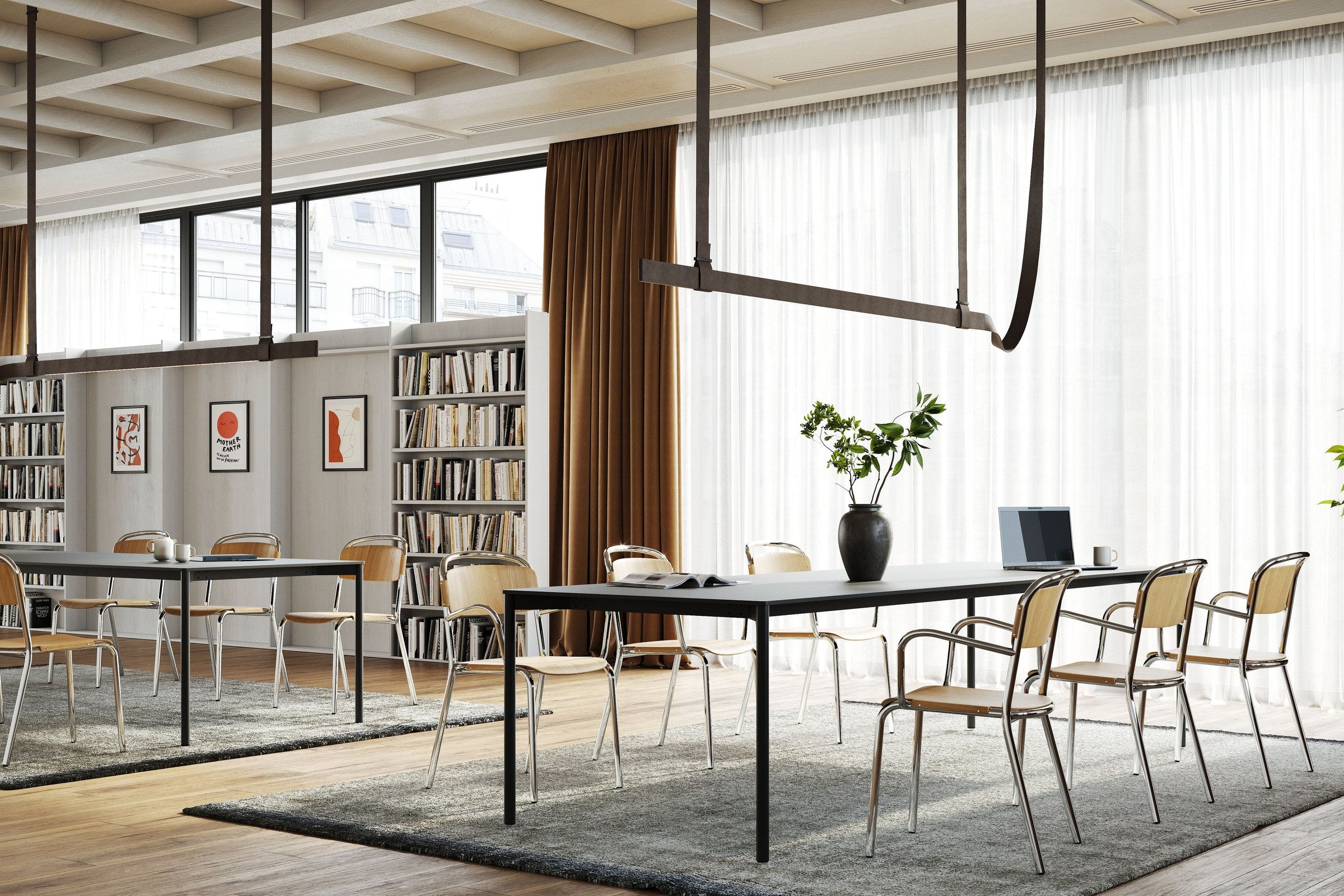
An Infiniti chair's seat height is set by the base, not by the model name. Across the Pure Loop family the same moulded shell is published at 440, 450, 455, 465, 475 and 490 mm seat height depending on which frame it sits on, a 50 mm spread, plus 415 to 530 mm on a gas lift and 655 to 760 mm as a stool. Against a 720 to 740 mm table that difference decides whether the chair works. The Sicla family behaves the opposite way and holds one set of dimensions across five bases. Knowing which family does which is most of the job.
One shell, many bases, and why that matters on a schedule
Infiniti builds families rather than single chairs. A shell is drawn once, tooled once, and then offered on a four leg frame, a sled, a four star base, a swivel base with castors, a timber leg, a gas lift column and a stool frame. The shell can be bare polypropylene, carry a seat pad, or be fully upholstered. A family of six or seven products on a Geneva product list is usually one shell doing seven jobs.
For a specifier that is genuinely useful. It means one visual language can run from the boardroom to the training room to the staff cafe without buying three unrelated chairs, and it means a fitout can be adjusted late without redrawing the look of a room. It also means the model name on a schedule is not enough information. "Pure Loop, black" describes nine different products with six different seat heights.

Pure Loop: the family where the base moves every number
Pure Loop is Claus Breinholt's design and the family Geneva carries in the most versions. The shell is polypropylene and glass fibre, offered as Mono in a single colour and as Binuance with an upholstered front shell in a two tone pairing. The published dimensions below come from the Geneva product pages for each version.
| Version | Overall height | Seat height | Width | Depth | Base |
|---|---|---|---|---|---|
| Armchair, four leg with arms | 784 | 440 | 538 (570 at floor) | 547 | Steel tube, 16 mm |
| Sled | 820 | 450 | 573 | 520 | Steel rod, 11 mm |
| Four star base | 810 | 455 | not published | not published | 670 by 670 |
| Four leg, stacking | 815 | 465 | 595 | 550 | Steel tube, 16 mm |
| Four leg, non stacking | not published | 450 | 470 | 530 | Steel tube, 16 mm |
| Wood leg | 805 | 475 | 467 | 550 | Solid oak |
| Swivel with castors | 845 | 490 | not published | not published | 670 by 670, castors 60 mm |
| Five star gas lift | 855 to 985 | 415 to 530 | 630 | not published | 645 by 615, castors 60 mm |
| Edu, gas lift with tablet | 750 to 870 | 400 to 520 | 543 | 760 with tablet | Five star aluminium |
| Lounge | 680 | 380 | 790 | 700 | Die cast aluminium swivel |
Two lines in that table are worth reading twice.
The first is the gap between the armchair at 440 mm and the swivel castor version at 490 mm. Both carry the same shell. At 440 mm with a 720 mm table you have 280 mm of thigh clearance and an armchair that tucks under. At 490 mm you have 230 mm, the arms are gone, and a tall sitter is perched. Neither is wrong. Specifying one when the drawing assumed the other is.
The second is the four leg frame, which is published twice. The stacking frame is 595 mm wide and 465 mm to the seat. The non stacking frame is 470 mm wide and 450 mm to the seat. That is 125 mm of width between two versions of the same chair, and width is what sets how many chairs fit along a 2400 mm table. Six chairs at 470 mm need 2820 mm of frame width; six at 595 mm need 3570 mm. If the schedule says stacking because the room doubles as a training room, the seating plan has to be drawn at the stacking width.

Sicla: five bases, one set of dimensions
Sicla is the counter example, and the easier family to specify. It is also Breinholt's, a polypropylene and glass fibre shell that Infiniti describes on its own product page as a lightweight monocoque. Geneva publishes the same dimensions for every fixed base version: 800 mm overall, 445 mm seat height, 670 mm arm height, 590 mm wide and 530 mm deep. Only the swivel castor version differs, and only in depth.
| Version | Seat height | Width | Depth | Base material |
|---|---|---|---|---|
| Four leg | 445 | 590 | 530 | Round steel tube, chrome or powder coat |
| Sled | 445 | 590 | 530 | Steel rod, 11 mm |
| Four star base | 445 | 590 | 530 | Aluminium, polished or powder coat |
| Wooden leg | 445 | 590 | 530 | Solid ash |
| Swivel with castors | 445 | 590 | 570 | Aluminium four star, castors 60 mm |
This is the family to reach for when one room needs several base types and the line of seat heights has to stay level. A boardroom on castors, the breakout on a sled and the quiet room on timber legs will all sit at 445 mm, which means one table height works for all three and the room reads as one idea rather than three.
It also makes the arm height usable. At 670 mm, Sicla's arms clear a 720 mm table top by 50 mm, so the chairs tuck in rather than knocking. Arm height is the dimension most often left off a schedule and most often discovered on site.

Tondina, Harmo and the timber shells
Alongside the plastic monocoques Infiniti runs two timber shelled families. Tondina is by Favaretto&Partners, a 16 mm steel tube frame with a three dimensionally pressed oak plywood seat and back. Harmo is by BrogliatoTraverso, a solid ash or beech frame with ash plywood. Both read as hospitality pieces and both are routinely used in workplace cafes and client floors.
| Model | Overall height | Seat height | Width | Depth | Shell |
|---|---|---|---|---|---|
| Tondina | 793 | 475 | 450 | 550 | Oak plywood |
| Tondina Armchair | 785 | 470 | 545 | 553 | Oak plywood, arms at 645 |
| Tondina Slim | 793 | 475 | 450 | 550 | Glass fibre reinforced polypropylene |
| Tondina Pop | 793 | 475 | 450 | 550 | Polypropylene |
| Tondina Lounge | 800 | 405 | 705 | 725 | Oak plywood |
| Harmo | 796 | 454 | 505 | 491 | Ash plywood on solid timber |
| Harmo Relax | 735 | 380 | 713 | 696 | Ash plywood, upholstered |
| Loop 3D Wood, four leg | 800 | 465 | 550 | 510 | 3D pressed veneer on plywood, arms at 630 |
| Loop 3D Wood, sled | 805 | 460 | 520 | 480 | 3D pressed veneer on plywood, arms at 620 |
| Canova | 788 | 460 | 441 | 467 | UV resistant polypropylene with cushion |
| Freya | 785 | 460 | 442 | 510 | Recycled polypropylene, upholstered inner |
| Porta Venezia | 802 | 465 | 380 | 494 | Polypropylene on solid beech |
Loop 3D Wood deserves a note of its own. It was Infiniti's first product in 2008, and the company describes it as the first monobloc shell in curved wood. It is the piece the brand was built on, and it still runs across four leg, sled, four star and five star bases with the same shell, in the same way Pure Loop does.
Three dimensions in that table are the ones that catch people out. Tondina at 450 mm wide and Porta Venezia at 380 mm wide are narrow chairs, which is how a long cafe bench gets more seats than the layout predicted. Tondina Lounge at 725 mm deep and Harmo Relax at 696 mm deep are not narrow, and a pair of them plus a side table will not fit the 1800 mm breakout nook that was drawn for two armchairs.
Where the stools land
Infiniti publishes every stool in a kitchen height and a bar height, and publishes a footrest height on most of them. That second number is unusual and worth having. The seat heights cluster tightly.
| Stool | Kitchen seat height | Kitchen footrest | Bar seat height | Bar footrest |
|---|---|---|---|---|
| Round Stool | 645 | 244 | 765 | 300 |
| Harmo Stool | 647 | not published | 747 | not published |
| Pure Loop Mini Rod | 650 | 260 | 750 | 355 |
| Pure Loop Mini Four Leg | 655 | not published | 760 | not published |
| Pure Loop Mini Dandy | 655 | 250 | 755 | 325 |
| Pure Loop Stool | 665 | 250 | 760 | 350 |
| Tondina Stool | 673 | 250 | 773 | 330 |
| Tondina Pop Stool | 673 | not published | 773 | not published |
| Pure Loop Mini, gas lift | 675 to 775 adjustable, overall height 855 to 955 | |||
The kitchen heights span 645 to 673 mm and the bar heights 747 to 773 mm. Within one brand that is a 28 mm and a 26 mm spread, which sounds small until two families are run along the same bench and the line of seat tops steps. If a project mixes Tondina stools and Round Stools on one 1050 mm poseur, the Tondina sits 8 mm higher at bar height. Nobody measures it; everybody sees it.
Matching those seat heights to a bench or counter height is a separate question with its own answer, and the numbers are set out in our guide to counter, bar and poseur heights and the stool heights that work under them, which uses Infiniti's published footrail figures as part of its working.
Specifier's note. Write the base into the schedule line, not just the model and the finish. "Pure Loop, Coal black" is nine products. "Pure Loop Mono, four leg stacking frame, matt black, Coal black shell, 465 mm seat height" is one, and it is the line that survives a value engineering exercise intact. The same applies to the stacking decision: on Pure Loop the stacking frame is 125 mm wider than the non stacking one, so a seating plan drawn on the narrow frame will not take the chairs that arrive.
What Infiniti publishes about how it is made
Infiniti was launched in 2008 inside OMP Group, a family owned industrial business at Castello di Godego in the Treviso countryside that had been making metal components for the contract furniture industry since 1983. That history shows in the range: the metal work is the part the company has been doing longest, which is why the base options are so deep.
The company states on its own site: "Our 100% Made in Italy production takes place in the factories of Godego, Riese, and Ramon, in the province of Treviso". Metal, plastic and bent wood are worked in house across those three plants. It also states that it has "always pursued a sustainable approach by using certified materials, such as FSC-certified wood", and that photovoltaic panels on its plants "allow us to save up to 425 tons of CO2 per year".
Its published certifications page names quality management to UNI EN ISO 9001:2015, environmental management to UNI EN ISO 14001:2015, and FSC. Those are management system certifications and a chain of custody scheme. They say how the company runs and where its timber comes from. They do not say what a chair will survive, which is the next question.
The test evidence is American, not European
This is the part worth knowing before an Infiniti chair goes into a schedule with a performance clause in it.
The product test report Infiniti publishes on its Harmo page is a CATAS report, sample number 234598, prepared for OMP S.R.L. and issued on 26 July 2017. CATAS is the Italian furniture testing laboratory at San Giovanni al Natisone. The tested sample is recorded with overall dimensions of 500 by 490 by 790 mm high, which is within a few millimetres of the Harmo chair's published dimensions. Every test in it is to ANSI/BIFMA X5.1-2017, the American general purpose office chair standard, and the chair is recorded as Type III.
| Test | Clause of ANSI/BIFMA X5.1-2017 | Load or cycles applied | Result |
|---|---|---|---|
| Backrest strength, static | 6 | 667 N, then 1,001 N, each for 1 minute | No defects |
| Drop test, dynamic | 7 | Drop height 152 mm above the uncompressed seat, 102 then 136 drops | No defects |
| Seating durability, cyclic, front corner off centre | 10 | 890 N for 20,000 cycles | No defects |
| Back durability, cyclic, Type II and III | 15 | 109 kg seat load with 334 N at the centre of the backrest, 120,000 cycles | No defects |
| Leg strength, front application | 17 | 334 N, then 503 N, for 1 minute | No defects |
| Leg strength, side application | 17 | 334 N, then 503 N, for 1 minute | No defects |
That is real, independent, published evidence and it is more than many brands put on a public page. It is also not the evidence an Australian schedule usually asks for. A specification that calls for AFRDI certification, or for EN 16139 at level 2, is asking a different question with different loads and a different sampling regime. The duty level framework and what the European levels actually mean is covered in our piece on using hospitality seating in a workplace.
The practical move is simple. Ask for the test report that covers the exact model and the exact base, because the report above covers one Harmo sample and nothing else in the range, and a four leg timber frame and a five star castor base fail in entirely different ways. If a report for that combination does not exist, say so in the schedule rather than implying one does.
The warranty is five years, and then it is not
Infiniti's warranty page is headed as a warranty for products assembled by OMP S.R.L., which is the entity a claim would actually be made against. It is a clearly written document and it is worth reading before the figure goes into a tender response, because the headline number does not apply to the parts most likely to fail.
| What | Period | What the page says |
|---|---|---|
| The product generally | 5 years | Runs from the date of purchase, which the page defines as the OMP invoice date |
| Upholstery | 2 years | Covered for manufacturing defects only, and treated as subject to normal wear and tear |
| Moving parts and mechanisms | 2 years | Gas lifts, moving parts and mechanisms are named |
| Outdoor products | 2 years | Applies to the product as a whole and to all of its components |
| Customer's own material | Not warranted | The quality of upholstery in a customer supplied fabric is excluded |
| Notification of a defect | 15 days | Notice must be given no later than fifteen days from discovery |
| Finish change from ageing or sunlight | Excluded | Listed as a change in surface finish rather than a defect |
| Continuous intensive, heavy duty or rental use | Excluded | Unless agreed in writing |
Three consequences follow for an Australian project. A gas lift stool specified for a staff cafe carries two years on the component that will be cycled hardest. A chair specified in a client's own fabric has no warranty on that fabric's performance, which is the trade off for a bespoke cover and should be recorded in the schedule. And an outdoor frame on a terrace drops the whole product from five years to two, so the decision to take a chair outside is a whole of life decision, not a finish decision.
The fifteen day notification clause is the one that quietly matters. A defect found during defects liability and reported three months later at the end of a batch is, on the face of the published terms, out of time. Facility managers inheriting an Infiniti package are better off being told that on handover.
How those published terms interact with Australian Consumer Law, which does not go away because a warranty document says otherwise, is set out in our article on what a commercial furniture warranty actually covers in Australia.

Where these chairs do not suit
A post about a brand that cannot say what the brand is wrong for is advertising. Three honest limits.
They are not task chairs. The gas lift versions of Pure Loop and Sicla raise and lower, and that is the whole of the adjustment. There is no back height adjustment, no lumbar adjustment and no weight based recline. For a desk that someone sits at for six or eight hours a day, the chair belongs in a different conversation, and the published ranges on the HAG range compared are the better starting point.
The published dimension set is uneven. Width and depth are not published for the four star and swivel castor versions of Pure Loop, and the footrest height is not published on four of the nine stools. Where a dimension matters to a clearance, request it in writing rather than scaling it off a photograph.
Outdoor is a narrower range than it looks. An outdoor frame is published for Pure Loop Mono, the Tondina Pop family and Tondina Slim. Timber shelled pieces are not outdoor pieces, and the two year warranty applies to everything specified outdoors. For a genuinely exposed position the corrosivity category of the site has to be checked first, which is the subject of our guide to specifying commercial outdoor furniture in Australian conditions.
How Infiniti compares with the other Italian name in the range
Geneva carries two Italian contract seating brands, and they are not interchangeable. Pedrali is the larger and older company, founded in 1963, with a deeper table and outdoor range and a published technical data sheet behind most products. Infiniti is a younger brand with a narrower catalogue and a much deeper base matrix on each shell, which is exactly what makes it useful when a project needs one chair language at six different heights. Where a project wants one supplier for chairs, stools and tables with full technical documentation, the Pedrali range compared is the better first read. Where a project wants one shell to do everything, Infiniti is the shorter route.
The full range Geneva carries, with the published dimensions for each version, sits on the Infiniti collection, and the brand background, designers and manufacturing detail are on the Infiniti brand page. Stools across every brand Geneva carries are gathered in the stools collection.
What to put on the drawing
Four things, none of which cost anything at design stage.
- The base, written out in full on the schedule line. Family, base type, stacking or non stacking, frame finish, shell finish and the published seat height in millimetres.
- The seat height checked against the table height actually specified. 440 to 475 mm against a 720 to 740 mm top. A 490 mm castor base and a 720 mm table do not belong on the same drawing.
- The width used in the seating plan taken from the version being bought. On Pure Loop the stacking and non stacking four leg frames differ by 125 mm, which is a chair per 2400 mm table over four tables.
- The warranty period recorded against the component, not the product. Five years generally, two on upholstery, moving parts and anything outdoors, nothing on a customer supplied fabric.
If a schedule currently reads as a model name and a colour, the quickest way to make it buildable is to put the published dimensions beside each line and see which ones move. Send us the seating part of the schedule and we will come back with the base, the published seat height and the width for every line, and flag the ones where the base in the specification does not suit the table height it is drawn against.
Frequently asked
What seat heights do Infiniti chairs come in?
On the versions with published Australian dimensions, the fixed seat heights for chairs used at a table run from 440 mm on the Pure Loop Armchair to 490 mm on the Pure Loop Swivel Castor Chair, with most models between 445 and 475 mm. Gas lift versions are published at 415 to 530 mm. Counter stools sit between 645 and 673 mm and bar stools between 747 and 773 mm.
Does changing the base change the dimensions of an Infiniti chair?
It depends on the family. Across Pure Loop it does: the same shell is published at 440, 450, 455, 465, 475 and 490 mm seat height depending on the base, and the four leg frame is published at 595 mm wide in the stacking version against 470 mm in the non-stacking one. Across Sicla it does not: all five fixed bases are published at 800 mm overall height, 445 mm seat height, 670 mm arm height and 590 mm wide, with only the swivel castor version differing, at 570 mm deep rather than 530 mm.
Which Infiniti chairs can be specified outdoors?
Infiniti publishes an outdoor steel frame for Pure Loop Mono, and Geneva's product pages list an outdoor frame option on the Tondina Pop family and an outdoor powder coat as standard on Tondina Slim. The decision is not only the frame. Infiniti's warranty page states that outdoor products are warranted for two years rather than five, and that the two year period applies to the product as a whole and to all of its components.
What warranty does Infiniti publish?
Infiniti's warranty page, headed as a warranty for products assembled by OMP S.R.L., states that the warranty covers the product for a period of five years from the date of purchase, that upholstery and moving parts such as gas lifts and mechanisms are covered for manufacturing defects for a period of two years, and that outdoor products are warranted for two years. It also states that products upholstered with customer owned materials are not warranted for the quality of that upholstery, and that a defect must be notified no later than fifteen days from discovery.
What standard are Infiniti chairs tested to?
The product test report Infiniti publishes for Harmo is a CATAS report, sample number 234598, issued 26 July 2017, testing to ANSI/BIFMA X5.1-2017 and recording the chair as Type III. That is the American office furniture standard, not EN 16139 and not an AFRDI certification. Where a schedule calls for a European duty level or an AFRDI level, ask for the report that covers the exact model and base being specified rather than reading the brand across.