
Which Jonas Ihreborn piece: the lounge range compared by seat height and depth
Published seat heights across the range run from 370 mm to 470 mm, and the piece that suits a lobby will not suit a staff cafe. The dimensions, the module widths, the test reports and the metreage it takes to recover each one.
Across the Jonas Ihreborn pieces Geneva carries, the published seat heights run from 370 mm to 470 mm, and the useful cluster for a commercial lounge is 420 to 460 mm. That one number does more to decide which piece belongs in a brief than the shape does. Arabesk at 370 mm is a low, reclined lobby chair. Seventy Five and Karla sit at 420 mm. Cosmo, Pod and Bumble Bee are at 450 mm, Cap and Talk at 460 mm, and Fly at 470 mm because it was drawn to go under a table. The manufacturer publishes those dimensions in centimetres, and they are converted to millimetres throughout this article.
Jonas Ihreborn is a family upholstery maker in Värnamo, in the Småland region of southern Sweden, and the range Geneva carries runs to 42 items: easy chairs, modular sofas, poufs, benches, side tables and coat stands. It is the kind of collection that reaches a schedule as a mood image rather than as a set of numbers, and then somebody has to draw it. What follows is the published data, pulled from the manufacturer's own product pages and product sheets and from the accredited test reports it publishes, read today. The full brand background sits on the Jonas Ihreborn brand page.
Seat height first, because it is the hardest thing to change later
A lounge chair has no adjustment. Whatever seat height it is made at is the seat height the building gets for the next fifteen years, and the consequences land on whoever has to use it. A 370 mm seat with a 550 mm seat depth is a chair you sink into and lever yourself out of. A 460 mm seat with a 520 mm depth is a chair most adults can stand up from without planning the move. Neither is better. They are different briefs, and the mistake is specifying the first one for the second brief because the image looked right.
Sorted by seat height, the range separates cleanly into three groups. Below 400 mm is lobby and lounge furniture. The 420 to 440 mm band is the general purpose middle, which is where most of the Seventy family sits. From 450 mm up the posture becomes upright enough for a staff cafe, a waiting area with turnover, or a table.
| Piece | Width | Depth | Height | Seat height | Seat depth |
|---|---|---|---|---|---|
| Arabesk | 780 | 850 | 740 | 370 | 550 |
| Karla | 750 | 790 | 710 | 420 | 540 |
| Seventy | 660 | 890 | 900 | 420 | 550 |
| Seventy Five | 590 | 780 | 810 | 420 | 500 |
| Seventy Five Wood | 590 | 780 | 810 | 420 | 500 |
| Seventy Five Care | 580 | 750 | 630 | 420 | 500 |
| Cute | 630 | 610 | 750 | 440 | 500 |
| Bumble Bee | 780 | 600 | 740 | 450 | 490 |
| Cosmo | 550 | 750 | 830 | 450 | 540 |
| Pod, low back | 720 | 720 | 800 | 450 | 510 |
| Pod, high back | 720 | 750 | 1090 | 450 | 510 |
| Cap | 660 | 660 | 720 | 460 | 540 |
| Talk | 710 | 690 | 800 | 460 | 520 |
| Talk, high back | 760 | 720 | 1240 | 460 | 520 |
| Fly | 640 | 610 | 750 | 470 | 500 |
The one in that table that is doing something different
Seventy Five Care is the Seventy Five adapted for people who need help getting out of a chair, and it is the piece most likely to be mis-scheduled because it looks like the others. The published table gives the armchair as 580 by 750 mm at a 420 mm seat height, then lists the headrest as a separate line at 1080 mm high. A chair specified for assisted standing belongs in the conversation about restraint and clinical requirement rather than in a lounge schedule, and that conversation is set out in Aged care furniture: what the rules require, and when a chair becomes a restraint. The same piece turns up in medical waiting rooms, where the governing numbers are chair counts and clear widths rather than style, covered in Healthcare waiting rooms: how many chairs, and how high.
Depth decides the plan, and it is the dimension people forget
Width is what gets drawn. Depth is what goes wrong. The spread across this range is 600 mm to 890 mm, which is nearly 300 mm of difference between two chairs that photograph the same size. Put Seventy at 890 mm deep against a wall with a 1000 mm path of travel in front of it and the path is gone. Put Bumble Bee at 600 mm in the same place and there are 400 mm to spare. On a tight floor that is the difference between a compliant circulation route and a redraw, and the clearances that are actually mandatory are set out in AS 1428 and the furniture schedule: which clearances are law and which are good practice.
Depth also decides delivery. A 890 mm deep chair with a fixed frame does not rotate inside a 1100 mm lift car the way a 600 mm chair does, and the modular pieces are worse because they arrive as several large soft objects rather than one. What the apertures on the route actually have to be is in Will it fit in the lift? The access dimensions that decide a furniture schedule.

The modular families, and what a module actually buys
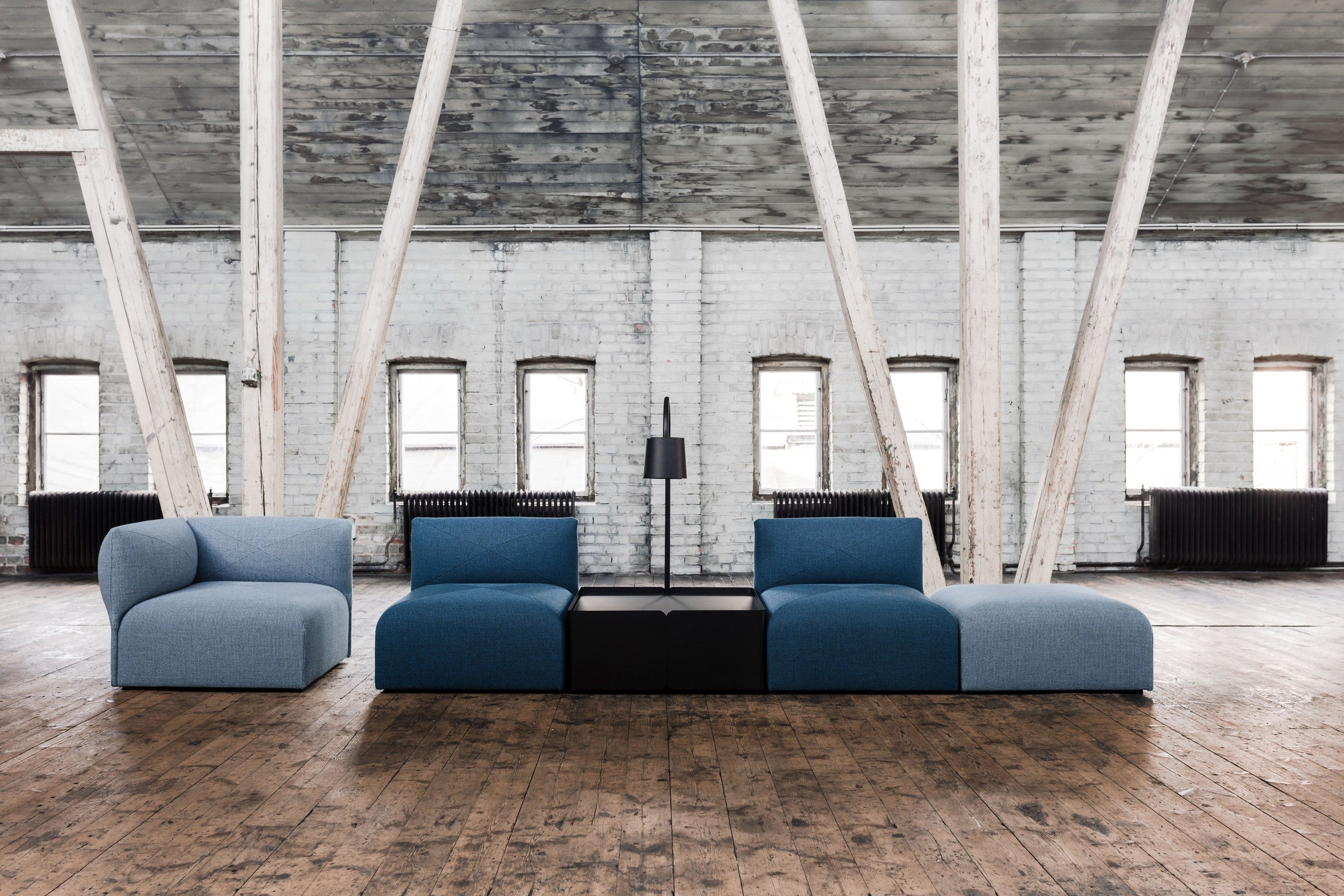
Three of the families build rather than sit: Blob, Blob Mini and Story. The reason to use one is not the shape, it is that a modular run can be re-planned without re-buying, and that a damaged module can be replaced on its own. The reason not to use one is that the module grid, not the room, sets the dimensions, and a 1000 mm corner on a 2400 mm wall leaves an awkward remainder.
| Family | Element | Width | Depth | Height | Seat height |
|---|---|---|---|---|---|
| Blob Lounge | Pouf | 810 | 810 | 400 | 400 |
| Blob Lounge | One seat | 810 | 1000 | 700 | 400 |
| Blob Lounge | Corner | 1000 | 1000 | 700 | 400 |
| Blob Lounge | Easy chair | 1190 | 1000 | 700 | 400 |
| Blob Mini | Pouf | 660 | 660 | 460 | 460 |
| Blob Mini | One seat | 660 | 830 | 750 | 460 |
| Blob Mini | Corner | 830 | 830 | 750 | 460 |
| Story | One seat base | 700 | 700 | 240 | 440 |
| Story | Two seat base | 1400 | 700 | 240 | 440 |
| Story | Three seat base | 2100 | 700 | 230 | 440 |
| Talk | Two seat | 1260 | 690 | 800 | 460 |
| Talk | Two and a half seat | 1510 | 690 | 800 | 460 |
| Talk | Three seat | 1810 | 690 | 800 | 460 |
| Talk, high back | Three seat | 1860 | 720 | 1240 | 460 |
| Talk Lounge | Three seat | 2120 | 920 | 770 | 430 |
| Cosmo | Sofa | 1500 | 750 | 830 | 450 |
| Seventy Five | Sofa | 1740 | 780 | 810 | 420 |
Blob Lounge and Blob Mini are the same idea at two scales, and the gap between them is large enough to matter. A Blob one seat module is 810 by 1000 mm. The Mini equivalent is 660 by 830 mm, which is 32 per cent less floor area for a module that still seats one adult at a 460 mm seat height rather than 400 mm. Both families publish 30 degree angled modules and the Mini adds a reversed module and a quarter circle pouf, so a curved run can be set out on a drawing rather than improvised on delivery day.
Story works differently again. The seat bases come in 700, 1400 and 2100 mm widths, and the backs are separate elements that stack: a backrest at 500 mm high, then add-on A at 300 mm, then add-on B at another 300 mm. Stacked to the top it stops being a sofa and becomes an enclosure, which is the point. The accredited test specimen of a three seater with both add-ons fitted measured 2200 by 750 mm and stood 1300 mm high.

The high back pieces, and the thing they are often asked to do
Talk and Story both publish a high back version, and both get specified in open plan on the expectation that a tall upholstered back will deliver speech privacy. It will not, on its own. A high back changes the sound path for a seated conversation and reduces how far the conversation carries, and that is worth having, but it is a partial measure and it is not an enclosure. What a back height actually achieves against a seated speech path, and the test conditions behind the claims, is the subject of Acoustic soft seating: what a high back actually does in an open plan. Nothing in Jonas Ihreborn's published material states an acoustic performance figure for the high back pieces, so there is no number here to quote and none should be put on a schedule.
What they do deliver is visual and dimensional. Talk goes from 800 mm high to 1240 mm, which is above the head of a seated person and above a standing sightline at close range. Talk also publishes a connecting wall element 1900 mm wide, which turns two facing sofas into a three sided setting, although the product page and the product sheet disagree over whether its 1000 mm figure is a depth or a height, so it needs confirming before it is drawn. Story's stacking backs reach 1300 mm as tested. Those are screening dimensions, and screening is a real benefit even when absorption is not part of the deal.

What the published test reports actually say
Four of the families have accredited test reports published by the manufacturer, issued by RISE Research Institutes of Sweden, an ISO/IEC 17025 accredited testing laboratory at Borås under accreditation number 1002. Each was tested to EN 16139:2013, at test level 1, as a complete test, and each report records that the tested object passed the test.
| Object as tested | Report | Tested | Specimen, W x D x H | Mass | Result |
|---|---|---|---|---|---|
| Modular sofa, Blob | 7F024199A, 16 Nov 2017 | 6 Oct to 3 Nov 2017 | 950 x 950 x 690 mm | 37.5 kg | Passed |
| Three seater sofa, Talk | 7F024199B, 16 Nov 2017 | 6 Oct to 7 Nov 2017 | 1870 x 720 x 1240 mm | 62 kg | Passed |
| Three seater, Story with add-on A and B | 7F024199C, 22 Nov 2017 | 26 Oct to 22 Nov 2017 | 2200 x 750 x 1300 mm | 83 kg | Passed |
| Seating furniture, Pod | 7F024199H, 19 Dec 2017 | 16 to 28 Nov 2017 | 720 x 750 x 1090 mm | 21 kg | Passed |
Three things in that table are worth more than the pass itself. The first is the masses, which are published nowhere else: 83 kg for a Story three seater with both add-ons, 62 kg for a Talk high back three seater, 37.5 kg for a single Blob module. Those are two person carries, they decide whether a piece travels assembled, and on a raised access floor they are a point load calculation rather than a shrug. The method for that calculation is in Will the access floor take it? Furniture point loads, panel grades and pedestals.
The second is the wording every report carries: the test results in this report apply solely to the specimen tested. The Blob specimen measured 950 by 950 mm, which matches no module in the current catalogue, and the Pod specimen recorded a 470 mm seat height against the 450 mm the product page publishes today. That is normal for a report issued in 2017 against a range that has moved since, and it is exactly why a tender response should name the report reference and the configuration rather than claiming a family is certified.
The third is the edition. These reports cite EN 16139:2013. A new edition, BS EN 16139:2025, was published on 31 July 2025 according to the Furniture Industry Research Association's archived note on it, which lists technical changes against the 2013 version including a backward fall test requirement, new definitions for single column seating, and new annex test methods for finger entrapment, shear and compression. A 2013 report is not void, but a specification that names the current edition should ask which edition the evidence was issued against. What the test levels mean, and how a contract seating certificate should be read, is covered in Hospitality furniture in a workplace: what transfers and what does not.
The fabric metreage is the repairability number
The best argument for upholstered furniture from a small factory is not the design story, it is that the piece can be recovered instead of replaced. That argument only works if somebody knows what recovering it takes, and most manufacturers never publish it. Jonas Ihreborn's product sheets do, as a metreage against each element.
| Piece | Fabric, metres |
|---|---|
| Cute pouf | 0.8 |
| Seventy footstool, Seventy Five footstool | 1.0 |
| Talk pouf, small | 1.3 |
| Cosmo easy chair | 1.4 |
| Blob Mini pouf, Talk pouf large | 1.6 |
| Seventy Five easy chair, Cute easy chair | 1.8 |
| Pod footstool | 2.0 |
| Seventy easy chair | 2.3 |
| Blob Mini one seat | 2.5 |
| Pod easy chair, low back | 2.6 |
| Blob pouf | 2.6 |
| Pod easy chair, high back | 3.4 |
| Blob one seat | 3.5 |
| Talk easy chair | 3.7 |
| Blob corner | 4.4 |
| Talk two seater | 4.4 |
| Talk high back easy chair | 4.7 |
| Blob easy chair | 5.2 |
| Talk three seater | 6.3 |
| Talk high back three seater | 8.6 |
Read that table as a whole of life figure rather than a curiosity. A Cosmo easy chair at 1.4 m is a half hour of a trimmer's time and a remnant. A Talk high back three seater at 8.6 m is a project in itself, and a client who wants that piece in a changing palette is better served by the standard back at 6.3 m plus loose cushions. The same logic decides whether a modular family is worth the premium: a damaged Blob module is 3.5 m of fabric and one unit out of a run, where a damaged fixed sofa is the whole sofa.
The number the sheets do not give is the roll width behind the metreage, and they do not say whether the figure assumes a plain fabric. A large pattern repeat, a one way pile or a fabric that cannot be railroaded will push the real quantity above the published figure, sometimes well above it. The fabric performance numbers that belong beside the metreage on a schedule, Martindale among them, are set out in Commercial upholstery ratings: which fabric numbers belong on a schedule, and the frames themselves are a wooden or steel structure with high resilience foam and polyester fibre in most of the range, which is the construction that takes a recover without complaint.
Specifier's note. The manufacturer's current product pages and its older product sheets do not always agree, and the differences are small enough to pass a proofread and large enough to matter in a tight plan. Blob Mini is published today as a 460 mm seat height with an 830 mm corner, where the 2020 sheet gives 450 mm and 850 mm. Talk's three seater is 1810 mm on the page and 1830 mm on the 2018 sheet. Cosmo is 750 mm deep on the page and 770 mm on the sheet. The Blob easy chair is 1190 mm on the page and 1170 mm on the sheet. None of those is a mistake by anyone, it is a catalogue that has moved over eight years while older documents stayed online. Take the dimensions from the current product page, and get the sheet reissued against the order before the setting out goes on a drawing.

Where it is made, and why that is on the page at all
Jonas Ihreborn publishes that its factory sits in Värnamo, close to its trusted local sub-suppliers in Småland, and that the location lets it keep control over the whole production process while keeping an in-house prototyping workshop. Värnamo municipality's own page on the company states, under a heading that says as much, that 99 per cent of production takes place locally. The municipality does not define whether locally means the town, the region or the country, and no method sits behind the figure, so it is worth quoting with that qualification attached rather than converting into a procurement claim.
The founder is described, by the company and by the municipality, as the third generation in a line of upholstery craftsmen. That matters to a schedule only in one practical way: a factory that still trims its own work is a factory that can quote a recover, a replacement cushion or a non standard length, and the published metreage above is evidence that this is a normal request rather than a favour. The rest of the collection, including the poufs and the ottomans that usually get added late, sits in lounge chairs and soft seating.
If you are working out which of these pieces belongs in a lobby, a waiting room or a staff cafe, send through the plan and the seat count and we will mark up the dimensions and the metreage against the actual setting out. Talk to Geneva before the schedule is issued, because seat height is the one thing that cannot be changed afterwards.
Frequently asked
What seat height does Jonas Ihreborn publish for its lounge chairs?
The published seat heights across the pieces Geneva carries run from 370 mm on Arabesk to 470 mm on Fly, converted from the centimetres the manufacturer publishes. The working cluster for a commercial lounge or waiting area is 420 to 460 mm, which is where Seventy, Seventy Five, Cap, Cosmo, Pod and Talk all sit. Anything at or below 400 mm is a deliberately low lounge posture and it is harder to stand up from.
Where is Jonas Ihreborn furniture made?
In Värnamo, in the Småland region of southern Sweden. The company describes a factory close to its trusted local sub-suppliers with an in-house prototyping workshop, and says the location lets it keep control over the whole production process. Värnamo municipality's own page on the company states that 99 per cent of production takes place locally, without defining what locally covers.
Has the range been tested to a contract seating standard?
Part of it has. RISE Research Institutes of Sweden issued accredited reports for Blob, Talk, Story and Pod in late 2017, each tested to EN 16139:2013 at test level 1 as a complete test, and each recorded as passed. Every report states that the results apply solely to the specimen tested, so a report covers the configuration described in it rather than a whole product family.
How much fabric does it take to recover one of these pieces?
The manufacturer's product sheets publish a metreage against most pieces. A Seventy Five easy chair is listed at 1.8 m, a Talk easy chair at 3.7 m, a Blob Lounge one seat module at 3.5 m and a Talk high back three seater at 8.6 m. The sheets do not state the roll width behind those figures or whether they assume a plain fabric, so a patterned or railroaded fabric needs its own calculation.
Which pieces suit a busy staff cafe rather than a lobby?
The pieces with a firmer posture and a smaller footprint. Cosmo is 550 by 750 mm with a 450 mm seat height, Fly sits at 470 mm on a 640 by 610 mm footprint, and Cap is 660 by 660 mm. The deep lounge pieces are the other way around: Seventy is 890 mm deep and Arabesk has a 370 mm seat height, and both of those belong in a lobby or a quiet corner rather than in a room that has to turn over at lunchtime.