
Which Lintex board: the range decoded by surface, frame and code
Lintex splits three ways before anything else is decided: magnetic ceramic steel, glossy MOOD-GLASS and matte SILK-GLASS. The family name then sets the frame, the frame sets the mounting, and a prefix in front of the article number sets the colour and the finish. Here is the range decoded, the published carbon figure for each family, and the one prefix that means two different things.
Lintex is a Swedish family owned company founded in 1983, with its main office and factory at Nybro in Småland, and the range splits three ways before anything else is decided: magnetic ceramic steel, glossy MOOD-GLASS and matte SILK-GLASS. All three carry a published 30 year warranty on the writing surface. After the surface, the family name tells you the frame, the frame tells you how the board mounts, and a prefix letter in front of the article number sets the surface colour and the finish. Get those four in order and a Lintex line on a schedule is unambiguous. Get them out of order and a board can arrive in a finish Lintex itself does not recommend for writing.
This is the brand read as a range rather than as a catalogue. For the generic questions, what the three writing surfaces are rated to, how far a board projects from the wall, what sizes are available and how the fixing works, the companion post Whiteboards and writable walls: what belongs on the specification carries the figures. What follows is the Lintex specific logic that sits on top of them.
Three surfaces, and the prefix that tells you which one you are getting
Every Lintex writing board starts as one of three surfaces, and the choice sets the warranty, the carbon figure, the weight and the way the board behaves after two years of daily use.
Magnetic ceramic steel
Ceramic steel is enamelled steel, a glass enamel fired onto a steel sheet. It is the surface on Air, Boarder, ONE, Wood and Acoustic Board, and it is the one Lintex warrants for 30 years. Lintex describes the ceramic steel it uses as Cradle to Cradle certified, and its 2024 catalogue states that the steel core is 50 per cent recycled and that the boards are up to 99 per cent recyclable at end of life. The same ceramic steel can be ordered as a chalkboard rather than a whiteboard, which is why the surface prefix list below carries green, blue, graphite grey and black alongside the two whiteboard colours.
MOOD-GLASS and SILK-GLASS
Both glass surfaces are tempered low iron glass, so the colour behind the glass reads true instead of picking up the green cast of ordinary float glass, and both are magnetic because a steel sheet sits behind the glass. The AREA declaration puts that steel sheet at 3.20 kg in a board with 15.0 kg of glass, which is a useful reminder that a glass board is a glass and steel assembly rather than a sheet of glass.
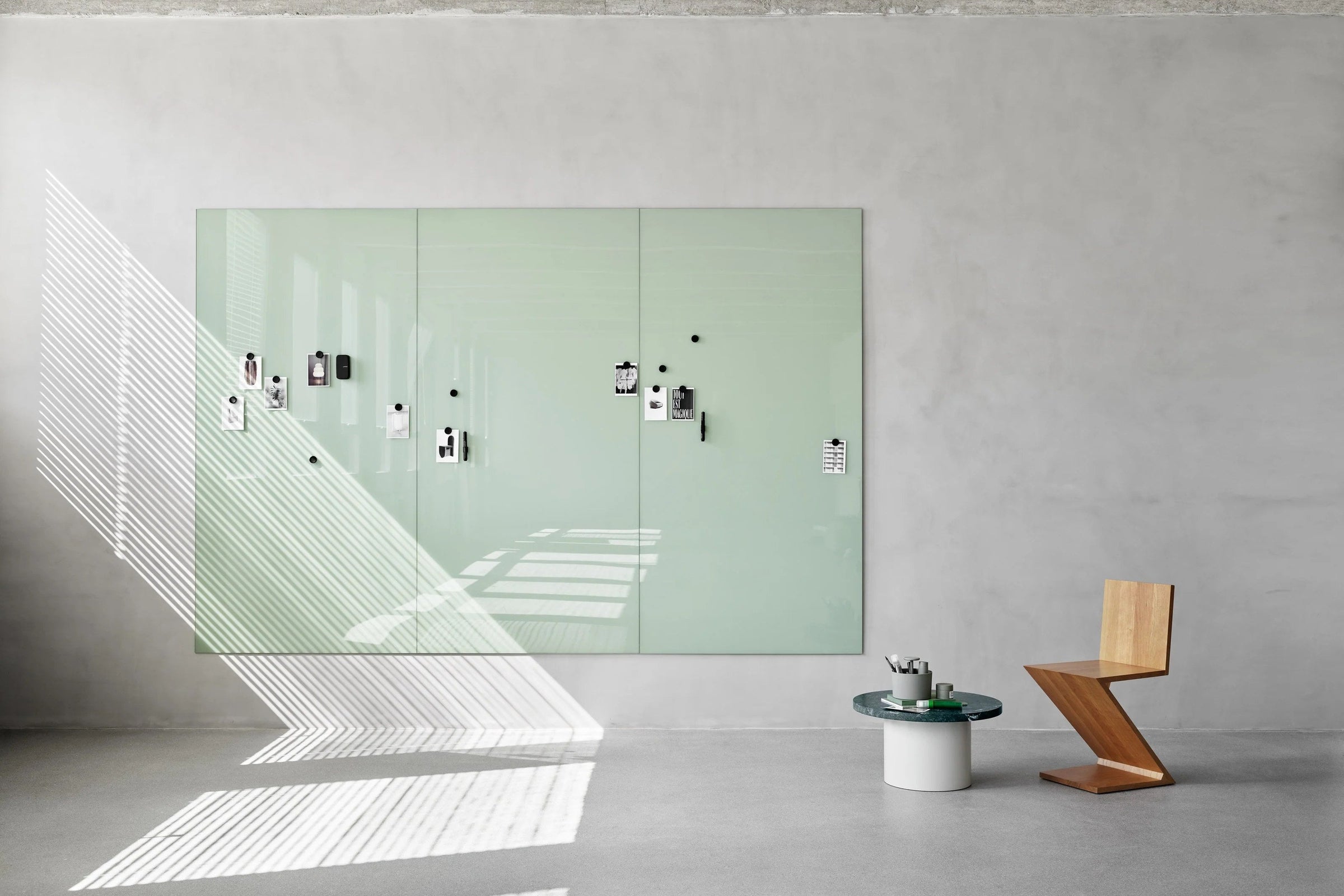
MOOD-GLASS is glossy. SILK-GLASS is matte. Lintex publishes both in the same 24 standard colours, each with a three digit number, Pure 130, Soft 150, Shy 120 and so on, with custom colours available on request. Mood Wall and Silk Wall are the same board in the two finishes, and they share one Environmental Product Declaration, S-P-05335.

The prefix list, as Lintex publishes it
Lintex does not use a separate article number for every colour. The article number is the model and the size, and the colour and finish are added in front of it as a prefix. The 2024 catalogue sets out the instruction plainly: when ordering chalkboards or whiteboards in other colours than white, add one of the following prefixes in front of the article number.
| Prefix | What it sets | Applies to |
|---|---|---|
| BE | Beige | Whiteboard surface |
| GR | Light grey | Whiteboard surface |
| G | Green | Chalkboard surface |
| GG | Graphite grey | Chalkboard surface |
| B | Blue | Chalkboard surface |
| S | Black | Chalkboard surface |
| S | Semi-matte | Surface finish |
| M | Matte | Surface finish |
Read the last three rows again. The catalogue uses S for a black chalkboard and S for a semi-matte finish, in two separate lists, with no third letter to separate them. On a drawing schedule that reads S 27327 there is no way to tell from the code alone whether the specifier asked for a black chalkboard or a semi-matte white whiteboard, and the two are not close. White ceramic steel is the standard surface, so anything other than white is a prefix decision that somebody has to make deliberately.
The glass families work the other way around. There the suffix letter M on an article number marks the matte SILK-GLASS version, and a Z suffix marks the portrait version of a board whose published dimensions are otherwise landscape. A trailing count, for example -3, marks a multi board set.
Specifier's note. Lintex publishes two statements about matte surfaces that look contradictory until you notice they are about different materials. The 2024 catalogue says of a matte ceramic steel surface: "Since writing is difficult to erase on a matte surface, we don't recommend matte surface as a writing board." The Silk Wall product page says of matte SILK-GLASS that "It offers the same high performance for writing and erasing as standard glassboards, but with reduced glare." Both are true. A matte prefix on a ceramic steel board is a surface treatment Lintex advises against for writing. SILK-GLASS is a different product level surface engineered to be matte. If a designer has specified a matte finish because the room faces a window, the answer is a Silk board, not an M prefix on a steel one. Write which one you mean in words, because the code will not tell the installer.
The frame decides the family, not the board
Once the surface is settled, Lintex's family names are mostly frame names. The writing surface repeats across families; what changes is the edge, and the edge is what the architect is actually choosing.
| Family | Writing surface | Frame or edge | Mounting | On the Geneva site |
|---|---|---|---|---|
| Air | Ceramic steel | Frameless, bevelled edges in the surface colour | Wall, concealed fittings | Lintex Air |
| Air Spaces | Ceramic steel, joined panels | Frameless, panel joints | Wall, concealed fittings | Lintex Air Spaces |
| Boarder | Ceramic steel | White or natural anodised aluminium | Wall, concealed fittings | Lintex Boarder |
| ONE | Ceramic steel | Black or white aluminium, mitred corners | Wall, concealed fittings | Lintex ONE |
| Wood | Ceramic steel | Solid oak | Wall, concealed fittings | Lintex Wood |
| Acoustic Board | Ceramic steel | Aluminium, chamfered, 30 mm absorbing core | Wall, concealed fittings | Lintex Acoustic Board |
| Mood Wall | Glossy MOOD-GLASS | Frameless glass | Wall, concealed fittings | Lintex Mood Wall |
| Silk Wall | Matte SILK-GLASS | Frameless glass | Wall, concealed fittings | Lintex Silk Wall |
| Area | MOOD or SILK glass | Solid oak, floating | Wall, concealed fittings | Lintex Area |
| Offset Wall | MOOD or SILK glass | Solid oak, offset gap used as a pen tray | Wall, concealed fittings | Lintex Offset Wall |
| Mood Fabric Wall | MOOD or SILK glass plus pinnable textile | Textile covered frame, 48 mm absorbent filling | Wall, concealed fittings | Lintex Mood Fabric Wall |
| Curve | MOOD or SILK glass | Frameless, rounded corners | Wall, concealed fittings | Lintex Curve |
Two things fall out of that table. The first is that every wall mounted family in the range uses concealed fittings, so the board sits tight to the wall and reads as part of it rather than as an object hung on it. That is a consistent detail across the range and it is the reason a Lintex board photographs the way it does. It also means the wall has to be right before the board arrives, because there is no visible bracket to absorb an error.
The second is that the oak framed families, Wood, Area and Offset Wall, are doing something other than decoration. A solid oak frame is the structural edge, and as the next section shows, it is also the lowest carbon edge in the range by a wide margin.

The climate figure a Green Star or BREEAM submission will ask for
Lintex publishes a climate footprint on most product pages for one nominated size, expressed in kilograms of carbon dioxide equivalent and labelled with the life cycle stages it covers. Those figures are the ones to quote, and the stage label matters more than the number.
| Family | Declared size (mm) | Published figure (kg CO2e, A1 to A3) | Per square metre of board (calculated) | EPD registration |
|---|---|---|---|---|
| Air | 1990 x 1190 | 89.2 | 37.7 | S-P-04560 |
| Boarder | 2005 x 1205 | 71.6 | 29.6 | S-P-05339 |
| ONE | 1507 x 1207 | 68.4 | 37.6 | S-P-06988 |
| Wood | 1508 x 1208 | 30.2 | 16.6 | S-P-06989 |
| Mood Wall | 1000 x 2000 | 72.1 | 36.1 | S-P-05335 |
| Silk Wall | 1000 x 2000 | 77.2 | 38.6 | S-P-05335 |
The per square metre column is ours, not Lintex's: it is the published figure divided by the declared board area, and it is there because the declared sizes differ from family to family and the headline numbers are therefore not directly comparable. Once normalised, five of the six families land between 29.6 and 38.6 kg CO2e per square metre, which is a narrow band. Glass and ceramic steel come out at much the same intensity, so a designer choosing glass over steel for the look of it is not making a carbon decision in either direction.
Wood is the outlier, at 16.6 kg CO2e per square metre, roughly 56 per cent of the next lowest family and 44 per cent of ONE, a board of almost identical area. The difference is the edge. ONE is framed in aluminium, Wood is framed in solid oak, and oak is a renewable material with a low product stage figure while primary aluminium is one of the highest. The OFFSET declaration shows the same material story in full: of a 33.04 kg board, 14.87 kg is medium density fibreboard, 8.94 kg is the oak frame and 7.41 kg is the ceramic steel, with aluminium limited to 0.64 kg of foil and 0.50 kg of brackets. If a project has a furniture carbon target rather than a furniture carbon report, the frame is where the decision is made.
Two boards with full cradle to grave declarations
Two families go further than a product stage figure. AREA is registered with EPD International as S-P-06990 and OFFSET as S-P-07575, both published on 11 January 2023 and valid until 11 January 2028. AREA publishes a global warming potential of 74.8 kg CO2e across stages A1 to C4 for a board of 1528 x 1028 mm weighing 23.32 kg, with AREA SILK at 78.1 kg CO2e, and records 13 per cent recycled content for AREA and 10 per cent for AREA SILK. OFFSET publishes 114 kg CO2e across A1 to C4 for a board of 2124 x 1324 mm weighing 33.04 kg.
Those cradle to grave totals cannot be put in the same column as the A1 to A3 figures above, because they include transport, installation, use and end of life. Mixing the two scales in a submission is the single most common way a furniture carbon claim comes apart under review. The claim types, what a Type I ecolabel is and what an EPD is actually declaring, are set out in Sustainable office furniture: which claims hold up on a schedule.
What Lintex publishes about its own operation, and what it does not
Brand sustainability pages are usually the least useful part of a manufacturer's website. Lintex's is an exception, because most of what it says is a reference to a third party document rather than an adjective. The page is headed, verbatim, "We let third parties verify our claims", and the substance under it is checkable:
- ISO 14001 certified as a company.
- A near term climate target approved by the Science Based Targets initiative, with company climate impact disclosed annually for Scope 1, 2 and 3 under the GHG Protocol.
- FSC Chain of Custody certification under FSC-C170086, with FSC labels on wood based products.
- EU Ecolabel on products, and EU Ecolabel or Oeko-Tex on fabrics and fillings.
- Möbelfakta, the Swedish scheme covering quality, environment and social responsibility, which it describes as including EN and ISO quality standards, absence of hazardous substances and compliance with the UN Global Compact principles.
- Listing in Byggvarubedömningen, the Swedish building product assessment database.
- Products able to contribute credits in BREEAM, LEED, WELL and DGNB.
On the factory itself, Lintex states that geothermal heating and more than 4,400 solar panels on the factory roof generate 1.6 million kWh annually, and that it is already a net producer of renewable energy. Its stated targets are circular products by 2030 and net zero climate impact by 2040.
What is not published is worth knowing too, because it is what a tender response will have to go and ask for. On the pages checked, Lintex does not publish employee numbers, does not publish what proportion of the range is made at Nybro as opposed to bought in, and does not publish absorption coefficients for Acoustic Board on the product page: that page names the test standards used, SS-EN ISO 354:2003, SS 25269:2013 and ISO 20189:2018, and shows an absorption area chart, but the coefficients and the absorption class sit in the test report rather than on the page. If an acoustic consultant needs a number for a model, it has to come from that report. How those coefficients are read, and what coverage actually changes in a room, is covered in Acoustic panels, screens and rafts: where the absorption goes.

Wall, mobile or divider: the three ways a Lintex board lands in a room
The wall mounted families are the bulk of the range, but a workplace fitout usually needs at least one board that is not fixed, and this is where the family names change meaning. Here the suffix tells you the base, not the frame.
M3 Mobile is a double sided ceramic steel board on polished aluminium legs, available with four castors, two of which lock, or with adjustable glides. The 2024 catalogue lists the board at 1505 x 1960 x 500 mm, with a 725 x 1960 x 500 mm flip chart easel in the same family. ONE Mobile runs in three widths at 1960 mm high and 500 mm deep, and a double sided version and a whiteboard screen version share that base. Wood Mobile puts the oak framed board on castors at 540 mm deep with flip chart hooks.
Unit is the one that is not a board at all in the usual sense. It is a mobile room divider carrying glass, textile or both, published at 1800 x 1255 x 165 mm and 1200 x 1855 x 165 mm, with retractable wheels so it can be rolled into place and then settled onto the floor. At 165 mm deep it is a screen that happens to be writable rather than a board that happens to move, and it is the right answer where a project wants to divide a space and write on the division without building anything.
Mobile boards occupy floor, and floor is scheduled. The footprints, the weights and the clash with an accessible path of travel are set out in the whiteboards and writable walls specification post, which carries the mobile board footprint and weight table. The short version is that a 500 mm deep base at 1960 mm high is a tall object with a small plan, and it wants a parking position on the drawing rather than a note saying loose.
Where a Lintex board is the wrong answer
A brand post that cannot say this is a brochure.
Where the brief wants a matte steel writing wall. Lintex advises against a matte ceramic steel surface as a writing board in its own catalogue. If matte is non negotiable, the answer is a Silk glass board, which is engineered for it, and that changes the weight, the fixing and the sizes available.
Where an acoustic model needs a coefficient today. Acoustic Board is a genuinely useful product, a writable surface with a 30 mm absorbing core instead of one more hard reflector in a room full of them, and it is published in five sizes from 1008 x 1205 mm to 3008 x 1205 mm at 8.2 to 22 kg. But it sits 47 mm off the wall, the deepest board in the wall range, and its published coefficients are in a test report rather than on the page. If the acoustic report is due before the furniture package, that is a sequencing problem worth knowing about in week one.
Where the wall is not ready. Concealed fittings across the whole range means the substrate carries the load with nothing visible to adjust. A glass board is heavy: the AREA declaration puts a 1528 x 1028 mm board at 23.32 kg and OFFSET puts a 2124 x 1324 mm board at 33.04 kg, before any allowance for a dynamic load when somebody leans on it. Writing board standards do not cover the fixing, which means the noggings are the specifier's problem and not the manufacturer's.
Where a single Australian warranty document is required up front. Lintex publishes a 30 year warranty on the writing surface on its ceramic steel product pages and a five year guarantee against manufacturing defects in the general terms of its 2024 catalogue, while its United States pages publish a 20 year warranty on all whiteboards and a lifetime warranty on porcelain enamel steel writing surfaces. Those are different documents written for different markets. Ask for the one that applies, in writing, and remember that in Australia the consumer guarantees sit underneath whatever the warranty says: that relationship is set out in Commercial furniture warranty: what it covers and what the law already gives you.

What goes on the schedule
A Lintex line that will survive procurement carries six things: the family name, the article number for the size, the surface written in words, the finish written in words, the colour name with its three digit number where the board is glass, and the mounting height. Lintex recommends gallery height for landscape boards, 150 cm from the floor to the centre of the board, with portrait boards usually mounted closer to the floor. Add the fixings note, because Lintex supplies the brackets and the instructions but not the wall screws, which depend on the wall.
Geneva supplies, delivers and installs the Lintex range Australia wide. The full range sits under Lintex boards and writing surfaces, the wider category including Geneva's own mobile boards sits under whiteboards and writing surfaces, and the brand background is on the Lintex brand page.
If you are holding a drawing with a board on it and no article number yet, send us the elevation and the wall type and we will come back with the family, the size and the fixing requirement: talk to the Geneva team.
Frequently asked
Who makes Lintex writing boards, and where?
Lintex is a Swedish family owned company founded in 1983, and its main office and factory are at Nybro in Småland in southern Sweden. The two third party verified Environmental Product Declarations published for the range, one for AREA and one for OFFSET, both name Nybro as the manufacturing site, so the claim is verifiable rather than marketing.
What is the difference between MOOD-GLASS and SILK-GLASS?
Both are tempered low iron glass, both are magnetic, and Lintex publishes both in the same 24 standard colours, each colour carrying a three digit number. MOOD-GLASS is glossy and SILK-GLASS is matte. Lintex says of the matte version that it offers the same high performance for writing and erasing as standard glassboards, but with reduced glare, which is the opposite of what the same catalogue says about a matte ceramic steel surface.
What warranty does Lintex publish on a writing board?
Lintex publishes a 30 year warranty on the writing surface on its ceramic steel product pages, and the general terms in its 2024 catalogue publish a five year guarantee against manufacturing defects. Its United States pages publish different figures again, a 20 year warranty on all whiteboards and a lifetime warranty on porcelain enamel steel writing surfaces. Those are separate documents, so the terms that apply to an Australian order should be obtained in writing before the schedule is issued.
Does Lintex publish a carbon figure for each board?
For many families, yes. The product pages publish a climate footprint for one nominated size, for example 89.2 kg CO2e for an Air board at 1990 x 1190 mm, and that figure covers life cycle stages A1 to A3 only. Two boards also carry full Environmental Product Declarations registered with EPD International, AREA as S-P-06990 and OFFSET as S-P-07575, both published on 11 January 2023 and valid to 11 January 2028. An A1 to A3 product stage figure cannot be compared with a cradle to grave EPD total.
Which prefix letter goes in front of a Lintex article number?
The 2024 catalogue publishes the surface prefixes as BE for a beige whiteboard, GR for a light grey whiteboard, G for a green chalkboard, GG for graphite grey, B for blue and S for black, and the finish prefixes as S for semi-matte and M for matte. Because S appears in both lists, a schedule line carrying only the code is ambiguous. Write the surface and the finish out in words next to the article number.